
After a carbon footprint audit, match one proposed reduction to its activity record, emission factor and inventory boundary before approving it. Put the reduction proposal beside the completed inventory. A lower total may reflect less physical activity, a different calculation or an activity moving to a supplier. Establish which explanation applies before turning the reported number into an investment commitment.
A carbon footprint audit examines reported greenhouse gas emissions, their calculation and supporting records within a stated boundary and period.
The inventory is the starting point for a commitment
The completed inventory gives the executive a record of emissions for a defined period. The next step is often to identify major sources and select reduction work. Start that selection with the inventory's scope. Find the sites, activities, gases and value-chain categories included, together with exclusions and estimates.
Read the audit or assurance statement separately from the footprint report. Identify what the reviewer examined, the reporting criteria and any limitations. A conclusion about the inventory does not automatically cover the savings forecast for a new project. If the proposal relies on that forecast, ask who checked it and what records they used. If the proposed reduction depends on a circular return route, the circular economy assessment follow-up checks the processor's acceptance specification.
The GHG Protocol Corporate Standard provides requirements for preparing an organizational emissions inventory. It also makes clear that it does not prescribe the verification process. Use the actual engagement and statement to establish what the completed review covers.
Keep the reported footprint and the proposed reduction as separate items in the approval paper. One describes the measured or estimated past. The other describes a change expected from a particular action. They need a clear connection, including the activity that changes and where its emissions will appear afterwards.
The situation analysis task is to understand the starting conditions before committing resources. Here, that includes the accounting boundary and the physical work behind each major source. A supplier contract, meter record or purchase ledger can matter more to the next decision than another summary chart.
What can the footprint establish?
An inventory helps locate emissions within the chosen scope. It can show whether fuel, purchased electricity or supply-chain activity deserves closer examination. It also gives the organization a documented basis for comparison. These are useful outputs when managers need to choose where further investigation would change an investment decision.
Ask the preparer to explain a major source in ordinary operating terms. Which activity produced it? Which quantity was recorded? Which factor converted that quantity into emissions? Check units and dates before comparing options. A spending estimate and a direct activity measurement may support different levels of detail.
The footprint can direct the next question without proving the answer to it. A large source may warrant investigation, but a reduction proposal still needs evidence that the proposed action changes it. Link the inventory row to the proposed operating change, then identify any other emissions that the change introduces.
Keep this task distinct from acting on an ESG assessment, which may inform broader investment or screening decisions. It also precedes the funding and delivery choices that follow a net-zero target. This decision concerns what reduction the completed footprint can support claiming.
Which activity actually changes when the proposed footprint reduction is implemented? Start the Walk →
Lower reported emissions, unchanged physical activity
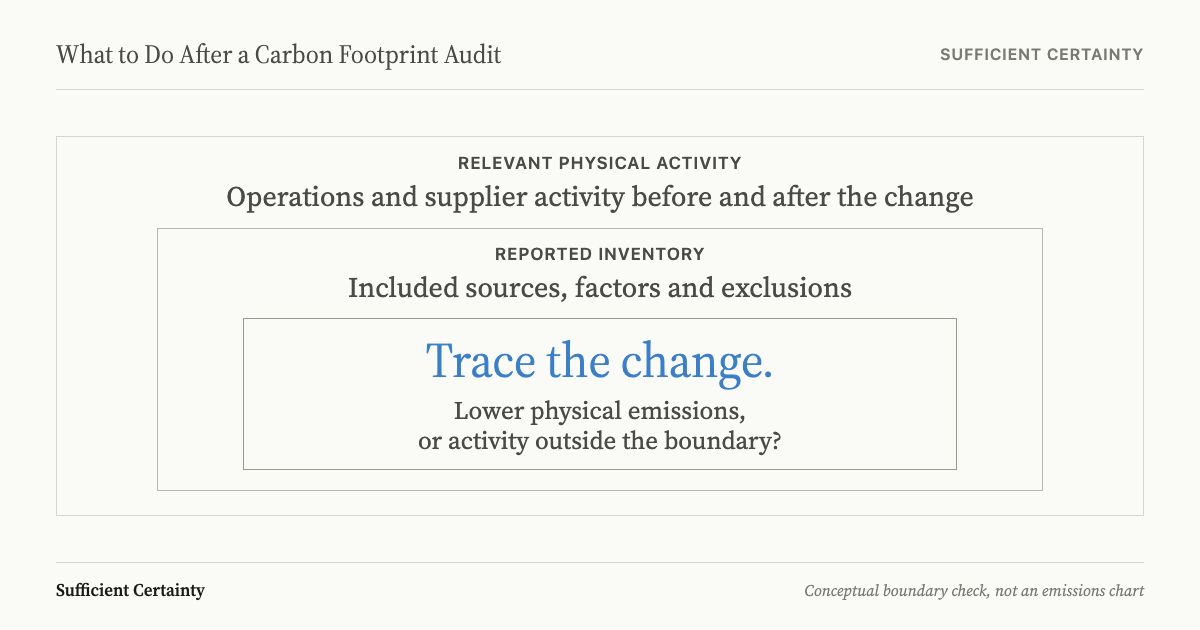
A reduction can appear in an organization's inventory when an activity moves outside the measured boundary. Consider a proposed outsourcing arrangement as a hypothetical check. If the same transport work continues under a contractor, an internal fleet total may fall. That alone does not establish that the transport activity produces less greenhouse gas.
The Corporate Standard's guidance on boundaries and tracking addresses outsourcing and changes between scopes. It distinguishes changes in reporting structure from changes in emissions to the atmosphere. The treatment of a base year depends on the change and which emissions the inventory already includes.
Trace the activity across the boundary before calling its disappearance a reduction. Identify the receiving supplier or site, whether its activity remains in the inventory and the information available about it. If the boundary excludes that activity, say so when describing the proposal. Do not give an inventory-only change a broader physical meaning.
Check the emission factor as well. A different factor can change the calculated result while the recorded activity remains constant. Ask whether it reflects a real change in the relevant energy or production source, a better estimate, or a revised calculation method. Preserve the explanation with the comparison.
This is a practical use of making assumptions visible. The important assumption might be that the supplier's process produces fewer emissions, or that a factor represents the location involved. Write the claim in terms that the operations owner and inventory preparer can both check.
Microsoft reported growth beyond its operational reductions
Microsoft's 2024 Environmental Sustainability Report announcement covered fiscal year 2023 against a 2020 baseline. It reported a 6.3% fall in Scope 1 and 2 emissions. Scope 3 emissions rose 30.9%, while the combined Scope 1–3 total rose 29.1%.
The company attributed much of the Scope 3 increase to datacenter construction, building materials and hardware components. Its response included more than 80 measures and a requirement for selected high-volume suppliers to use carbon-free electricity for Microsoft goods and services by 2030. These were reported historical results and announced measures, not evidence of their later success.
A reduction in one part of the inventory can coexist with growth in the total. The case does not show that Microsoft moved activity outside its boundary or received a clean audit opinion. It shows why an approval paper must identify which part of the footprint a proposed reduction changes.
For another organization's investment, examine whether the proposal includes the materials, purchased equipment or supplier activity needed to implement it. An operational saving may be real and useful. The decision still needs a clear account of additional emissions elsewhere and the period over which the comparison is made.
Ask the project owner to show both results when they matter: the change in the targeted source and the change across the relevant wider activity. Label estimates and unavailable data. Keep the calculation versions used for the original footprint and the proposed comparison. A later reviewer should be able to reproduce why the figures differ. If the wider result is unknown, narrow the claim to the result supported by evidence. Do not silently treat the missing category as zero.
Approve the reduction claim at the same boundary used to test it. An executive can still choose the project for other reasons, such as cost or reliability. Those reasons belong in the decision paper too, so an unsupported environmental claim does not carry the decision by itself.
Trace one proposed reduction before approval
Select the proposal closest to a commitment. Bring its owner, the inventory preparer and the person holding the activity records together. Follow one claimed saving from the baseline quantity to the new operating arrangement. Record the factor, boundary, comparison period and any excluded activity.
If an uncertain input could reverse the comparison, test that input before seeking more detail elsewhere. The article on what follows sensitivity analysis explains how to focus work on a decision-changing input. Here, that could mean obtaining supplier activity data or confirming the actual production location.
State what evidence will justify the commitment, and what claim that evidence permits. The Universal Decision-Making Method connects the proposed action with its assumptions and the certainty needed to act. The result can be approval, a smaller commitment or a pause for one specific missing record.
Finish by assigning the record that will show what happened after implementation. Identify who obtains it and when the comparison will be repeated. If the supplier, process or accounting boundary changes, review the claim before repeating it. The completed audit then supports a checkable commitment with an honest description of its limits.
Does the proposed reduction change physical emissions or move them beyond the inventory boundary?
Work through your decisionNo sign-up. Just pick your decision and start.
Grant Purdy is the co-author, with Roger Estall, of Deciding (2020), and the architect of the Universal Decision-Making Method.