
After completing a competitive analysis, the standard next step is to formulate a strategic response: invest, divest, differentiate, or match. That sequence skips a step. Before committing resources, test whether the assumptions your strategic response depends on are supported by evidence or only by agreement.
Blockbuster's leadership in 2000 had accurate competitive data on Netflix and responded to it aggressively. By 2010, they were bankrupt. Not because the analysis was wrong, but because nobody tested the assumption the entire response was built on.
Competitive analysis is the systematic assessment of rivals' capabilities, strategies, and market positions to inform strategic decisions.
Blockbuster and the assumption nobody checked
Blockbuster's competitive intelligence operation in the early 2000s was not negligent. The company tracked Netflix's subscriber growth, monitored its pricing, and studied its distribution model. Satell (2014) documented how Blockbuster's analysis correctly identified the trajectory: online DVD rental was growing, and Netflix was the market leader in that channel. The analysis produced the right data. Blockbuster responded to it.
In 2004, the company launched Blockbuster Online, its own DVD-by-mail service, and within two years had attracted several million subscribers.
In early 2005, CEO John Antioco eliminated late fees, sacrificing approximately $800 million in annual revenue to compete on customer experience. These were not the moves of a company ignoring its competitive analysis. They were the moves of a company acting on it.
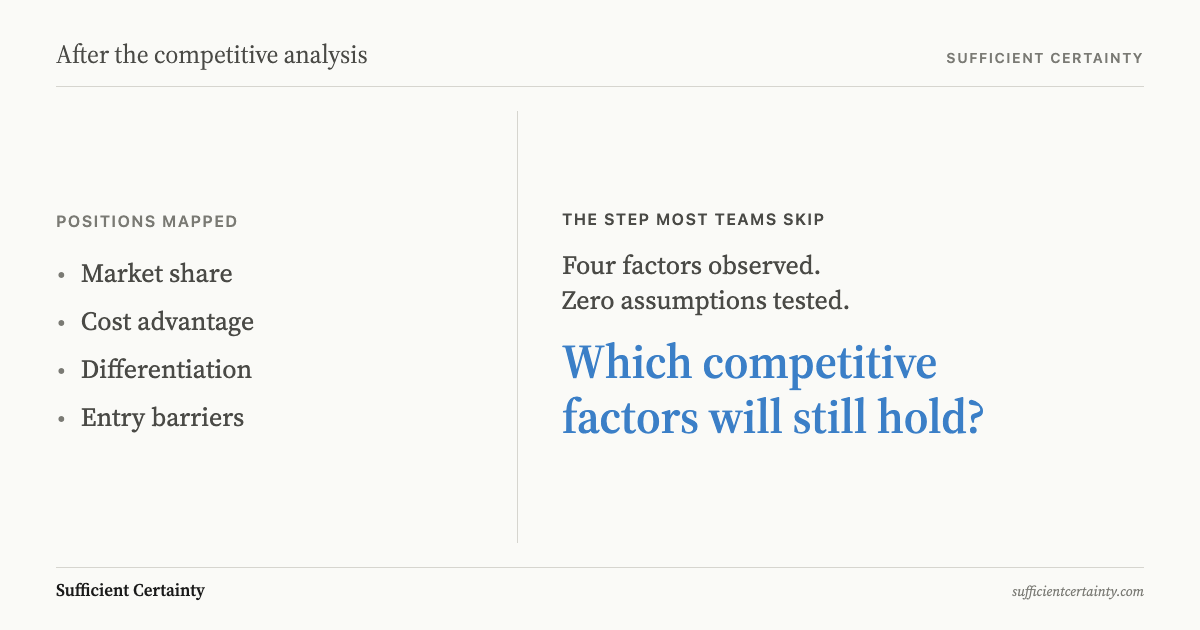
What the analysis never surfaced was the assumption underneath every strategic response: that physical retail presence was Blockbuster's core competitive advantage, and that customers would continue to value the in-store experience enough to sustain 9,000 locations. This assumption was not hidden. It was structural.
Blockbuster's entire cost model, its real estate commitments, its staffing levels, its supply chain, was built around the premise that stores were assets, not liabilities. The competitive analysis tracked what Netflix was doing. It did not test whether the condition Blockbuster's own strategy depended on was stable or eroding.
Antioco (2011) described how the activist shareholder Carl Icahn reversed many of these competitive responses after gaining board control, reinstating late fees and cutting investment in the online business.
But the deeper problem was already set. Blockbuster's strategic responses, even the aggressive ones, were layered on top of an unexamined assumption about what customers would continue to value.
When streaming began to replace both physical rental and DVD-by-mail, Blockbuster's cost structure made pivoting impossible. Nine thousand leases, tens of thousands of employees, a distribution model designed for physical inventory.
Netflix, unburdened by retail infrastructure, could shift to streaming without dismantling an existing business. The competitive analysis had mapped the rival correctly. It had not tested whether Blockbuster's own strategic foundation would hold.
The pattern is familiar beyond this case. The analysis does its work, the data is accurate, and the response still fails because the assumption connecting analysis to action was never named. Good analysis does not guarantee good outcomes when the bridge between them rests on conditions nobody verified.
Write down the assumption your competitive response depends on most and ask whether anyone tested it before the resources were committed. Start the Walk →
What competitive analysis gets right, and where it stops
Competitive analysis, as Porter (1980) formalised it, does something genuinely useful. It forces organisations to look outward. Instead of building strategy from internal capability alone, the framework requires attention to rivals' positioning, their resources, their likely moves, and the structural forces that shape competition.
Chen (1996) extended this by showing that competitive responses depend not only on awareness of a rival's actions but on the motivation and capability to respond. Both contributions make the same point: understanding the competitive landscape is necessary for sound strategy.
The problem is not what competitive analysis produces. The problem is what happens next. The standard sequence runs: analyse competitors, identify threats and opportunities, formulate strategic response.
Teams move from analysis to action in a straight line. That line assumes the conditions revealed by the analysis will persist long enough for the response to work. It assumes the organisation's own capabilities are what they appear to be. It assumes the market structure captured in the analysis is the market structure the strategy will encounter.
A competitive analysis snapshot captures rivals' positions at a specific moment. But strategy executes over months or years.
The analysis shows what competitors are doing now. It does not test whether the conditions the strategic response depends on will hold when the response takes effect. SWOT analysis shares this same gap: an accurate diagnostic followed by an untested leap to prescription.
This is the structural gap. Competitive analysis is a diagnostic tool. It tells the organisation what it faces. It does not test the assumptions the organisation makes when it decides what to do about it.
When teams skip from competitive data to strategic commitments, they inherit every untested assumption in between. The more thorough the analysis, the more dangerous the gap, because a comprehensive report creates the impression that the thinking is complete.
The checkpoint between analysis and action
The step between competitive analysis and strategic response is not more analysis. It is a checkpoint: name the assumptions the proposed response depends on, and determine whether they have evidence behind them or only agreement.
Start with the strategic response the competitive analysis supports. For each major commitment, ask three questions.
What does this response assume about the organisation's own position? What does it assume about how quickly the competitive landscape will shift? Has anyone tested those assumptions against evidence, or were they adopted because they seemed reasonable in the meeting?
Standard competitive response
- Treat analysis findings as a direct brief for strategy
- Accept that the organisation's current position will hold
- Commit resources based on the competitive snapshot
- Monitor competitors for changes after launch
With assumption testing
- Separate competitive findings from the assumptions the response depends on
- Test whether internal capabilities match the strategy's requirements
- Identify which conditions could shift before the response takes effect
- Build monitoring into the decision before committing
The five-step method (Frame, Tentative Elements, Assumptions, Sufficient Certainty, Implement and Monitor) treats this checkpoint as structural. The third step, surfacing assumptions, exists precisely because every analytical output rests on conditions the analysis itself does not verify. Competitive analysis is no exception.
A five forces analysis maps industry structure. A competitive analysis maps rival positions. Neither tests whether the organisation's planned response rests on something solid or something assumed.
This does not require discarding the competitive analysis or extending the timeline. It requires a pause between producing the findings and acting on them.
The pause asks: which elements of this strategic response would change if one of its underlying assumptions turned out to be wrong? The responses that survive that question are the ones worth resourcing. The ones that do not survive it need revision before the organisation commits.
Blockbuster did not lack competitive analysis. It lacked the step between analysis and action where someone would have asked: is physical retail actually the asset this strategy treats it as, or is it the cost structure that will prevent the company from adapting?
The checkpoint is not additional research. It is the discipline of naming what the strategy assumed and deciding whether that assumption has been earned.
Strategic thinking does not end when the analysis is complete. It begins when someone asks what the analysis took for granted.
The organisations that treat competitive analysis as a finished input build strategy on assumptions they never verified. The ones that pause to test those assumptions build strategy on evidence, which is harder to produce and harder to ignore.
You could act on every competitive finding and still leave the assumption your strategic response depends on untested.
Work through your decisionNo sign-up. Just pick your decision and start.
Grant Purdy is the co-author, with Roger Estall, of Deciding (2020), and the architect of the Universal Decision-Making Method.