
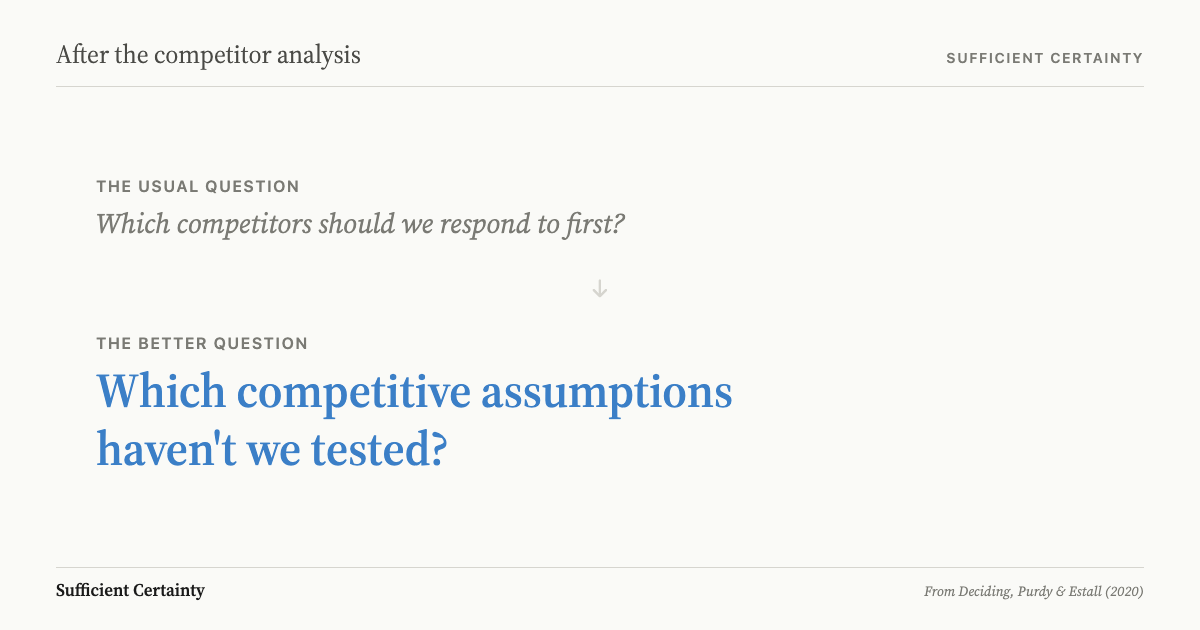
After a competitor analysis, most teams move straight to competitive positioning: differentiate here, defend there, attack where the gap looks widest. The step they skip is testing whether the competitor profiles reflect current reality or comfortable assumptions about rivals who may have already changed course.
A competitor analysis maps rival strengths, strategies, and market positions to inform competitive decisions.
The standard next step after a competitor analysis
Porter's Competitive Strategy (1980) established competitor analysis as a core discipline of strategic management. Chapter three laid out four diagnostic questions about each rival: what drives the competitor, what the competitor is doing and can do, what the competitor believes about itself and the industry, and what the competitor's current strategy is. The profiles generated by those questions feed the positioning decision that follows.
The positioning step follows a predictable sequence. Teams identify where competitors are strong and where gaps exist. They assess which gaps align with their own capabilities. They choose a position that exploits competitors' weaknesses or avoids head-on confrontation. The output is a competitive response strategy: a set of moves designed to capture or defend market share based on what the profiles revealed.
Chen (1996) refined the framework by adding two dimensions: market commonality (how much two firms overlap in the same markets) and resource similarity (how comparable their resource endowments are). These dimensions help teams predict which competitors are most likely to attack and which are most likely to respond. The competitor profile becomes a predictive tool, not just a descriptive one.
The sequence from profiles to positioning to response is taught in every strategy course and embedded in most industry analysis workflows. It gives teams a structured path from data to action. The path assumes the profiles are accurate.
What that step adds
The positioning step converts a descriptive exercise into a prescriptive one. A competitor analysis without positioning is a set of profiles in a slide deck. The positioning step forces a choice: given what these rivals are doing, where should this firm compete?
That contribution matters. Before structured competitor analysis, competitive decisions were largely reactive, driven by whatever a rival did last quarter. Porter's framework and Chen's extensions gave strategists a way to think about competitive dynamics before they unfolded. A firm that understands which competitors share its markets and resources can anticipate moves rather than simply respond to them. The result is strategic thinking grounded in competitive structure rather than quarterly surprises.
The positioning step also creates accountability. Once a team commits to a competitive position, it becomes possible to measure whether that position is working. Without the positioning step, competitor analysis remains interesting but not actionable. The move from "here is what competitors are doing" to "here is what this firm will do about it" is where strategy begins.
The limitation is not in the positioning step itself. It is in the assumption that the profiles driving the position are sound. A competitor profiled as "focused on enterprise buyers" may have quietly shifted to mid-market. A rival described as "lacking distribution capability" may have signed a partnership that changes the picture entirely. The positioning inherits whatever the profiles contain, verified or not. So does any wargame whose rival team is briefed from them. The brief is one of the first things to test when deciding what to do after a wargame. The gap between a competitor's actual strategy and the profile team members drafted in a workshop is where assumptions enter the decision unannounced.
Name the competitor assumption your response strategy depends on most and ask what evidence supports it. Start the Walk →
Where the standard playbook breaks down
Bergen and Peteraf (2002) identified a structural problem in competitor identification: firms consistently define their competitive set too narrowly, based on existing industry categories rather than resource similarity or potential market overlap. Teams profile the competitors they already know and miss the ones that could matter most.
The deeper problem is not scope. It is that competitor profiles are treated as findings when they are often guesses. A profile stating "Competitor X has a 15% cost advantage in manufacturing" may rest on a single data point, an industry report from two years ago, or a salesperson's impression. The profile looks precise. The precision is formatting, not evidence. Zahra and Chaples (1993) catalogued these blind spots in competitive analysis, finding that managers routinely overestimate their knowledge of competitors while underestimating the rate at which competitive conditions change.
Research in Motion (RIM), the maker of BlackBerry, provides a well-documented case. In 2007, when Apple launched the iPhone, RIM held roughly 50% of the US smartphone market. RIM's competitor analysis identified Apple as a new entrant. The profiles were detailed: Apple lacked enterprise security certification, had no physical keyboard, and had no relationships with corporate IT departments. Every element of the profile was factually accurate at the time.
The response strategy followed logically. RIM reinforced enterprise features, expanded its keyboard product line, and treated consumer smartphones as a separate market unlikely to cross into corporate procurement. The competitor profile drove the positioning. The positioning drove the investment.
What the analysis had not produced was a test of the assumptions behind that response. RIM assumed enterprise IT departments would continue to control device selection. It assumed physical keyboards were a durable preference, not a habit that touchscreen typing would displace. It assumed Apple would not pursue enterprise security certification. Every assumption was testable. None were tested. Within six years, BlackBerry's market share had fallen below 3%. The profiles were accurate. The assumptions underneath them were wrong. Sull (1999) described this dynamic as "active inertia": organisations respond to disruption by accelerating the activities that succeeded in the past, reinforced by competitor analyses that confirm the familiar frame rather than questioning it.
The pattern is consistent across the steps teams take after structured competitive analysis and after a Wardley map. The more detailed the competitor profile, the less likely anyone is to question what it assumes.
The step to take first
The positioning step is not the problem. The problem is positioning before testing. Before a competitor profile enters the strategy conversation, it needs to survive a simple question: what evidence supports this claim about the rival?
Take each major finding from the competitor analysis and rewrite it as a testable claim. "Competitor X is focused on enterprise" becomes "Competitor X will not pursue mid-market customers within the planning horizon." Then ask two things: how much influence does this claim have on the positioning decision, and how confident is the team that it is true?
A finding with high influence and low confidence is the one that needs investigation before it shapes a competitive response. One conversation with a shared customer. One review of a competitor's recent job postings or patent filings. One check on whether the "distribution gap" in the profile reflects a strategic choice or a timing difference. These checks convert assumptions into evidence or reveal that the profile was wrong. Either result is better than the alternative: committing resources to a position that rests on guesswork. Teams that skip this step do not save time; they trade deliberation now for correction later, and correction is always more expensive.
The five-step decision-making method (Frame, Tentative Elements, Assumptions, Sufficient Certainty, Implement and Monitor) places assumption-testing before commitment for exactly this reason. A competitive position built on untested profiles is not a strategy. It is a bet disguised as analysis. RIM's competitor profiles supported a bet on enterprise keyboards. Testing the assumptions underneath those profiles, specifically whether IT departments would hold their gating role and whether keyboard preference was structural, would have changed which positions survived scrutiny.
This is the step between completing a competitor analysis and committing to the response it suggests. Separate assumptions from findings. Test the ones that carry the bet. A response strategy built on an untested competitor profile is a guess wearing a spreadsheet. Starting the test at the competitive forces level and working down to individual rival profiles ensures nothing load-bearing passes unchecked into the strategy.
You could close this tab and carry that decision into another week.
Work through your decisionNo sign-up. Just pick your decision and start.
Grant Purdy is the co-author, with Roger Estall, of Deciding (2020), and the architect of the Universal Decision-Making Method.