
After a CAGE distance analysis, turn one distance finding into a written operating obligation for the proposed partner before approving the route. A country comparison can be complete while the staffing responsibility remains blank. Open the partner proposal and identify who must change daily work to address the difference recorded in the analysis.
CAGE distance analysis compares cultural, administrative, geographic and economic differences between places that can affect business activity.
Distance analysis helps compare operating conditions
A CAGE distance analysis helps compare the conditions under which a business operates across places. Pankaj Ghemawat's original argument warns that foreign-market attraction can be overstated when managers overlook distance. That is a useful correction before resources are committed to a proposed operating route.
The framework can direct attention to a practical difference that a financial comparison misses. A working language may affect customer support. A border may affect how service work is authorized. The useful output is a specific difference that changes the work required, rather than a country score that no operator can interpret.
A distance finding becomes useful when it identifies work that the chosen route must provide. Put the finding beside the proposed division of responsibilities. Ask whether the parent company, local partner or another party will perform that work. Each answer produces a different obligation and may require a different operating arrangement.
The strategic thinking discussion concerns the choices behind a strategy. Here the narrower choice is how a particular distance will be handled within the proposed route. A partner's local presence is relevant evidence, but it does not automatically assign responsibility for every local task.
Keep the analysis available to the people negotiating the operating agreement. A phrase such as local knowledge needs a practical meaning before the agreement is signed. Specify what knowledge must reach the operating team, who maintains it and how it changes a decision. Otherwise the proposal can retain the benefit while assigning nobody the work.
The proposed partner must accept the same responsibility that the sponsor believes has been assigned. Reading the finding together can expose that difference before it becomes a missed handoff.
Which distance changes the partner's obligations?
Select a distance that changes a task in the proposed model. Ghemawat distinguishes cultural, administrative, geographic and economic differences. For this checkpoint, choose the difference that requires an identifiable operating response. Avoid converting every heading into a generic promise that the partner will handle local matters.
Suppose the analysis identifies a language gap in technical customer support. This is an illustrative proposal, not a claim about a company in the case below. Write the obligation precisely: the partner supplies qualified staff who can receive a local-language complaint, obtain the required technical information and hand it to the responsible service team.
Then ask who can approve the translated instruction and who can change it after a product update. The parent may retain technical authority while the partner manages local communication. That arrangement requires a usable handoff, not merely two parties agreeing that language matters. Review one proposed handoff before relying on the arrangement.
The distance does not determine who owns the response; the operating agreement must do that. This differs from asking whether a country is attractive or whether sufficient customers exist. Those questions belong to the market-entry analysis checkpoint. The current task concerns the responsibility needed to make a chosen route workable.
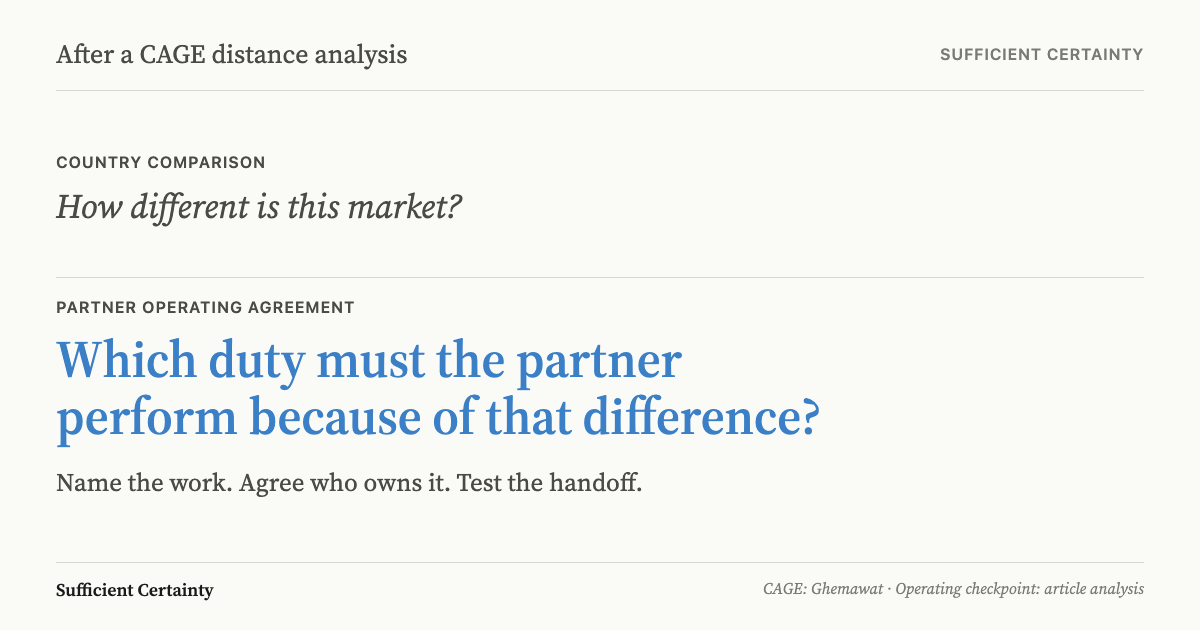
Specify evidence that the obligation can be met. A proposed staffing plan can identify roles and authority. A review of the service handoff can show whether the parties understand the same task. Neither establishes all future performance. State the limit so the approval paper does not claim more than the check supports.
Approval should depend on evidence for the required duty, rather than confidence in a general partner description. The distinction is similar to checking an assumption: identify the claim carrying the commitment, then obtain evidence that can change the decision.
Turn the distance finding into a partner duty that can be checked. Start the Walk →
Best Buy closed its own stores and retained Five Star
Best Buy's fiscal 2011 Form 10-K provides an illustrative comparison within the same country. The company described acquiring Five Star partly to gain knowledge of Chinese customers and an immediate retail presence. It also operated Best Buy-branded stores in China. Those routes did not use identical operating models.
The report says Five Star primarily used vendor employees and full-time sales associates to sell products. The Best Buy-branded stores used a model similar to the US stores. It also described scope for Five Star regional management to vary operations locally. These distinctions concern how the business operated, rather than the distance between two national labels.
In the same report, Best Buy announced the closure of eight Best Buy-branded stores in China. It planned 40 to 50 Five Star openings. The openings were a plan, not evidence that every planned store opened. The report's China information used a two-month reporting lag. Its figures should be read within that reporting basis.
The same country can require different operating duties under different formats. The report does not establish that Best Buy used CAGE. It does not prove a single cultural cause for the closures. It supports a narrower comparison: the two formats assigned selling and local adaptation differently.
For a current proposal, use that distinction to inspect the duty being assigned. Who provides sales staff? Who can vary local operations? Who receives the information needed to approve a change? These are questions for the present agreement, not descriptions of historical Best Buy contracts.
The PESTEL and SWOT market-entry discussion examines assumptions behind entering a market. This comparison keeps the country fixed and asks whether the proposed route actually provides the required operating work. A new country ranking would leave that question unanswered.
Avoid treating the local partner as a single capability. A partner may understand customers while depending on vendors for sales staff. It may know a region while lacking authority to change a group policy. Ask about the task itself. The answer should describe who can perform it under the proposed arrangement, and what the sponsor must still provide.
Write a testable obligation before choosing the format
Before signing the partner agreement, write one obligation from the selected distance finding. Name the responsible party, the work to be performed and the evidence required for acceptance. Include the authority needed to perform it. A responsibility that depends on another party's permission must identify that dependency.
An obligation is testable when the reviewer can distinguish performance from a promise. For the illustrative language handoff, review who receives the complaint and who owns the technical reply. Resolve any disagreement about responsibility before treating local-language support as provided. The review may support the proposal, require a revised handoff or show that the chosen arrangement needs to change.
Country-level conclusion
- Record a language difference
- Choose a local partner
- Leave customer handoffs unspecified
Operating obligation
- Name the handoff owner
- Review the working translation process
- Accept responsibility against evidence
Put the agreed duty in the operating schedule and preserve its acceptance reason in the decision record. Keep unresolved duties visible to the person approving the route. A negotiation deadline should not convert an unanswered operating question into an assumed service.
Use the Universal Decision-Making Method to connect that evidence to the intended outcome. Decide whether the remaining uncertainty is acceptable for this commitment. A limited investigation may proceed with an open duty that a binding operating agreement cannot leave unresolved. The standard depends on what is being authorized.
Keep a clear boundary around the acceptance check. A successful review of one customer-support handoff does not prove every service obligation. Record the product and channel covered by the review. If the proposed route later expands, check whether the agreed responsibility expands with it. This makes the earlier evidence reusable without silently extending its meaning to different work.
Set a review trigger for changes affecting that duty. A partner replacing its service provider or losing authority to approve local changes can invalidate the earlier agreement. Identify who will receive that information. The analysis has supported the route when the required operating responsibility is understood, accepted and supported by evidence.
The country comparison still needs an agreed operating responsibility.
Work through your decisionNo sign-up. Just pick your decision and start.
Grant Purdy is the co-author, with Roger Estall, of Deciding (2020), and the architect of the Universal Decision-Making Method.