
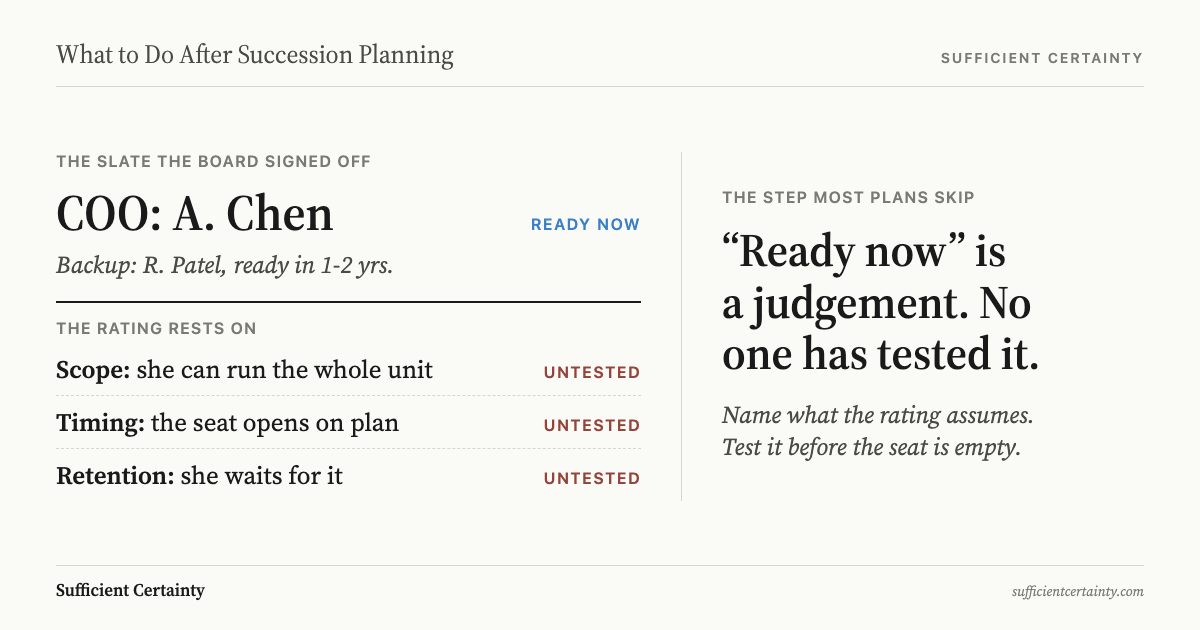
After succession planning, test the assumptions behind each readiness rating and each name on the slate before the organisation relies on the plan to fill a vacancy. A bench-strength report reads like a list of people ready to step in, but every rating on it is a forecast about a person, a role and a date that has not arrived yet.
Succession planning is the process of identifying an organisation's critical roles, naming internal successors for each, rating their readiness, and developing them before the roles fall vacant.
The textbook sequence after succession planning
Once the critical roles are identified and successors named, the plan moves into its operating phase. The first task is readiness. Each candidate is placed in a band, commonly ready now, ready in one to two years, or ready in three to five. Many organisations derive the bands from a nine-box grid that plots current performance against potential. The US Office of Personnel Management describes the same pattern: assess key positions, identify talent risks, clarify readiness, and summarise it in depth charts.
The second task is development. Each gap between a candidate and the target role, in effect a skills gap analysis for one person, gets an individual development plan: a stretch assignment, a rotation, coaching, or a formal program, with an owner and a date.
The third task is reporting. Bench strength is summarised for the executive team and the board, usually as a coverage ratio: the share of critical roles with at least one ready-now successor, the roles with no named successor at all, and any candidates flagged as flight risks. A people or nominations committee reviews the summary, often once a year.
The fourth task is the refresh. Slates are revisited in the annual talent review, names added and removed as people move, and ratings adjusted. At the end of the cycle the organisation holds a document that says who will fill each critical role, and roughly when.
The value in that sequence
The sequence forces a conversation most leadership teams avoid. Naming which roles are critical means naming which are not. Naming a successor means someone has to defend the choice in front of peers. A vague belief that the organisation has good people becomes a list of names that can be challenged.
The plan also exposes single points of failure. A critical role with no named successor, or with one successor who is also named on three other slates, is a finding in its own right. Like a governance audit, the exercise turns a diffuse worry into specific findings someone has to answer for. Development budgets get pointed at specific people rather than spread across a generic leadership program.
For the board, the bench-strength report is one of the few regular views into whether the organisation can keep running if key people leave. That makes it a genuine instrument of organisational governance. Unexamined dependence on a handful of individuals is a recurring thread in governance failures, and the succession plan is where that dependence becomes visible. The plan is a real inventory of intent. It is not yet evidence that anyone on it will succeed in the role.
The structural blind spot
A readiness rating looks like an assessment. It is closer to a forecast, and it rests on assumptions the planning process rarely writes down.
The first is that the rating predicts performance in the target role. Ratings are formed by watching people in their current jobs, and strong current performance tends to inflate judgements of potential, a textbook case of the halo effect. The concept being rated is itself unsettled. Silzer and Church (2009) found little agreement within or between organisations on what potential means, which is why they framed the core question as "potential for what?"
The second is that the role will look the same when the vacancy arrives. The slate is built against today's job. Cappelli (2008) argued that high-potential programs and job rotation were designed for a stable business environment and captive talent pipelines that no longer exist, so forecasts of talent demand carry real risk.
The third is that the named people will still be there and still want the job. Successors resign, relocate, or turn the role down, and the reasons often surface only afterwards, as exit interview analysis shows.
- A named successor for each critical role
- Readiness bands: ready now, one to two years
- Bench-strength coverage by business unit
- Whether readiness ratings predict performance in the role
- Whether the role will look the same at vacancy
- Whether the successor will stay and accept
- Whether one name is covering several slates
A fourth assumption hides in the arithmetic. Coverage ratios often count ready-in-two-years candidates as bench, which treats people still in development as capacity. A bench-strength report counts names. It does not test whether the conditions that make those names useful will hold.
Pick the successor rated ready now for your most critical role and write down what has to stay true for that rating to hold when the seat opens. Start the Walk →
How the FAA learned this
Air traffic control is a critical role in the strictest sense: a certified controller cannot be replaced from another department at short notice. After President Reagan fired 11,345 striking controllers in 1981, the Federal Aviation Administration rebuilt the workforce in a cohort that would reach retirement together. In June 2004 the Government Accountability Office testified that about 68 percent of controllers would be eligible to retire by 2011, and that certifying a new controller takes two to four years and sometimes longer.
The FAA issued its first comprehensive controller workforce plan in December 2004. The plan answered the headcount question. The workforce plans that followed rested on two readiness assumptions: that people in the training pipeline could count towards staffing, and that the busiest facilities could be refilled by controllers transferring in from other facilities.
The Department of Transportation's Office of Inspector General reported in June 2023 that about 26 percent of the FAA's roughly 13,300 controllers were trainees. As of March 2022, excluding trainees, 22 of 26 critical facilities were below the workforce plan's staffing minimum. On average a controller not yet fully certified spent 41 percent of the time on position. Headquarters and facility managers still disagreed on how to count trainees, a dispute the inspector general had flagged in 2016.
The transfer pipeline thinned as well. The manager of Atlanta's approach control facility told auditors it received 40 controllers in 2018 and 27 across the three years from 2019 to 2021. Pandemic training pauses lengthened certification times further. By the audit, 20 of 26 critical facilities sat below the FAA's 85 percent staffing threshold, with New York's approach control at 54 percent, and the inspector general found the agency lacked a plan to address it.
The plan had a name against every seat. It never tested how many of those names could work the seat.
Testing assumptions before committing resources
The five-step method fits between the approved slate and the development spend that follows it. Frame the purpose first: continuity of which outcomes, in which roles, over what horizon. Treat the slate and the development plans as Tentative Elements, open to revision, rather than as settled appointments.
Then list the Assumptions behind each rating. Will this person perform in the role as it is likely to exist in three years? Will they still be here, and do they want it? Is the same name covering several slates? Does ready in two years count as coverage, and on whose evidence? Each question should have an owner, which is where succession connects to accountability in leadership. For the chief executive's seat the first question is the hardest, and the work after CEO succession planning starts by writing down what the next CEO will have to decide.
Sufficient Certainty means deciding how much evidence a rating needs before the board relies on it. For a ready-now rating in a role that cannot sit empty, an acting assignment that exercises the real decisions is worth more than another talent review. The standard of evidence should rise with the cost of the role sitting vacant.
Implement and Monitor closes the loop. Set monitoring triggers that reopen a slate: a successor resigns, the role is redesigned, a certification or development milestone slips. A succession plan earns trust by being tested against the vacancy it exists to fill, before that vacancy arrives.
You could refresh the slate and fund every development plan and still leave the readiness ratings behind it untested.
Work through your decisionNo sign-up. Just pick your decision and start.
Grant Purdy is the co-author, with Roger Estall, of Deciding (2020), and the architect of the Universal Decision-Making Method.