
After market research, test the assumptions the findings depend on before committing budget to a launch, a redesign or a price change. A research report reads like a record of what customers want. Most of it is a record of what customers said, in a survey or a focus group room, about a choice they were not yet making.
That difference looks academic until the sales figures arrive. One of the largest retailers in the world spent two years learning it in public.
Market research is the systematic collection and analysis of information about customers, competitors and markets, used to guide decisions on products, pricing, positioning and launch.
The textbook sequence after market research
Once fieldwork closes, the findings move through a well-worn sequence that mirrors most versions of a data-driven decision-making framework. The first step is synthesis. Survey results, interview notes and focus group transcripts are coded, cross-tabulated and reduced to a handful of insights: what customers value, what frustrates them, what they say they would pay, and which competitors they compare against.
The second step is segmentation and targeting. Respondents are grouped by need, behaviour or demographics, and the team chooses which segments to serve. Each chosen segment gets a profile and a size estimate, usually built from the purchase intentions respondents stated in the survey.
The third step is translation into a proposition. The insights become a positioning statement, a product specification, a price point or a store format. Concept tests check that the proposition lands with the target segment before the design is finalised.
The fourth step is the business case. Stated intentions are converted into a demand forecast, the forecast into revenue, and the revenue into an investment request. The team sets launch metrics and success thresholds, and the case goes to the executive team or the board.
At the end of the sequence the organisation holds a plan that carries the authority of the customer's own words. That authority is the point of the exercise. It is also where the trouble starts.
The value in that sequence
The sequence replaces the loudest opinion in the room with evidence from outside it. Product teams, founders and executives all carry theories about what customers want. Research forces those theories to meet actual customers, and many do not survive the meeting.
Segmentation adds discipline. A team that has sized its segments cannot plan for everyone, and has to explain why it chose one group over another. Concept testing catches propositions that confuse or irritate before money is spent building them.
The business case adds accountability. Once a forecast is written down, results can be measured against it, and the gap between the two becomes a signal rather than a matter of recollection. An organisation trying to build a data-driven culture depends on exactly this kind of written baseline.
Research earns its place in the sequence. An organisation that launches without it is guessing. The weakness sits further along, in how the findings are treated once they are written up: as settled facts about the market rather than as claims still waiting for evidence from behaviour.
The structural blind spot
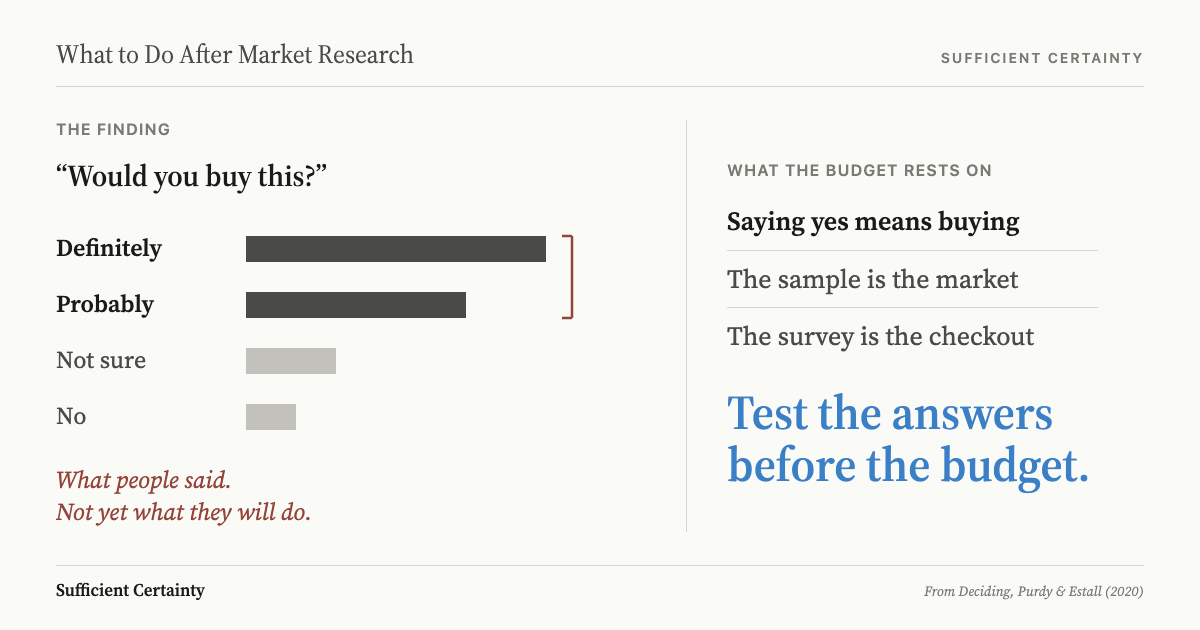
Almost every market research finding is a report of what people said, not what they did. A survey records an answer given at a desk or on a phone, with no price tag, no queue, no competitor across the road and no money leaving an account. The business case then treats that answer as a forecast of behaviour in the store.
The gap is measurable. In a review of meta-analyses covering many kinds of behaviour, Sheeran (2002) found that intentions explained on average about 28 percent of the variance in what people went on to do. Most of what drives behaviour sits outside the stated intention.
Purchase research has its own version of the gap. Morwitz, Steckel and Gupta (2007) found that purchase intentions predict sales better for existing products than new ones, over short horizons than long ones, and for specific brands than whole categories. Large strategic bets usually sit at the weak end of every one of those conditions.
Two further assumptions ride along. One is the sample: the people who answered are taken to represent the people who will buy. The other is context: a preference expressed in the research setting is taken to hold when the choice is real and the alternatives are visible. The research does not check either.
Then the finding acquires social weight. Once it is presented as "the customers told us", challenging it sounds like arrogance towards the customer. Later data that fits is welcomed and data that does not is explained away, the pattern described in confirmation bias in decision-making. "We asked the market" becomes a reason to stop asking.
Pick the survey finding your launch budget leans on hardest and write down what customers would have to do at the checkout for it to hold. Start the Walk →
How Walmart learned this
In 2009 Walmart was rolling out Project Impact across its US stores. Aisles were widened, the promotional pallets that filled the central "Action Alley" were cleared, stores were remodelled, and thousands of slower-selling items were cut from the shelves. The aim was a cleaner, easier store that would keep existing shoppers and attract new ones.
Customer research appeared to confirm the bet. On the February 2010 earnings call, Eduardo Castro-Wright, who ran Walmart U.S., reported the highest customer satisfaction scores the business had recorded, "which confirms to us that customers really like what they are seeing in our stores." He cited a sales lift in control-tested stores with a clean Action Alley and said the rollout would be accelerated. That test measured clearing the main aisle, and left the effect of cutting items from the range unmeasured.
Management put most of that decline down to a lower average ticket driven by price deflation, with only a slight fall in traffic, so one quarter proves little about the remodel on its own. Even so, record satisfaction had arrived alongside falling sales, and the following year showed which of the two to trust.
The sales kept falling. In the 13 weeks to January 2011, Walmart U.S. comparable sales dropped a further 1.8 percent, and chief executive Mike Duke told investors that "some of the pricing and merchandising issues in Walmart ran deeper than we initially expected." By then Bill Simon was running the US business.
The reversal was explicit. By May 2011 Walmart had put 8,500 items back on its shelves. At the June 2011 shareholders' meeting Simon gave the reason in two sentences: "Our customers can't buy it if we don't sell it. And if we don't sell it they go somewhere else to buy it." US comparable sales did not return to growth until the quarter ending October 2011.
The satisfaction scores were not false. Shoppers did like the cleaner stores. What the research never tested was the assumption the program rested on: that shoppers who rated the store higher would keep buying their whole list there after items on it had gone. The scores measured how the store felt. The sales measured whether it still did the job.
Testing assumptions before committing resources
The step between research and commitment is a deliberate pass over the business case to name what the findings are being asked to prove, and to separate what customers said from what the plan needs them to do. Another survey would only add more of what customers said.
The five-step method gives that pass a structure. Frame the decision and its purpose, so the research is judged against the choice actually being made. Set out the tentative elements: the proposition, the segment, the price. Then surface the assumptions each element depends on, and mark each one as observed behaviour or stated preference.
Stated preferences that carry the forecast are the ones to test in behaviour: a limited trial, a handful of stores, a pilot at real prices, an A/B test on a live page, measured in purchases rather than ratings. A test that measures a rating only repeats the research. The same rule holds after an MVP launch, where early enthusiasm is easy to mistake for demand.
Sufficient certainty, the fourth step, sets how much evidence is enough to commit, given what is lost if the assumption fails. The fifth, implement and monitor, names the signals that would show the assumption breaking, such as traffic, basket size and lost categories, and the point at which the team would reverse. The reversal trigger belongs in the plan before launch.
Research on rivals needs the same treatment, which is why what to do after a competitor analysis follows the same pattern. Market research is one input to data-driven decision making, and like any data it answers only the question it was asked.
You could size the launch budget from what respondents said they would buy and still leave whether they will buy it untested.
Work through your decisionNo sign-up. Just pick your decision and start.
Grant Purdy is the co-author, with Roger Estall, of Deciding (2020), and the architect of the Universal Decision-Making Method.