
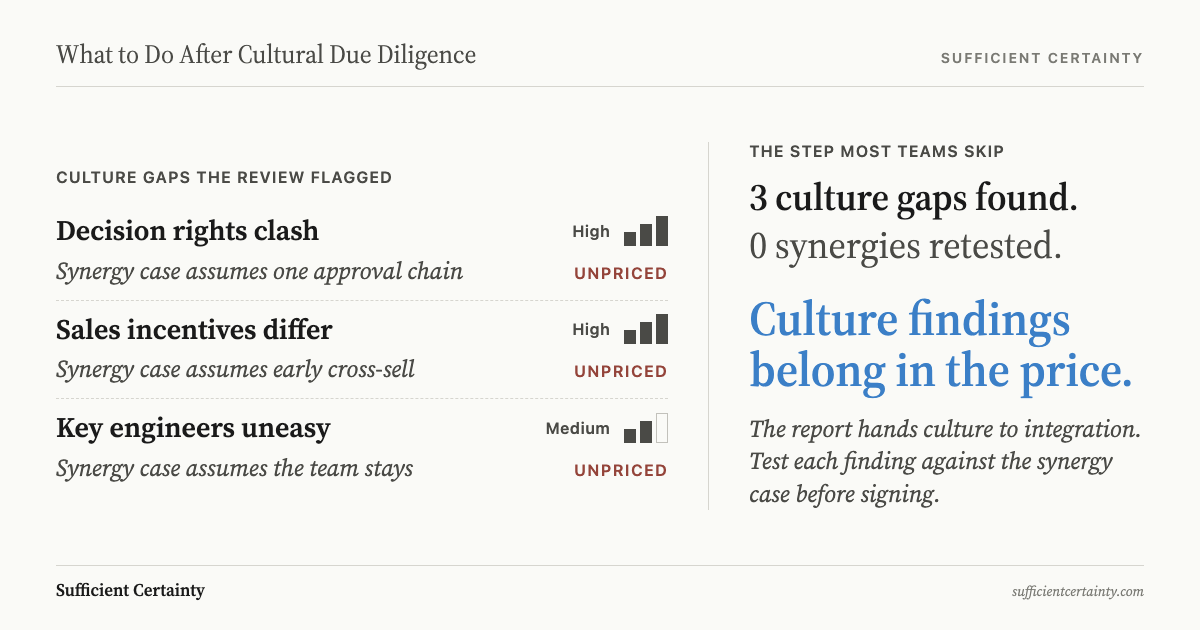
The findings of cultural due diligence matter more to the price than to the integration plan. After the report arrives, take it back to the synergy schedule before the board approves the final bid.
Ask whether the deal thesis depends on people behaving in ways the report says they will not. If it does, culture is a condition of the deal rather than a workstream.
Then re-pricing, keeping the target standalone and walking away all come back onto the table.
Cultural due diligence is the pre-close assessment of how acquirer and target make decisions, reward people and get work done, used to judge fit and integration risk.
Scoring the culture gap and handing it to integration
The usual output is a culture gap report, one strand of the wider due diligence review. Interviews, surveys, document reviews and site visits are distilled into a set of dimensions, such as decision rights, appetite for risk, pace, customer orientation and how performance is rewarded. Each organisation gets a score, and the distance between the two scores is shown as a heatmap of where friction is likely.
From there, the report is addressed to the integration team. The integration management office takes the findings and turns them into workstreams: a culture lead, a leadership alignment program, a communication plan and a set of Day One messages. Retention packages are sized for the people whose departure would hurt most, usually senior sellers, engineers and the managers who hold customer relationships.
The 100-day plan then sequences the work. Reporting lines are drawn, the combined leadership team is named, and decisions about which systems, policies and ways of working will survive are scheduled against milestones. Some acquirers write a cultural integration charter that states the target behaviours for the combined organisation and the measures that will track them.
This is the same sequence that follows a general cultural assessment inside a single organisation, compressed into the window between signing and close. The difference is that in a deal the report also sits in the data room, next to the financial, legal and commercial findings.
A culture gap report makes the first year survivable
None of that work is wasted. A good culture gap report tells the integration team where the arguments will start before they start. It identifies the people who carry informal authority in the target and who would leave first. It flags the policies, such as sales commission plans or approval limits, that will cause the loudest reaction if they are changed on Day One. That alone prevents avoidable damage.
The research supports taking culture seriously without treating difference as automatically bad. A meta-analysis of 46 studies covering 10,710 deals by Stahl and Voigt (2008) found that cultural differences affect sociocultural integration, synergy realisation and shareholder value in different, and sometimes opposing, ways. The effects depended on how related the two businesses were and on which dimensions of culture differed. A report that names the specific differences, rather than a single fit score, gives the acquirer something to work with.
It also improves the rest of the situation analysis. Financial and commercial diligence describe what the target owns and earns. Cultural diligence describes how that result is produced, which is often the part a buyer is paying for without saying so. Deciding how much due diligence is enough is easier when the behavioural evidence is on the table alongside the numbers.
Pick the synergy line that only pays out if people change how they work, and read it against the culture finding that says whether they will. Start the Walk →
Culture filed on the wrong side of the signature
The weakness is in the question cultural due diligence is asked to answer. The question is usually some version of: how different are these two organisations, and how should the difference be managed? That question has an answer built into it. It assumes the deal goes ahead and places culture after closing, as a problem for the people who inherit the deal.
Meanwhile the synergy schedule, which the price is built on, is full of behaviour. Consolidating two sales forces assumes sellers will sell the other company's products to their own customers. Merging customer care assumes agents will adopt one set of processes and one billing system. Cross-selling assumes the target's account managers will introduce the acquirer's people. Each line is a forecast about how people will act. Financial due diligence tests the arithmetic; cultural diligence is the only workstream collecting evidence on the behaviour.
- Scores on each culture dimension
- A heatmap of likely friction
- Key people at risk of leaving
- Which synergy lines need changed behaviour
- Whether the price already pays for that change
- Whether a standalone model avoids the clash
- The finding that should stop the deal
So the one body of evidence about behaviour is routed to the people who start work after the price is fixed. The framing decided where the findings would go before anyone read them.
The people inside a merger are poorly placed to catch this later. In laboratory mergers run by Weber and Camerer (2003), performance fell after two firms with their own working codes were combined. Participants overestimated how well the merged firm would perform and blamed members of the other firm rather than the conflict between cultures. Integration teams inherit that attribution problem. By the time the shortfall shows up, it looks like a people problem, not a pricing error.
Sprint Nextel named culture a fit and a risk, never a condition
Sprint and Nextel agreed to combine on 15 December 2004 in what their joint proxy statement called a "merger of equals." The companies estimated the net after-tax present value of synergies at about $12 billion, net of $800 million in integration costs. Of that, $4.4 billion was to come from lower selling, general and administrative costs, including consolidating subscriber care, billing and information technology and reducing combined sales and marketing costs.
Culture appears twice in the same document. Among the reasons the Sprint board gave for approving the deal was "the cultural fit" of both companies. In the risk factors, the list of integration challenges included "addressing differences in business cultures, preserving employee morale and retaining key employees." Culture was a reason to proceed and an integration risk. Nowhere was it tied to the savings lines that required two sales and care organisations to work as one.
The merger closed on 12 August 2005, with an executive headquarters in Reston, Virginia and an operational headquarters in Overland Park, Kansas. Sprint Nextel's 2007 annual report still carried the same risk factor, now "including in connection with our headquarters consolidation in Kansas," and stated that integrating Nextel and the affiliates acquired alongside it "has caused" interruptions of, or loss of momentum in, the business. At year end, about 72% of direct post-paid subscribers were on a single billing platform.
The company lost about 2.8 million net post-paid subscribers on its iDEN network during 2007. In the fourth quarter it recorded a $29.7 billion goodwill impairment, writing off almost all of the $26.3 billion of goodwill booked on the Nextel merger and related acquisitions and the $4.4 billion already on its books. A new chief executive, Daniel Hesse, joined on 17 December 2007.
The annual report ties the write-down to a sustained fall in the share price, driven by weaker subscriber numbers, and to lower cash flow forecasts. It does not blame culture, and this account does not claim otherwise. The point is narrower. Shareholders voted on a document that valued behaviour-dependent savings in billions and treated cultural difference as something to address afterwards.
Which synergy lines survive the culture findings?
Before the final bid goes to the board, take the synergy schedule and mark every line that requires people in either organisation to work differently from how they work today. Put the relevant culture finding next to each marked line. This is a deal team document, owned by the people setting the price, not by the integration office.
Then ask of each marked line whether the price already pays for that change in behaviour, and what the deal is worth if the culture stays as found. The answer reframes the options. Re-price by stripping the line out of the value. Keep the target standalone and give up the savings that depend on combining it. Change the integration model so the behaviour does not need to change. Or walk away.
The Universal Decision-Making Method treats the deal thesis as a set of assumptions to be named before commitment. The trigger for doing so is the board paper for the final bid. After signing, the options narrow to integration.
Sprint and Nextel named culture as both a fit and a risk. What they lacked was certainty that the savings in their synergy case could survive it.
Work through your decisionNo sign-up. Just pick your decision and start.
Grant Purdy is the co-author, with Roger Estall, of Deciding (2020), and the architect of the Universal Decision-Making Method.