
After a cultural assessment, most teams feed the profile into a change program or integration plan. The step they skip is testing whether the assessment captured how people actually behave or only what they report about how they behave.
A cultural assessment maps an organisation's shared values, norms, and behaviours to a structured profile, typically through surveys, interviews, and observation against a diagnostic framework.
The standard next step after a cultural assessment
The standard move after a cultural assessment is to design interventions that close the gap between the current culture profile and the target state. If the assessment reveals a hierarchical, risk-averse culture and the strategy requires agility, the response is a program aimed at shifting behaviours and leadership practices toward the desired profile.
The process follows a sequence. The assessment instrument produces scores or typologies. Practitioners compare the current profile against a desired state drawn from strategic priorities. Gap analysis identifies where the distance is greatest. A change program is designed to close those gaps through leadership development, communication campaigns, and structural redesign. The profile itself becomes the authority, and teams stop questioning the inputs once the output looks like data.
Several diagnostic frameworks structure this work. Cameron and Quinn's Organisational Culture Assessment Instrument maps cultures onto four types: Clan, Adhocracy, Market, and Hierarchy. Denison and Mishra (1995) linked culture traits to effectiveness measures such as sales growth and return on assets. Schein's three-level model distinguishes artifacts, espoused values, and basic underlying assumptions. The McKinsey 7S model puts shared values at the centre of seven elements it checks for fit. Each framework produces a profile. Each implies that the organisation can move from current state to desired state by acting on the gaps the profile reveals.
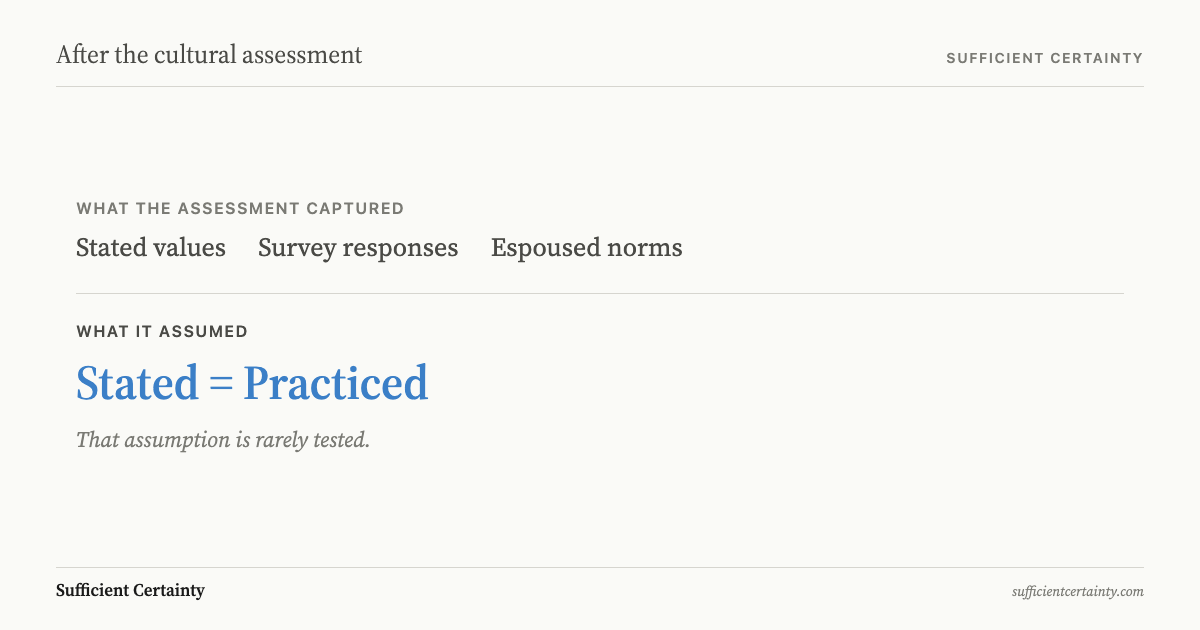
In practice, most cultural assessments operate at the espoused-values level. They capture what people say they value, not what they do when those values are tested. Surveys ask employees to rate statements like "this organisation encourages innovation" or "leaders here are approachable." The answers reflect declared beliefs. Whether those beliefs govern actual behaviour under pressure is a separate question, and one the standard instruments do not ask.
In change management, the assessment is treated as the diagnostic step. Once it is complete, the assumption is that the organisation's culture is now known and the work of changing it can begin. An organisational change management plan typically treats the assessment output as a verified input.
What that step adds
The change program adds movement. A cultural assessment on its own is description. It tells the organisation what its culture looks like according to the instrument. Without a program, the assessment sits in a report and never reaches operating practice. The program converts the profile into interventions: workshops, behavioural nudges, reward system redesign, leadership coaching. It gives leaders who sense a problem something concrete to act on.
The contribution is real. Organisations that have never named their culture now have a shared vocabulary. Teams that disagree about "how things work here" can point to a profile and discuss specifics rather than trading anecdotes. Watkins (2013) argued that one of the primary values of studying organisational culture is precisely this: giving leaders a language to talk about something that otherwise operates invisibly. When a team discusses organisational alignment, the cultural assessment provides the reference frame.
Where a cultural assessment reveals a gap between the current state and strategic requirements, the program assigns accountability. Someone owns the shift from hierarchy to agility, or from siloed operations to cross-functional collaboration. The program creates timelines, milestones, and checkpoints. This is genuine progress over an assessment left on a shelf.
But the program inherits whatever the assessment gives it. If the assessment says the culture is collaborative, the program treats collaboration as the starting condition. If the assessment says employees value transparency, the program assumes transparency is present. The change program does not test its own inputs. It operationalises them.
Write down the cultural finding your change program depends on most and ask whether anyone observed it in practice or only in a survey. Start the Walk →
Where the standard playbook breaks down
The playbook breaks down at the boundary between what people report and what people do. Schein's three-level model identifies this boundary explicitly: artifacts are visible, espoused values are stated, and basic underlying assumptions are taken for granted and rarely surfaced. Most cultural assessment instruments measure at the espoused-values level. They collect what employees are willing to declare about their organisation's culture. They do not test whether those declarations survive contact with a budget dispute, a missed deadline, or a merger.
The 1998 merger of Daimler-Benz and Chrysler demonstrated the cost. The deal was valued at approximately $36 billion and positioned as a "merger of equals." Pre-merger due diligence included cultural compatibility analysis. Both organisations described their cultures in terms that appeared aligned: engineering excellence, innovation, global ambition. Cartwright and Cooper (1993) had already warned that cultural compatibility assessments in mergers tend to capture declared values rather than operating norms, but the DaimlerChrysler assessment followed the standard playbook.
In practice, the two cultures were incompatible at the level of basic assumptions. Daimler operated through formal hierarchy, consensus-driven engineering review, and centralised authority. Chrysler operated through informal networks, rapid prototyping, and decentralised decision-making. The assessment had captured what executives said their cultures valued. It had not tested how those cultures actually functioned when forced to share reporting lines, budgets, and product decisions. Within two years, most senior Chrysler executives had departed. By 2007, Daimler sold Chrysler to Cerberus Capital Management for approximately $7.4 billion.
The assessment was not poorly executed. It measured what the instrument was designed to measure: espoused values. The assumption that espoused values predict operational behaviour was never tested, because the instrument did not require it. The change management plan and integration strategy both inherited that untested assumption. When resistance to the integration surfaced, it was attributed to individual reluctance rather than structural incompatibility at the assumptions level.
The step to take first
The change program is not the problem. The problem is building the program before testing the assessment it rests on. Before a cultural profile enters a change plan, each finding needs to survive a question: is this something observed in practice or something declared in a survey? Exit interview themes need the same test before they fund a retention plan.
Take each assessment output and rewrite it as a claim. "The organisation values innovation" becomes "People here choose unfamiliar approaches over proven ones when both are available and the stakes are high." Then test the claim against what actually happens. A finding that matters to the change program and rests on survey responses alone is the one that needs investigation before the program builds on it.
Cultural assessment reports "innovation" as a core value. Program invests in hackathons, idea platforms, and innovation workshops. Two years later, no measurable change in new product output. The real barrier was a six-layer approval process that killed proposals before prototyping. The assessment measured aspiration, not practice.
Same finding. Before committing resources, the team tests whether stated innovation value corresponds to actual behaviour: how many proposals reached prototyping last quarter, what happened to the last three failed experiments. The test reveals the approval bottleneck. The program targets the process, not the mindset.
The five-step structure in the Sufficient Certainty method places assumption recognition before any commitment. Frame the decision. Identify tentative elements. Surface the assumptions embedded in the assessment. Determine whether enough of those assumptions have been verified to proceed with sufficient certainty. Then implement with monitoring in place. An assumption that appeared in a survey and was never tested against actual behaviour is not evidence. It is an input that needs verification.
The cultural assessment produces a starting point, not a conclusion. The profile tells the organisation what people reported. What people do under pressure, when the strategy conflicts with the norms, when the budget forces a choice between stated values and operational convenience, is a different question. Testing that question before the change program commits resources is the step that determines whether the program addresses real culture or a portrait of the culture people wanted the assessment to see.
You could close this tab and carry that decision into another week.
Work through your decisionNo sign-up. Just pick your decision and start.
Grant Purdy is the co-author, with Roger Estall, of Deciding (2020), and the architect of the Universal Decision-Making Method.