
After a NIST cybersecurity assessment, attach the supporting evidence to one high-priority control gap before approving its budget. All five functions assessed in the Postal Regulatory Commission's FY2024 FISMA evaluation received Ad-Hoc, Level 1 ratings. That finding describes an assessed program, not the probability of an attack. The practical question is what evidence would justify the next control investment.
A NIST cybersecurity assessment evaluates cybersecurity outcomes or controls against selected NIST guidance within a stated scope.
Attach evidence to the cybersecurity profile
Start with the assessment's scope and version. Identify the services it covers and the date of the evidence. A review against the Cybersecurity Framework differs from a detailed assessment of individual security controls. Both can be useful. Neither label alone tells the budget holder what was actually checked.
For a CSF assessment, retain the Current Profile beside the Target Profile. NIST's Organizational Profiles guide describes how profiles express present and desired cybersecurity outcomes. The comparison gives a basis for an action plan. It also leaves room to document the evidence behind each outcome.
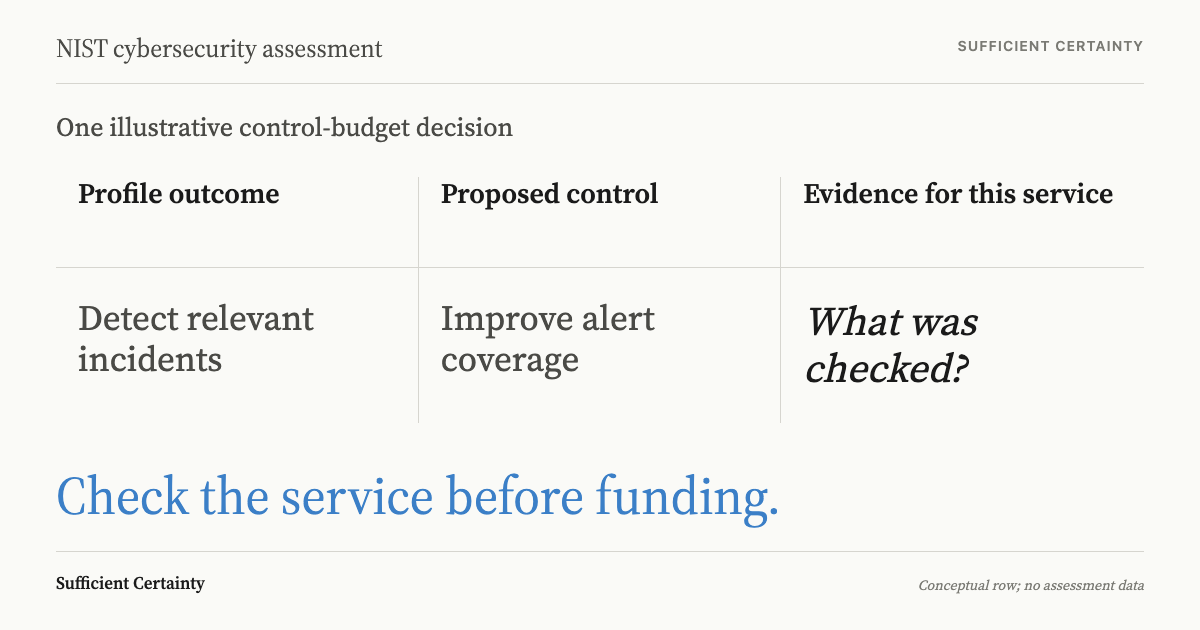
Choose one proposed investment that depends on an assessment finding. Open the relevant profile row. Add the source document or test result, with its date. Identify any part of the service that the evidence does not cover. Keep that limitation beside the finding rather than in a separate appendix.
A statement such as “logging is enabled” needs a defined boundary. Does it cover the service being funded? Does the evidence show that the logs reach the intended destination? Those questions concern the purchase decision. They help separate a documented setting from the capability the organization intends to buy.
Keep the original finding intact when adding this information. A budget note should not silently change an assessor's conclusion. If new evidence changes the recommendation, identify the change and who reviewed it. This lets the decision maker distinguish the assessment result from the later proposal.
Place the proposed cost beside its prerequisites. A technical change may depend on an approved procedure or staff time. Record that dependency in the decision record before allocating money. Fund the capability that the evidence supports.
A NIST profile makes control gaps comparable
The framework gives different teams common terms for discussing cybersecurity outcomes. A service owner can describe the required availability without specifying a particular product. A security team can then identify possible controls. This helps a budget discussion move from a list of tools to the services those tools must protect.
CSF 2.0 includes six functions, including Govern. It describes outcomes rather than prescribing how every organization must achieve them. A Target Profile should therefore reflect the organization's requirements. Choosing every possible improvement can conceal the decisions that need attention first.
Retain findings about working controls as well as gaps. Evidence that a control works within the required scope can support keeping it. Replacing a functioning arrangement consumes money and staff attention. The assessment should help the organization compare that option with repairing an unsupported capability.
The following display is a qualitative schematic. Its bar lengths distinguish checked evidence from dependencies requiring investigation. They show no measured proportion, control count, or level of certainty.
The distinction belongs in risk assessment discussions wherever a recommendation relies on information beyond the reviewed scope. A profile organizes the findings; evidence supports the commitment.
A NIST profile identifies gaps. Examine the assumption behind the control investment before committing its budget. Start the Walk →
Do the profile ratings describe the same services?
Before comparing ratings, check what each rating refers to. One may summarize an organization-wide policy review. Another may describe tests on a single production system. Putting both in the same chart does not make their coverage equal. Keep the assessed boundary visible when deciding which gap matters to a particular service.
Evidence also has a date. A control test conducted before a system migration may say little about the replacement. A supplier's document may cover its own service but exclude the customer's configuration. Neither result needs to be dismissed. Each needs to be used within the conditions it actually supports. Before relying on assurance after a SOC 2 audit, match the report scope and customer duties to the planned service.
The missing dependency can change the purchase. A plan to improve detection may assume that existing staff can investigate every new alert. If that assumption is wrong, buying more detection software may increase unattended work. Check the staffing arrangement before treating software deployment as the desired outcome.
This is a proposed planning example, not a reported finding about the Postal Regulatory Commission. It illustrates how assumptions in decision making enter an implementation plan. The target is explicit; the conditions needed to achieve it can remain unstated.
An assessment of profile outcomes also differs from adversarial testing. NIST's technical testing guide addresses methods for finding vulnerabilities and examining technical security. A document review cannot establish everything a penetration test might examine. A penetration test, in turn, cannot establish that a supplier contract assigns the required responsibilities.
Match the check to the uncertainty that could change the decision. Use evidence-based decision making to set that question before gathering more material. Ask what was tested before interpreting the rating.
The Postal Regulatory Commission had uneven control evidence
The Postal Regulatory Commission is a separate agency from the United States Postal Service. For FY2024, KPMG evaluated the commission's information security program under USPS Office of Inspector General oversight. This was a FISMA evaluation aligned with NIST framework functions. NIST did not conduct the assessment.
The September 2024 report rated Identify, Protect, Detect, Respond and Recover at Ad-Hoc, Level 1. KPMG assessed the program as not effective. These five assessed functions belong to that historical evaluation. They should not be confused with the six-function CSF 2.0 Core.
The report records policies and procedures that had been drafted but lacked leadership approval. It also records the CISO's departure in April 2024 and limited implementation resources. KPMG made nine recommendations. PRC agreed with all of them. These findings describe FY2024, not the commission's present condition.
Those reported facts reveal different kinds of unfinished work. Drafting a procedure does not approve it. Approval does not assign enough staff to implement it. A proposed control budget must account for whichever condition remains unresolved. The implementation plan depends on more than a drafted policy.
The proposed application is to check each dependency before approving a target. This article does not claim that PRC used that approach. Nor does a Level 1 rating establish a measured likelihood of compromise. The case supports a narrower point: the assessed program lacked necessary arrangements despite having draft documents.
For another organization, the useful question is whether its chosen control can operate under its actual staffing arrangements. Incident decisions that require executive authority also need a named person with the power to act. A technical plan can depend on that authority long before an incident occurs.
Check a decision-changing control before setting the budget
Select the gap that could change the proposed investment. Write the decision in plain terms: approve this control for this service, under these operating conditions. State what the control must achieve. Then identify the assumption that could make the expenditure ineffective.
Give that assumption a check suited to the service. A recovery target needs evidence that the required service can be restored. An alerting target needs evidence that someone can receive and act on alerts. A supplier dependency needs evidence that the necessary responsibility has been accepted. Choose the check that could change the allocation.
If the check fails, return to the proposed option. The response may be to change the control or assign the missing staff. It may also be to delay the expenditure until a necessary approval exists. Avoid recording the gap as closed merely because a purchase order was issued.
Set the acceptance condition before running the check. Decide what result would support the expenditure and what result would require a different option. This is the practical question behind having enough information to decide. It prevents an open-ended search for documents that never resolves the purchase.
The Universal Decision-Making Method connects that assumption to the purpose of the decision. Record the resulting choice, its evidence, and any unresolved condition in a decision record. Revisit the choice when the service changes or its assigned staff become unavailable. Approve a supported operating arrangement, with a clear reason to review it.
You could fund every NIST profile gap and still leave the staffing needed to operate those controls untested.
Work through your decisionNo sign-up. Just pick your decision and start.
Grant Purdy is the co-author, with Roger Estall, of Deciding (2020), and the architect of the Universal Decision-Making Method.