
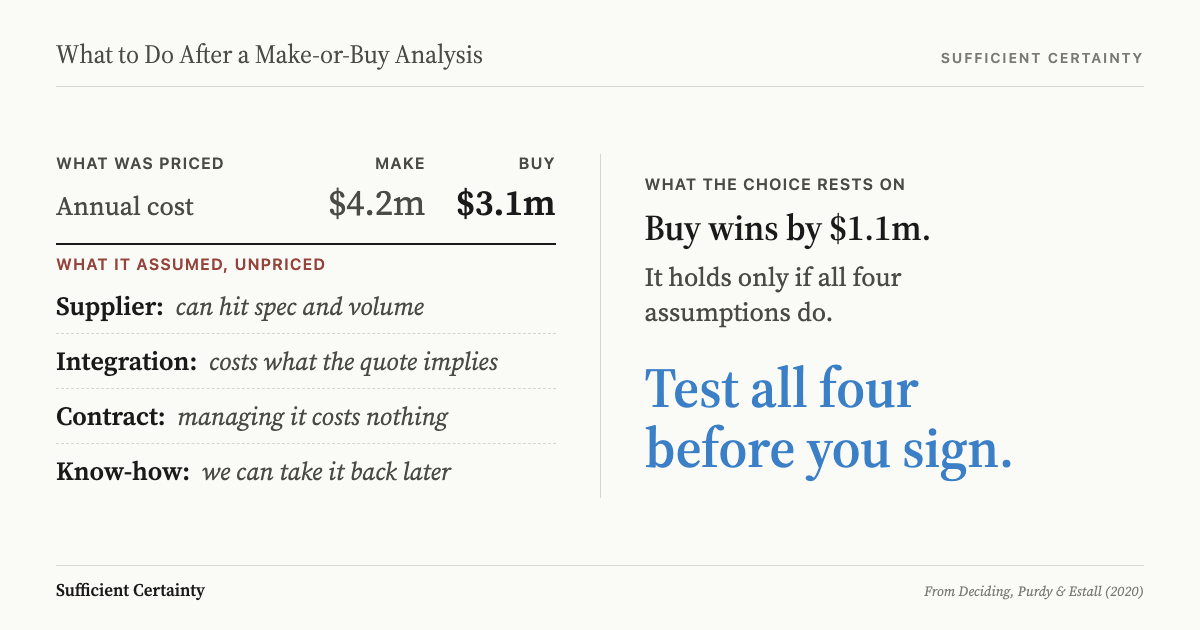
After a make-or-buy analysis, test the assumptions behind the cost comparison, above all whether the supplier can do the work at the quoted price, before signing the contract. The spreadsheet sets a cost the organisation has measured against a price someone has promised, and only one of those has been tested. Boeing spent a decade learning what that difference is worth.
Make-or-buy analysis compares the full cost and strategic value of producing a component or service in-house against buying it from an external supplier.
What make-or-buy analysis delivers
A make-or-buy analysis starts with relevant cost. On the make side sit direct materials, direct labour, variable overhead and any fixed cost that would disappear if production stopped. Allocated overhead that stays either way is left out. On the buy side sit the supplier's price, freight, receiving inspection and the cost of managing the contract. The result is a like-for-like figure per unit, or a cash-flow comparison over the life of the arrangement.
Good practice goes further than unit cost. In a 1992 Harvard Business Review article, Ravi Venkatesan argued that sourcing should follow the capabilities a company needs to keep, and that manufacturing focus now means "learning how not to make things." Components that set the product apart stay in-house. Parts a specialist can make better go out. The analysis becomes a statement about what the organisation is for.
Most analyses also score qualitative factors alongside cost, such as quality history, lead time, exposure of intellectual property and the chance of training a future competitor. The better versions state the volume and time horizon they assume, because a buy decision that wins at low volume can lose at high volume, and a make decision can look expensive only until the supplier's second price rise.
Run properly, the analysis exposes the real internal cost, which allocated overhead often inflates, and puts a figure on the alternative that can be discounted over the contract term like any NPV analysis. Like a trade study, it ranks options against stated criteria, and the recommendation arrives with a number attached.
That number is useful. It moves the conversation from habit to evidence, from "we have always built this" or "suppliers are cheaper" to a figure that can be argued with. Among decision-making frameworks, few give a sourcing decision a clearer shape. The analysis is strongest where the costs on both sides can be observed.
What it leaves unexamined
The two sides of the comparison are not the same kind of number. The make cost comes from the organisation's own ledgers and production history. The buy cost is a quote. It assumes the supplier can build the part to specification and at volume, for the price on the page. One side is measured and the other is promised, and the spreadsheet treats them as equals. A cost-benefit analysis has the same blind spot, weighting a loose forecast and a contracted cost alike.
Whether a supplier can do the work is a feasibility question, and it deserves the testing a technical feasibility study would give it. A supplier that has never made the part at scale is offering a forecast. So is one that will rely on its own sub-tier suppliers, whose names may not appear in the analysis at all.
Quotes are also written to win work. A supplier bidding for a long contract has reason to price the early years keenly and recover margin through change orders once the buyer depends on it. The analysis takes the quote at face value because it has nothing else to use.
The costs of buying also sit partly off the sheet. Someone has to write specifications, inspect first articles, resolve parts that do not fit at assembly and manage changes. Those tasks usually land in overhead, which makes in-house work look expensive and bought work look cheap.
- In-house unit cost against the supplier's quote
- Capacity freed for core work
- Whether the supplier can build at volume
- Cost of fitting bought parts at assembly
- In-house skill needed to write the specifications
- Price of bringing the work back
Then there is reversibility. Once the skills and tooling leave, bringing the work back costs more than keeping it would have, and the supplier knows it. The bargaining power of suppliers rises with every year the buyer loses the ability to make the part. The analysis prices the decision to buy but rarely prices the cost of undoing it.
Write down what the supplier has to do for the buy option to stay cheaper, and ask who has seen them do it at your volume. Start the Walk →
When the gap cost Boeing three years
In February 2001, John Hart-Smith, a senior technical fellow in Boeing's Phantom Works, presented a paper to the company's Technical Excellence symposium in St Louis: "Out-Sourced Profits: The Cornerstone of Successful Subcontracting." He argued that outsourcing should be understood "as an added cost, not a cost reduction," and that make-buy decisions should wait "until after the product has been defined and the relative costs established."
He also named the costs the comparison misses. Without on-site quality and supplier management from the prime contractor, he wrote, its performance "can never exceed the capabilities of the least proficient of the suppliers. These costs do not vanish merely because the work itself is out-of-sight."
The 787 took the other path. Under a strategy set in 2003, about 50 tier-one partners would design major sections of the airframe, make the upfront investment and manage their own subcontractors. The plan rested on each partner being able to do work Boeing had long done itself.
First delivery was planned for 2008. Boeing bought Vought's share of the Global Aeronautica fuselage venture that June, then in July 2009 agreed to pay about $580 million for Vought's 787 operation in North Charleston. Vought's chief executive said the program's financial demands were "clearly growing beyond what a company our size can support." Alenia's half of Global Aeronautica followed in December. The first 787 reached All Nippon Airways in September 2011.
The delays had other causes too, including a new composite structure and a machinists' strike. Yet in January 2011, the head of Boeing Commercial Airplanes, Jim Albaugh, told a Seattle University audience: "We spent a lot more money in trying to recover than we ever would have spent if we'd tried to keep the key technologies closer to home."
Some Wall Street analysts put the added costs at $12 billion to $18 billion, on top of the $5 billion Boeing had planned to invest. Albaugh's sentence is a make-or-buy comparison, rerun a decade late with the missing costs included.
One step before the contract
The step belongs between the recommendation and the signature. The five-step Universal Decision-Making Method gives it an order. Frame the decision around purpose: is the organisation buying to cut cost or to gain a capability it lacks? The answer changes which assumptions carry weight.
Treat the recommendation to buy as a tentative element, not a conclusion. Then surface the assumptions under it: the supplier can build at volume for the quoted price, its sub-tiers are sound, parts will fit at integration, enough in-house skill remains to specify and inspect the work, and the arrangement can be reversed at a known cost. A vendor risk assessment covers some of this. Most of it sits inside the cost model.
Next, decide what counts as sufficient certainty. Some assumptions can be tested cheaply, with a pilot lot, first-article inspection, a visit to the supplier's line or an independent should-cost estimate. Others cannot be tested before signing, and those belong in the contract as step-in rights or a staged transfer. The aim is to know which assumptions would reverse the recommendation if they were wrong.
Then implement and monitor. Name the signals in advance, such as late first articles or engineers being seconded to the supplier's floor. Each one shows the promised side of the comparison drifting away from the measured side. Give someone the job of watching them, with the authority to reopen the sourcing decision before the supplier's problems become the buyer's.
A make-or-buy analysis compares what is known with what is promised. The step before the contract tests the promise.
You could sign with the cheaper option and still leave the supplier's ability to deliver it untested.
Work through your decisionNo sign-up. Just pick your decision and start.
Grant Purdy is the co-author, with Roger Estall, of Deciding (2020), and the architect of the Universal Decision-Making Method.