
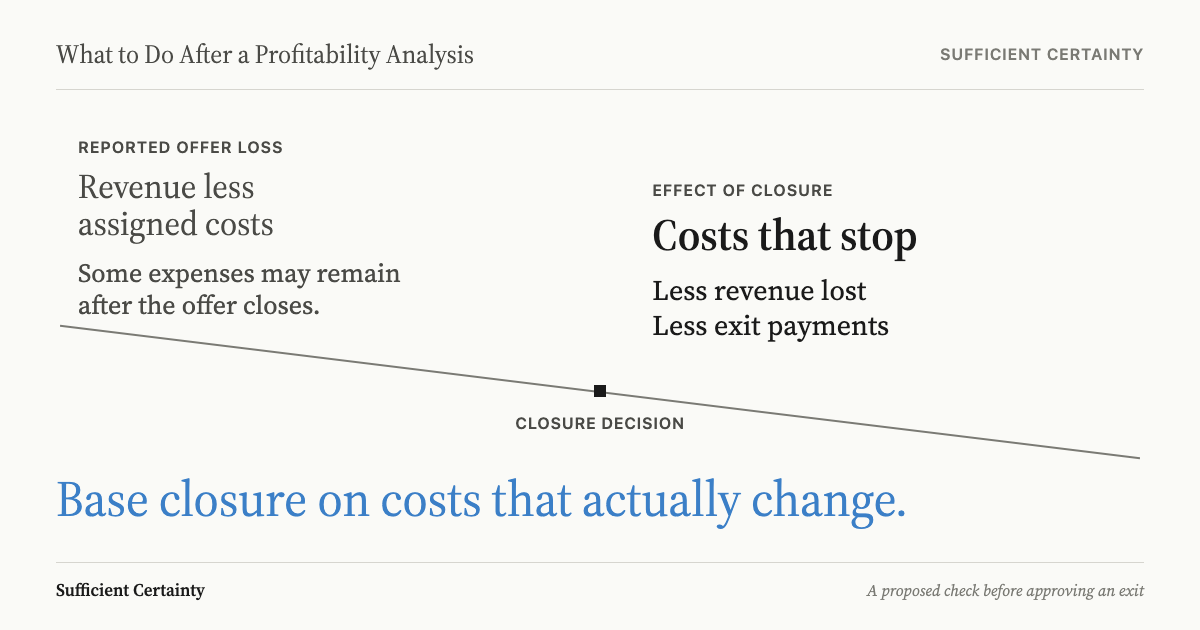
After a profitability analysis, ask the finance team to list which costs would stop if the offer closed. Closing an offer that reports a loss can make the remaining business worse off. Before approving an exit, establish which expenses would actually end and which would stay.
Profitability analysis compares revenue with the costs assigned to a product, customer, service or business unit to establish its financial result.
The margin report supports a proposed change
The completed report gives the business unit head a starting point. It identifies where revenue fails to cover the costs included in the calculation. Keep the detail behind that result. A total loss does not show whether the problem comes from discounts, service demands or shared expenses.
Begin with the offer under review. Check that its revenue and costs cover the same period and activity. Match customer rebates and credits to the sales that earned them. Ask finance to separate adjustments for earlier periods from the result for current trading. Otherwise, a late credit can make a continuing problem appear temporary.
Ask the analyst to reconcile the offer total to the business unit accounts. Check returns, warranty work and after-sales support that appear outside the sales team's report. If the allocation basis changed during the period, show that change separately. These checks establish what the completed analysis actually measures before anyone uses it to support a decision.
Retain the distinctions between gross margin, contribution and the result after shared costs. OpenStax explains contribution margin as sales less variable costs, available to cover fixed costs and contribute to profit. Positive contribution can therefore sit alongside a loss after allocated expenses.
The reported loss needs a different calculation before it can justify closure. Consider two lines in an illustrative profitability report. Both can be accurate, yet they do not support the same immediate response.
A review of break-even assumptions asks whether sales can cover the specified costs. This decision starts with recorded trading results and asks what a proposed change would do to the whole business.
Frame the decision around the effect of retaining, changing or closing the offer. The offer's position in a margin ranking helps select what to examine. It does not remove the need to compare those alternatives.
Which expenses would actually stop if the offer closed? Start the Walk →
Which costs will disappear after exit?
Make a reconciliation beside the completed report. Start with the recorded result and identify each expense attributed to the offer. For every claimed saving, ask the responsible owner what payment would stop, under which agreement, and from what date. Retain the document that supports the answer.
ACCA's relevant-cost guidance distinguishes a change in cash flow from a change in cost allocation. Moving an expense to another product does not save the business money. Apply that distinction before transferring a loss from the profitability report into an exit recommendation.
A cost assigned to the offer is not automatically a saving available on exit. A central support team may still need the same staff after closure. Ask its manager whether headcount or purchased services would change. An empty desk does not establish a saving.
Check supplier terms before removing purchasing costs. A rebate may depend on purchases across several offers. Closing one could reduce the rebate on the remaining purchases. Put the contract beside the calculation and ask procurement to confirm the effect. Treat an unresolved interpretation as an open item.
Record the cost owner's response even when no saving is available. Mark whether capacity would be removed, left idle or used elsewhere. For proposed redeployment, identify the receiving activity and what it would otherwise have to buy. Do not count both a payroll saving and a benefit from using the same employee elsewhere.
Then examine the alternative to exit. Could the business change delivery terms or stop an expensive service feature? Ask the commercial owner which customers have accepted the proposed change. A revised price in a spreadsheet needs evidence that customers will pay it. Include the work required to implement the change.
The OpenStax discussion of relevant information distinguishes avoidable costs from costs that remain under the alternatives. It also stresses the decision period. Choose a period that includes the commitments under review, rather than a convenient month that excludes them.
Use the same dates for continuing, redesigning and closing. Show continuing service obligations and any payments needed to exit. The work after a cash-flow analysis helps check whether money is available when those payments fall due.
Compare alternatives over the period in which their costs can actually change. A delay before savings begin can alter the preferred action even when the eventual saving is credible.
Nordstrom separated Canada exit costs from expectations
On 2 March 2023, Nordstrom announced a wind-down of its Canadian business. In its earnings release filed with its Form 8-K, management said it had considered reasonably available options. It said it could not see a realistic route to profitability for the Canadian operation.
The release forecast approximately $400 million lower total company sales and $35 million higher earnings before interest and taxes in fiscal 2023, relative to fiscal 2022. That earnings expectation excluded wind-down charges. Nordstrom separately expected $300 million to $350 million in pre-tax wind-down charges, mainly from writing down its investment in Canada.
The expected earnings improvement and the charges required separate treatment. The release does not establish that the forecast improvement occurred. It also does not publish the underlying profitability model. It supports a limited lesson about presenting an exit decision, not a claim that a particular calculation proved closure was best.
A write-down reduces an asset's recorded value. Do not enter the full accounting charge as a new cash payment without checking its components.
For a business unit head, the useful application is to present the exit proposal in parts. Keep the recurring trading effect separate from the cost of leaving. Explain which amounts affect earnings and which require cash. Do not call an earnings improvement a cash saving.
Then compare the proposal with a credible redesign. The purpose is not to reproduce Nordstrom's decision. Its public announcement cannot settle whether another offer should close. The work after cost-benefit analysis also requires attention to the conditions behind the preferred answer.
Use the case to improve the comparison, rather than to justify the same outcome. A closure recommendation should show why the alternatives offer less value under the conditions this business faces.
Reconcile the proposed closure with avoidable costs
Before approval, put a short comparison beside the margin report. Give each alternative the same starting data. Identify differences in revenue and expenses, with evidence for each material change. Use the strategic thinking perspective to include the offer's role in the wider business.
Approval should concern a defined change to the business, not the removal of an unfavourable report line. The Universal Decision-Making Method provides a sequence for making that change explicit.
- Frame: state the purpose, such as improving the business unit's sustainable contribution while meeting existing customer commitments.
- Tentative Elements: describe continuing, a specific redesign and closure as real alternatives. State what each would require.
- Assumptions: identify the conditions behind the comparison. Confirm when a contract can end and whether a proposed price is acceptable.
- Sufficient Certainty: decide which unresolved condition could change the preferred alternative. Obtain evidence about that condition before committing.
- Implement+Monitor: assign the actions needed for the chosen alternative. Specify what result or missed condition would require another decision.
Keep the signed reconciliation with the approval. If the decision creates a business case for further spending, carry its expected benefit into delivery. Ask the cost owner to confirm when each claimed saving reaches the accounts.
Do not turn an uncertain exit estimate into a firm benefit because the approval meeting is near. Record the amount that remains unresolved and who must confirm it. If that amount could reverse the recommendation, defer the affected commitment until the comparison is reliable enough. If it cannot, explain why the decision can proceed.
Review the decision if a saving cannot be achieved or a redesign loses the customers it needs. The comparison then needs revision. Retain, redesign or exit according to the future effect on the business, with the reported margin as supporting evidence.
The reported loss leaves the closure decision open until avoidable costs and lost revenue are compared.
Work through your decisionNo sign-up. Just pick your decision and start.
Grant Purdy is the co-author, with Roger Estall, of Deciding (2020), and the architect of the Universal Decision-Making Method.