
After a quarterly business review, and before setting next quarter's targets, check whether the actions that closed this quarter's gap will hold, or just moved the shortfall into next quarter. A review that closes its forecast gap has usually proved less than the room believes.
A gap measures distance from plan. A closed gap says nothing about where the closing revenue came from, or what it will cost the quarter that follows.
A quarterly business review (QBR) is a structured meeting in which leaders compare the quarter's results and forecast against plan and agree actions for the quarter ahead.
The IOU in Under Armour's revenue line
The SEC's 2021 order against Under Armour describes a company that closed its forecast gap five quarters running, then could not close the sixth. Under Armour had reported year-over-year revenue growth above 20% for 26 consecutive quarters from the second quarter of 2010, and repeated the streak on earnings calls. In April and May 2015, its Financial Planning and Analysis (FP&A) group warned senior management that projections for North American wholesale apparel had fallen $120m below the late-2014 numbers.
From the third quarter of 2015, the internal forecast for company-wide revenue fell short of analysts' estimates. Senior management directed FP&A and senior sales staff to close the gap, partly by finding orders customers had asked to receive next quarter and shipping them in the current one. The order calls these pull forwards, and it makes no finding that the revenue was recorded outside GAAP. Every dollar was a real order, shipped a quarter early.
About $45m came forward into the third quarter of 2015 and $99m into the fourth. That fourth-quarter figure kept growth above 20%, which would otherwise have fallen below that mark for the first time in more than five years. In January 2016, FP&A told senior management the first-quarter forecast was short, partly because of those pull forwards.
By February, the company considered revising its public revenue guidance for the quarter, something it had never done. One senior executive wrote: "The issue is that we pulled forward a lot in Q4 and there is not as much room in Q2 but we will see."
The answer each quarter was the same. In July 2016, FP&A forecast that about $65m would need to come forward to meet analysts' estimates and keep growth above 20%. Senior management said growth below 20% "would be an extremely difficult story." In September, a key customer that had already been asked to move more than $30m of orders replied: "More..More..more..30% [price discount] please." Under Armour agreed a 25% discount and an extra 30 days to pay for another $6.7m.
That reply was evidence about demand. It arrived as one more line in the plan to close the gap.
By late 2016 the borrowing no longer worked. The company pulled forward about $172m, roughly 13% of the quarter's revenue, and still missed. At a meeting on 15 December 2016, a senior executive said the company had "been living in this bubble for a while" and was "not going to compromise 2017." On 31 January 2017, Under Armour reported the miss and its stock fell about 23%. Quarterly growth then stayed in single digits or negative, according to the SEC's 2021 order.
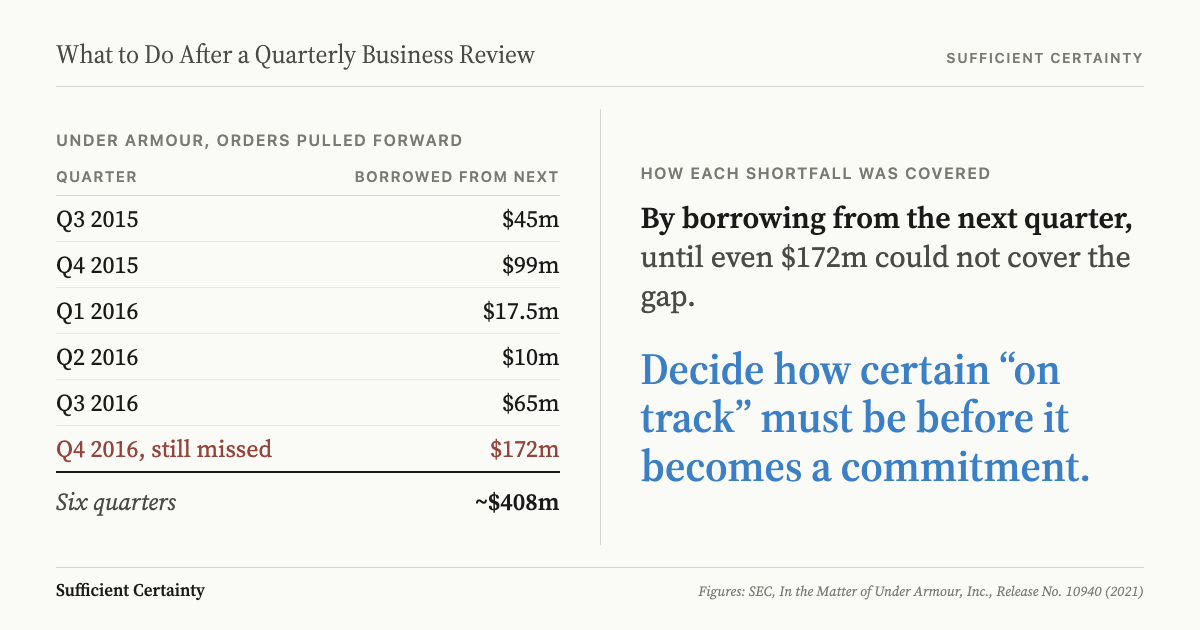
Internally, senior management described pull-forward revenue as "bad," "unnatural" and "unhealthy." In 2021, Under Armour paid a $9m civil penalty to settle, without admitting or denying the findings. Each quarter's forecast review amounted to a gap analysis, and each answer was treated as settled. The information was never missing. What was missing was a standard for how a closed gap had to be closed.
Take the actions your last review booked against the gap, mark which ones borrow from next quarter, and decide how much of the forecast they can carry before it is reaffirmed. Start the Walk →
Sharp on the gap, blind to how it closed
A quarterly business review earns its place. It forces the forecast into the room every thirteen weeks, sets it against plan and puts names beside the variances. Under Armour's forecasting did that part well. FP&A flagged the $120m apparel decline in April and May 2015, months before the first pull forward, and flagged the first-quarter 2016 hole the earlier pull forwards had dug. The early warning worked.
The review also produces a bridge: a list of actions, each with an owner and a dollar figure, that takes the forecast from where it is to where the plan says it should be. That bridge is the most useful page in the pack. It turns a variance into things people will do before the quarter closes, and it lets the next review check whether they did them. If a response requires corrective spending, the follow-up to budget variance analysis reconciles the material difference before judging whether the evidence supports that commitment.
Where the review stops is the test it applies to the bridge. The usual question is whether the actions add up to the gap. A dollar of new demand and a dollar borrowed from next quarter add up the same way, so a bridge built from either closes the gap on the slide. A forecast is a single estimate of one future, and treating it as the only future is how a borrowed dollar starts to look like a planned one.
The pressure to accept that arithmetic is well documented. Graham, Harvey and Rajgopal (2005) surveyed more than 400 financial executives and found most would sacrifice long-term economic value to meet a short-run earnings target. Jensen (2001) argued that target-based budgeting teaches managers to game the numbers rather than report them. A review whose only success condition is a closed gap invites exactly that.
The damage compounds because a pull forward hits twice. Under Armour's internal emails described a "double impact on the growth rate": borrowed orders raise the base in the earlier year and lower the later one. A review that grades one quarter at a time can see that effect and still approve the bridge, because each slide is green on its own terms, and a green slide is read for confirmation rather than challenged.
Target-setting frameworks carry the same weakness in a different form. The OKR cycle at least separates committed targets from stretch bets. A QBR usually makes no such distinction among the actions that close a gap, so every line counts at face value.
What must a closed gap prove before next quarter is set?
The checkpoint sits after the review and before its forecast is used for anything that commits the organisation: reaffirming guidance, setting next quarter's targets or telling the board the quarter is on track. Take the gap-to-plan bridge and split every line into two columns. Demand-driven actions win revenue that belongs to this quarter. Borrowed actions move revenue across the quarter boundary.
Pull forwards, extended payment terms offered for early delivery, discounts tied to ship dates and orders a customer does not want until next quarter all go in the borrowed column. Each borrowed dollar comes off next quarter's opening forecast in the same meeting.
The threshold has to exist before anyone reads the total. Decide what share of the bridge can be borrowed before "gap closed" becomes "gap moved", and what evidence a demand-driven line needs to count: a signed order, a confirmed delivery date, a customer who wants the goods now. The threshold is a decision, not a calculation, and it belongs to whoever owns next quarter's number.
The review finds a gap, books next quarter's orders against it and reports the quarter on track. Next quarter's targets are then set on a forecast that still counts revenue already shipped.
The bridge is split into demand-driven and borrowed lines. Only the demand-driven share counts toward a closed gap, and the borrowed share is deducted from next quarter's forecast before its targets are set.
The customer's September 2016 reply to Under Armour is the test case. Under a threshold, a line that needs a 25% discount to ship early fails the evidence test, and the gap stays open on the slide, which is where it actually was.
The analyst who reports the borrowed share is doing the review's real work, and should not be blamed for the bad news. The Universal Decision-Making Method calls this sufficient certainty: decide how certain the organisation needs to be before it commits, then check whether the evidence meets that standard. It is also a question of accountability in leadership: who signed off, and on what evidence.
A closed gap is a claim, not a result. Test it before the next quarter is built on it.
Under Armour's reviews showed the gap closed every quarter. What they didn't have was a limit on how much of that closing could be borrowed from the next one.
Work through your decisionNo sign-up. Just pick your decision and start.
Grant Purdy is the co-author, with Roger Estall, of Deciding (2020), and the architect of the Universal Decision-Making Method.