
After setting OKRs, and before you cascade them, check each key result against its objective: what would have to be true for hitting the number to mean the objective has actually moved?
In July 2011, investigators appointed by the Governor of Georgia named 178 Atlanta Public Schools educators, 38 of them principals, as participants in cheating on state tests. Educators cited the district's annual targets more than anything else to explain it.
Writing the targets is the easy half. Deciding what confidence they must carry is the half that gets left out.
OKRs (objectives and key results) pair a qualitative objective with a small set of measurable key results that show whether the objective is being reached.
Cascading, checking in and grading the quarter
Once the company-level OKRs are agreed, the standard sequence is well worn. Each objective and its key results are published where everyone can see them, usually in a shared document or an OKR tool. Teams then draft their own sets, linking each one upward so that a sales team's key result on renewal rate visibly supports the company objective on retention.
Every key result gets a single owner. That owner reports progress at a regular check-in, weekly in most teams, often with a traffic-light status or a confidence score from 1 to 10 attached to the update. Mid-quarter, leaders look across the set, spot the key results drifting red and decide whether to add effort, change approach or drop the item.
At the end of the quarter, each key result is graded, commonly on a scale from 0.0 to 1.0. The grades feed a short retrospective, the retrospective feeds the next quarter's draft, and the cycle starts again. Structurally, this is one of the cleaner accountability frameworks in use: every number has a name beside it.
What happens next varies. Some organisations keep OKR grades out of performance reviews on purpose. Many do not, and the grades become inputs to bonuses, promotions and headcount decisions. That is the moment a key result stops being a planning device and becomes a judgement about people.
OKRs make ambition visible early enough to argue about
The method earns its popularity. Andy Grove built it at Intel to force managers to say what they would achieve and how anyone would know, and John Doerr later carried it to Google. Its first gift is focus: a team that can only name three to five key results has to choose, and the choosing exposes disagreements that would otherwise surface only once the work is under way.
Its second gift is transparency. When every team's OKRs are public, overlaps and gaps show up at the start of the quarter instead of in a post-mortem. Unlike a dashboard of standing KPIs, OKRs describe change, so they invite the question of what has to be different for the number to move.
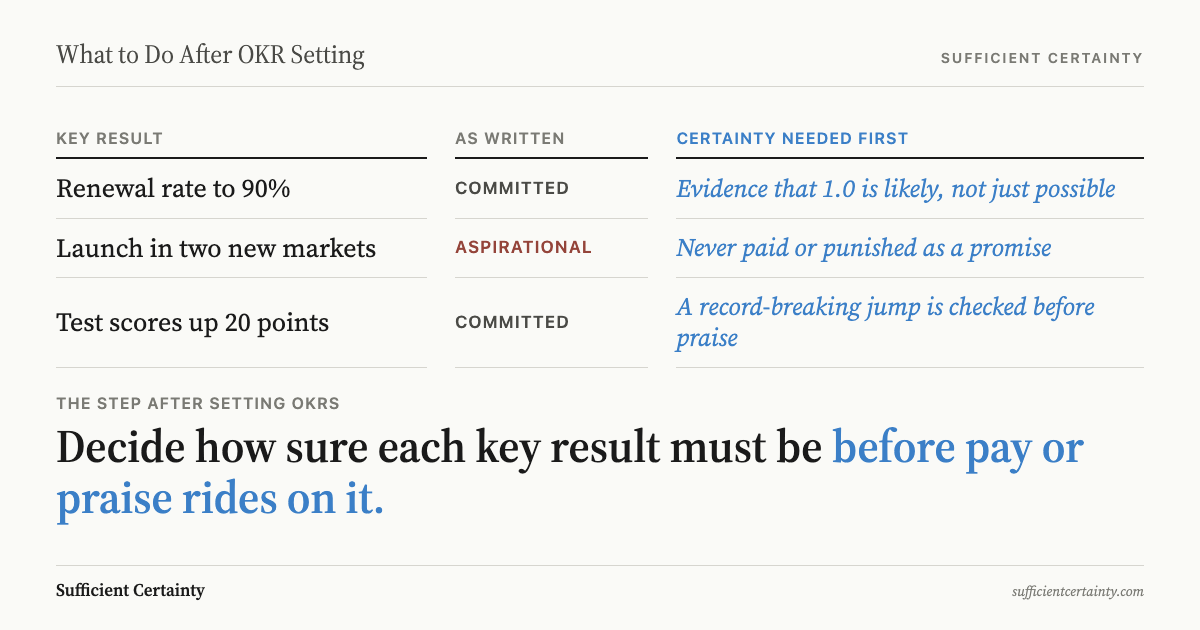
The better implementations also admit that not every target is meant to be hit. Google's re:Work guide puts the sweet spot for a grade at 60 to 70 per cent, and Google's internal OKR playbook separates committed OKRs, expected to score 1.0, from aspirational ones, expected to average 0.7. That split is the framework quietly conceding a point about certainty: some numbers are promises and some are bets.
Before any key result is linked to a bonus or a review, write down whether it is a promise or a bet, and what size of reported jump gets checked before anyone is praised for it. Start the Walk →
The ratchet under Atlanta's test scores
Beverly Hall became superintendent of Atlanta Public Schools in 1999. Each year her administration, working with an outside consultant, set targets on the state's Criterion-Referenced Competency Tests for every school and grade, and the board approved them. Schools that met 70 per cent of their targets earned a bonus for every employee and a seat on the floor at the annual convocation. The rest sat in the bleachers. In 2009 Hall was named National Superintendent of the Year.
The targets worked like a ratchet. According to the special investigation report, they rose annually and were often unrealistic given their cumulative effect. The investigators found the bonus itself gave little incentive to cheat. Fear of termination and public ridicule did the work, and each year's inflated score raised the bar the next year's had to clear.
Each reader held the same number to a different standard of certainty. At the top, the targets were ambitions. Further down, they carried the consequences of commitments. An aspirational key result was being enforced as a committed one, and nobody had decided which it was.
The second failure ran in the other direction. As the gains grew improbable, the district had no threshold for how unusual a result had to be before it was checked rather than celebrated. The Atlanta Journal-Constitution questioned the gains as early as 2001, and again in 2006 and 2009. The report found that Hall and her officials never once investigated to confirm the scores were legitimate.
A state erasure analysis of the 2009 tests flagged 58 Atlanta schools. A Blue Ribbon Commission appointed by the district's board obtained no admissions and suspected cheating at 12. The governor rejected that inquiry and appointed special investigators in August 2010. They confirmed cheating at 44 of the 56 schools examined, and more than 80 educators confessed. The results were accepted at far lower certainty than their improbability warranted.
The investigators described "a culture of fear, intimidation and retaliation," and wrote that the district had become so "data-driven," with such pressure to meet targets, that its leaders "lost sight of conducting tests with integrity." That accountability culture grew in the gap between the two failures.
None of this is peculiar to schools. Ordóñez and colleagues (2009) reviewed how specific, challenging goals narrow attention and raise unethical behaviour when consequences attach to them. Atlanta is simply the case with the clearest paper trail.
How sure does each key result need to be before it carries weight?
The missing step sits between setting the OKRs and using them. For each key result, write down the confidence it needs for three separate uses: to plan and resource against it, to attach pay or consequences to it, and to accept a reported result as real. These are different thresholds, and a key result can clear one while falling well short of the others.
Start with the label. If a key result is aspirational, it cannot carry committed-level consequences. If it is committed, the owner should be able to say what evidence makes 1.0 likely, not just possible. A team that cannot name that evidence has written an aspiration and filed it under the wrong heading.
Then set the acceptance rule before the quarter starts. Decide what size of gain would be unusual enough to verify before it is rewarded, and who does the verifying. A result well beyond anything the team has produced before is not automatically suspect, but it has not yet earned the confidence a bonus requires. Data-driven leadership depends on knowing how far the data can be trusted.
The artefact to check is the key-result sheet itself: each line should show its committed or aspirational label, the confidence required for each use, and the evidence behind the current figure. The trigger is the point where grades are first linked to reviews or bonuses, and again before the first quarter's grades are accepted. The same discipline applies to choosing scorecard measures.
Targets carry less risk than the decisions that hang on them. The method treats sufficient certainty as a question asked of each decision, and accountability in leadership begins with making that question explicit before the consequences land.
Atlanta had a target for every school and grade. What it didn't have was a threshold for how improbable a gain had to be before anyone checked it.
Work through your decisionNo sign-up. Just pick your decision and start.
Grant Purdy is the co-author, with Roger Estall, of Deciding (2020), and the architect of the Universal Decision-Making Method.