
After a strategic alliance review, test the assumptions its verdict rests on before anyone signs a renewal, a restructure or an exit. The review is good at measuring what the partnership has delivered and poor at asking what has to stay true for the next term to work. The costliest of those assumptions can sit in a clause written on signing day and not read since.
A strategic alliance review is a periodic assessment of a partnership's performance, strategic fit, value and governance, ending in a recommendation to renew, restructure or exit.
What a strategic alliance review delivers
A strategic alliance review is the scheduled point at which the partners, together or separately, stop running the alliance and judge it. The scope usually covers four areas: partner performance against agreed commitments, strategic fit with each parent's direction, value delivered against the original business case, and the health of the governance that runs the relationship. It ends in a recommendation, timed to a contract term or milestone, and it is one of the places where strategic thinking meets a signature.
The stakes justify the discipline. Kaplan, Norton and Rugelsjoen (2010) opened their account of alliance scorecards by calling corporate alliances a 50/50 bet, citing McKinsey research that only half of joint ventures return more than the cost of capital to each partner. Dyer, Kale and Singh (2001), studying 1,572 alliances across 200 corporations, found that companies with a dedicated alliance function achieved a 25 per cent higher long-term success rate.
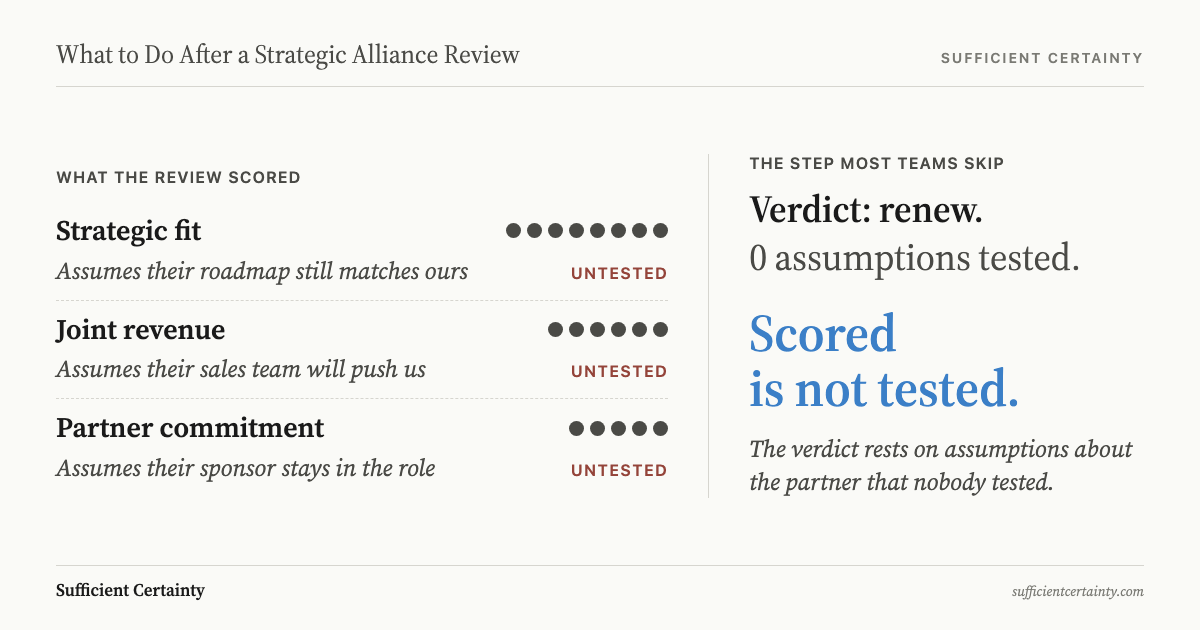
Run properly, the review replaces anecdote with evidence. Joint purchasing savings are counted against the target set at signing. Milestones on shared programs are marked hit or missed. Governance gets a candid read: whether the steering committee still meets, whether escalations are resolved or parked, and whether each side still sends people with the authority to decide.
It also forces a conversation the day-to-day relationship avoids. Alliance managers on both sides have every reason to report that things are going well. A fixed date and a required recommendation make someone say out loud whether the partnership still earns its place. The review connects the alliance back to the case that justified it, sometimes a growth strategy review that chose a partner over building alone, and to the due diligence done before signing.
What reaches the decision-makers is a verdict on how the alliance has performed. The renewal decision is about how it will perform, under terms that may behave very differently in the next period than they did in the last.
What it leaves unexamined
The review is retrospective by design. Every measure in it describes a period that has ended. The recommendation commits the organisation to a period that has not started, and it carries assumptions the scorecard never touched: that the partner stays financially sound, that its strategy keeps pointing the same way, that the people who negotiated the deal still run it, and that the exit and change-of-control terms stay dormant.
Those terms are where exposure builds. Put and call options, termination triggers, buyout formulas and non-compete clauses were priced at signing, against the partner as it was then. A review that scores savings and milestones can report green while the partner's balance sheet turns an obscure clause into its best way out. Checking a counterparty's condition is routine in a third-party risk assessment. An alliance review can skip it because the partner is treated as a colleague, not a counterparty.
Renewal pressure adds to the blind spot. Years of joint investment argue for carrying on, and the sunk cost pull is strongest when the money already spent is large and visible. A restructure can look like the safe middle path, but a restructure that leaves the exit terms untouched renews the exposure along with the relationship.
Pick the clause in your alliance agreement that moves the most value on a trigger and write down what it would cost you if the partner used it before the renewal is signed. Start the Walk →
When the gap cost General Motors $2bn to leave Fiat
On 13 March 2000, General Motors signed a Master Agreement with Fiat. According to GM's 2002 annual report, GM took 20 per cent of Fiat Auto Holdings, parent of Fiat's car business, for $2.4bn. Fiat bought about 5.4 per cent of GM's main class of common stock for the same sum that July. The partners formed powertrain and purchasing joint ventures. Fiat got a put option: from January 2004 to July 2009 it could require GM to buy its shares at fair market value.
GM reviewed the investment, and the reviews were not soft. With Fiat Auto's performance deteriorating, a 2002 review cut the stake's carrying value from $2.4bn to $220m, a $2.2bn charge. The same report judged the joint ventures on their own terms.
On the put, the report gave no number. What GM might have to pay was "not quantifiable", and whether Fiat would exercise was "unknown". The filing listed ways the put might never bite: later agreements, other provisions of the contract, actions Fiat may have taken, or Fiat simply choosing not to. The weaker Fiat Auto became, the less the last of those could be relied on.
The partners then restructured rather than resolved. In 2003 Fiat recapitalised Fiat Auto Holdings without GM, cutting GM's stake to 10 per cent, and GM argued that the recapitalisation and asset sales breached the agreement. On 26 October 2003, GM's 2003 annual report records, the two signed a standstill and pushed the put window out a year, to January 2005 through July 2010. The exposure was deferred, not priced.
In late 2004, GM's annual review wrote the remaining $220m to zero. On 13 February 2005, three weeks into the new put window, GM agreed to pay Fiat about $2bn to terminate the agreement, cancel the put and acquire an interest in diesel engine assets, booking a $1.4bn pre-tax charge, per GM's 2004 annual report.
The two kept supplying each other powertrains under contracts GM said provided considerable ongoing savings. GM's filings had valued the stake year after year; until the settlement, they never put a number on the clause that set the exit price.
One step before the renewal decision
The insertion point sits between the review's recommendation and the signature on a renewal, restructure or exit. The findings stand. What gets added is a short test of what the next term depends on, run before the recommendation becomes a commitment. The five-step Universal Decision-Making Method gives that test a structure.
Frame the decision as the next term, not the last one: what the organisation commits to, for how long and on what terms. List the Tentative Elements: renew as is, renegotiate named clauses, rebuild the governance, or exit on schedule. Surface the Assumptions each option carries, starting with the partner's financial condition, its strategic direction and every clause that moves value on a trigger.
Decide what Sufficient Certainty means for this alliance. An agreement with an embedded put or buyout formula warrants a priced scenario, not a line in a risk note. Then Implement and Monitor, with named triggers such as a partner downgrade, a change of control or a missed capital call that reopen the decision before the next scheduled review.
One test is cheap. For each option or termination clause, write down who would exercise it, under what conditions, and what it would cost. An answer of "unknown" is the finding.
Writing the list down, rather than recalling it, is the core of surfacing assumptions in decision-making, and the same test applies after a strategic gap analysis that counts on a partner to close part of the gap. A clause priced before renewal can be renegotiated; a clause priced by the partner gets paid.
You could renew the alliance on the review's recommendation and still leave the partner's condition and the exit terms the renewal depends on untested.
Work through your decisionNo sign-up. Just pick your decision and start.
Grant Purdy is the co-author, with Roger Estall, of Deciding (2020), and the architect of the Universal Decision-Making Method.