
After a growth strategy review, the standard move is to fund the approved initiatives, cascade the targets into budgets and start the rollout. The step that decides whether any of it works comes before the money moves: testing the assumptions behind the review's conclusions, above all the assumption that new growth will behave like the old. Starbucks set a target of 40,000 stores in 2006 and announced 600 US closures less than two years later.
A growth strategy review is a periodic assessment of which markets and products a company should pursue next, what growth targets to set, and how to fund them.
Starbucks' 40,000-store goal and the assumption nobody checked
In its fiscal 2006 annual report, Starbucks stated a long-term goal of approximately 20,000 stores in the United States and at least 20,000 in international markets. It ended that year with 12,440 stores and planned about 2,400 openings for fiscal 2007. The growth strategy was easy to state and easy to track: more stores, in more places, at a steady pace.
Doubts surfaced early. In February 2007, Howard Schultz, then chairman, warned senior executives in a memo that the push to 13,000 stores had led to "the watering down of the Starbucks experience". The memo leaked. The expansion continued.
The year-end results in November 2007 showed the plan being delivered. Starbucks reported 2,571 new stores for fiscal 2007, 1,788 of them in the US. It also reported that US store traffic fell 1 per cent in the fourth quarter, the first decrease since the company began publishing the figure three years earlier. Comparable sales still rose, carried by a higher spend per visit.
Management attributed the traffic figure to the economic slowdown and two price increases. Chief executive Jim Donald dismissed suggestions that Starbucks was oversaturating markets, pointing to steady success with new stores in Seattle. The company kept its long-term goal of 40,000 stores. The one number that could test the growth target was explained by everything except the growth target.
The assumption underneath the target was that a new store would find new customers rather than divide existing ones. Opening counts, revenue and comparable sales could all rise whether that assumption held or not, because price increases covered the gap left by fewer visits. A growth review that measures delivery against plan cannot tell whether the plan was right.
Schultz returned as chief executive on 7 January 2008. Within weeks the company cut planned US openings to about 1,175 from a revised 1,600, flagged around 100 underperforming stores for closure, and said fewer openings could "potentially reduce cannibalization of our existing stores." In July it announced it would close about 600 US company-operated stores, with pre-tax charges of $328 million to $348 million and up to 12,000 positions cut.
Roughly 70 per cent of the stores slated for closure had opened since the start of fiscal 2006. Most of the stores that failed were products of the growth push. The same blind spot shows up after a strategic gap analysis, where the gap gets measured and the target that defines it does not.
Pick the growth initiative your target depends on most and write down what has to be true about the customers it assumes before the budget moves. Start the Walk →
What a growth strategy review gets right and where it stops
A growth strategy review earns its place. It forces a leadership team to choose among options instead of pursuing all of them. Ansoff's 1957 matrix still frames the choice well: sell more of existing products in existing markets, take existing products into new markets, build new products for existing customers, or diversify. Each quadrant carries a different degree of unfamiliarity, and a review that names the quadrant has already named part of the uncertainty.
The review also turns ambition into numbers: store counts, share targets, revenue from new products, capital allocated to each initiative. Numbers let a board see what it is funding and let managers see what they will be judged on. That is the practical difference between strategic thinking and strategic planning: thinking chooses the direction, planning makes it countable.
Most reviews also draw on sound inputs. Market sizing, industry structure from a five forces analysis, the record of past initiatives, the balance sheet's capacity to fund new bets. The inputs are usually good; the trouble is what happens to them once the targets are approved.
The stopping point is predictable. The review ends when the options are ranked and the targets set. Everything after that is execution: budgets, rollout schedules, quarterly tracking against plan. A store-count target contains claims about demand, about cannibalisation, about site quality at the margin. Once approved, those claims stop being discussed and start being measured against. Nobody owns them, so when one begins to fail, nobody is watching for it.
That is why the next review so often confirms the last one. Good news reads as validation. Bad news reads as execution noise or the economy. Tracking progress toward a target tests execution, not the target.
Standard growth review
- Ranks the options and sets the targets
- Allocates capital to the approved initiatives
- Tracks delivery against the plan
- Reads shortfalls as execution or market noise
With assumption testing
- Lists the claims each target depends on
- Releases capital in tranches tied to those claims
- Tracks the signals that would prove a claim wrong
- Reads shortfalls against the assumptions first
The checkpoint between analysis and action
The missing step sits between approval and funding. It does not reopen the review. It asks what the review's conclusions assume, and which of those assumptions would sink the plan if wrong. The five-step Universal Decision-Making Method gives it a sequence: Frame the decision, set out the Tentative Elements, surface the Assumptions, decide what level of certainty is Sufficient, then Implement and Monitor.
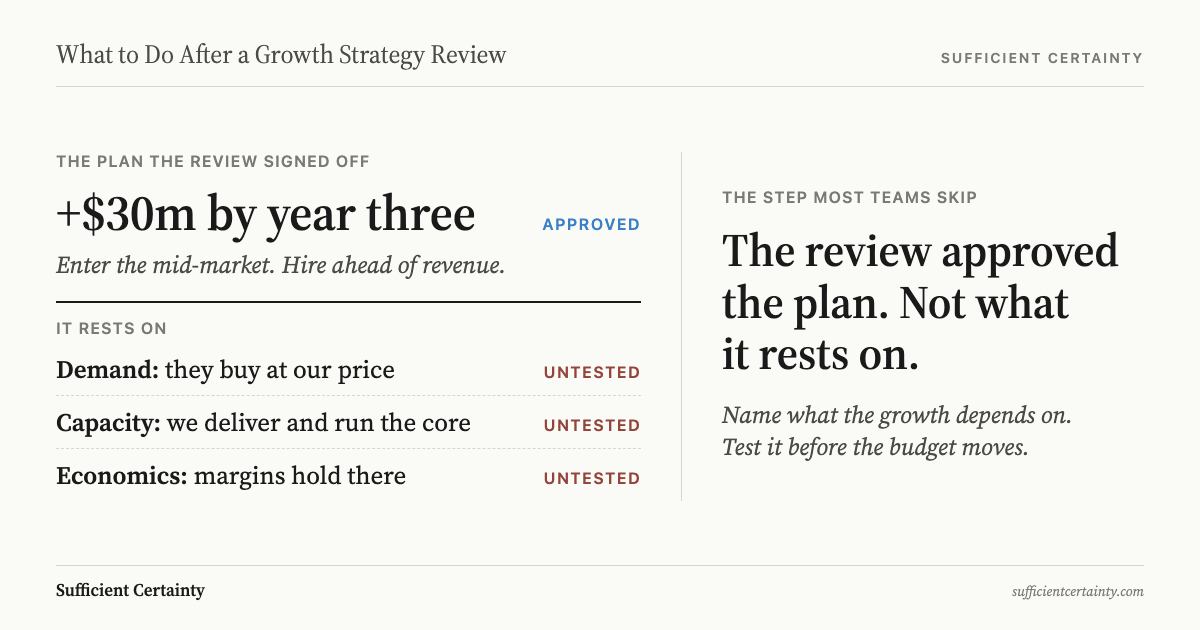
Applied to a growth review, Frame means stating what the growth is for, not only how much. The Tentative Elements are the options and targets the review produced, held as proposals rather than commitments. The Assumptions are the claims those proposals rest on: that new units add demand rather than split it, that new markets behave like the home market, that the organisation can deliver at the planned pace. Most of them are never written down in the review itself.
Sufficient Certainty is a judgement made assumption by assumption, weighted by what it would cost to be wrong. Not every claim needs testing before launch. A wrong guess about the order in which secondary markets open costs a quarter. A wrong guess about whether new stores bring new customers costs the program. The ones that carry the whole target need testing first.
| Cheap if wrong | Costly if wrong | |
|---|---|---|
| Untested | Launch sequence across secondary markets. Proceed and adjust as data arrives. | New units add demand rather than split it. Test before funding the next tranche. |
| Tested | Format and pricing proven in existing markets. Proceed as approved. | Market headroom → moves here when the assumption is tested, and becomes a monitored trigger |
The assumption most worth testing is the one every target depends on and no report measures. For a store rollout, that is incremental demand: sales at new stores set against sales lost at existing stores nearby. For a new-market bet, it is whether customers there behave like the ones at home. The same logic decides which opportunities are worth betting on at all.
Implement and Monitor closes the loop. Each critical assumption gets a named signal and a threshold agreed before the capital is released. Starbucks already published the right signal, US store traffic, and read its first decline as noise. A signal only works if the decision says in advance what it will mean. That is strategic thinking applied to a growth plan: set the threshold first, and a 1 per cent fall in traffic becomes a decision point instead of a footnote.
You could fund the initiatives the review approved and still leave the demand assumption behind the growth target untested.
Work through your decisionNo sign-up. Just pick your decision and start.
Grant Purdy is the co-author, with Roger Estall, of Deciding (2020), and the architect of the Universal Decision-Making Method.