
After a strategic gap analysis, most teams move straight to building a roadmap that closes each gap. The step they skip is testing whether those gaps rest on assumptions nobody has verified.
A strategic gap analysis compares where an organisation is now against where its strategy says it should be, then catalogues the distance between the two states so leadership can decide what to close first.
The standard next step after a strategic gap analysis
The textbook answer is straightforward: prioritise the gaps, then build action plans to close them.
In practice this means sorting gaps by impact and feasibility, assigning owners, setting milestones, attaching budgets. A capability gap gets a training program or a hire. A technology gap triggers a procurement cycle. A market-position gap produces a revised go-to-market plan.
The logic is linear. The gap analysis told the organisation where it falls short. The action plan tells it how to catch up. Most strategy consulting engagements follow this sequence without questioning it. Both McKinsey's strategic-planning frameworks and BCG's transformation playbooks treat the gap-to-roadmap transition as the natural next move. So do most internal strategy teams.
Inside large organisations, the gap analysis typically lands in a slide deck that travels upward through layers of review, from business unit heads through the C-suite to the board. At each level, the question is the same. How should these gaps be closed? The roadmap is the answer that satisfies the question. By the time it reaches the board for approval, it has been pressure-tested for financial feasibility and operational sequencing. What it has not been tested for is the validity of the gaps it was built to close.
Corporate planning functions typically produce a gap-closure matrix: rows for each identified gap, columns for actions, owners, timelines, KPIs. The output looks rigorous. It carries the weight of spreadsheets and Gantt charts. Senior leadership reviews the plan, approves a budget, and the organisation begins executing.
This is also what most post-gap-analysis guidance recommends, whether the original analysis was strategic or operational. The emphasis is always on speed: close the gaps before conditions change.
The assumption underneath all of it: the gaps are correctly identified and the target state is sound. Conditions will hold long enough for the plan to work.
What that step adds
The gap-to-roadmap transition does real work. It converts abstract strategic intent into concrete commitments.
Before the roadmap, leadership has a list of shortfalls. After it, every shortfall has an owner, a budget line, a deadline. Accountability becomes tangible. Progress becomes measurable. The vague sense that "the organisation needs to improve its digital capability" becomes a specific program with quarterly milestones.
The roadmap also forces prioritisation. Organisations cannot close every gap simultaneously. Resources are finite. The planning process compels leadership to sequence its investments, to decide which gaps matter most and which can wait. Without that discipline, organisations default to closing whichever gap has the loudest sponsor, which rarely correlates with strategic importance.
For boards and oversight committees, the roadmap is governance infrastructure. It gives non-executive directors something to monitor beyond quarterly financials. It creates reporting cadences. It makes the abstract question "is the organisation on strategy?" answerable with evidence rather than assertion. It provides a common reference point: when a question arises about whether a particular initiative belongs on the agenda, the gap analysis and its roadmap supply the test.
Organisations that skip this step tend to drift. Strategic intent stays on slides. Departments optimise locally without reference to the larger picture. The gap analysis becomes a document that was produced, reviewed once, filed. Nothing connects the strategic diagnosis to operational reality.
Converting gaps into plans is genuine strategic thinking work. It demands hard choices about resource allocation and timing. It surfaces conflicts. The value is real. What is missing is a prior step that checks whether the foundation underneath all those plans is solid.
Where the standard playbook breaks down
Every strategic gap analysis rests on assumptions. The current-state assessment assumes the data it draws on is accurate and complete. The target state assumes whatever a competitive analysis concluded about competitive conditions, and that customer behaviour will develop in predicted ways. The gap measurement itself assumes the distance between current and target is the right distance to care about.
These assumptions rarely get examined. The urgency to close gaps before the window shifts pushes teams past the question of whether the analysis they are acting on is sound.
JCPenney's 2012 transformation under CEO Ron Johnson is an instructive case. Johnson, who became CEO in late 2011 after running Apple's retail operation, inherited a company that had already diagnosed its strategic gaps with precision. Revenue was declining. Stores looked dated compared to competitors. The pricing model, built on constant promotions and coupons, was eroding margins.
Johnson's gap-closure plan mapped directly to each identified gap. Replace the coupon-driven pricing with transparent "Fair and Square" everyday prices. Redesign stores around branded boutiques to reposition the brand upmarket. Each initiative was a logical response to a documented shortfall.
The assumptions behind the plan were never tested. Johnson assumed customers wanted pricing honesty over the psychological reward of hunting for deals. He assumed the existing customer base would follow the brand upmarket rather than defect to competitors. The transition speed, which was essentially overnight, went unquestioned.
Revenue dropped 25% in the first year, from $17.3 billion to roughly $13 billion. Johnson was removed after seventeen months. His successor reinstated the coupon-and-promotion model almost immediately.
The gaps were real. JCPenney genuinely trailed competitors on store experience and brand positioning. The failure was in the assumptions behind the gap-closure strategy, which were treated as settled facts when they were hypotheses about customer behaviour that no one had checked.
A board reviewing Johnson's plan before launch would have seen a coherent strategy: identified gaps mapped to concrete actions with a clear timeline. What it would not have seen, because no one had produced it, was an assessment of the assumptions connecting those gaps to the proposed remedies.
| What the gap analysis produced | What it assumed | Gap to test |
|---|---|---|
| Market share gap: 18% current vs. 25% target | Total addressable market holds steady | Is the market growing or fragmenting into unreachable segments? |
| Capability gap: no in-house data analytics function | Qualified hires are available within budget and timeline | Does the labour market support this hiring plan? |
| Customer retention gap: churn at 22% vs. target 10% | Churn is driven by service quality, not pricing | Has anyone verified why customers are actually leaving? |
| Technology gap: legacy ERP vs. cloud-native competitors | Migration can proceed without disrupting current operations | What is the real operational cost of running parallel systems? |
A gap analysis that looks rigorous can produce plans that look rigorous. Neither the analysis nor the plan reveals the assumptions holding both together. Those assumptions are where the risk lives.
The step to take first
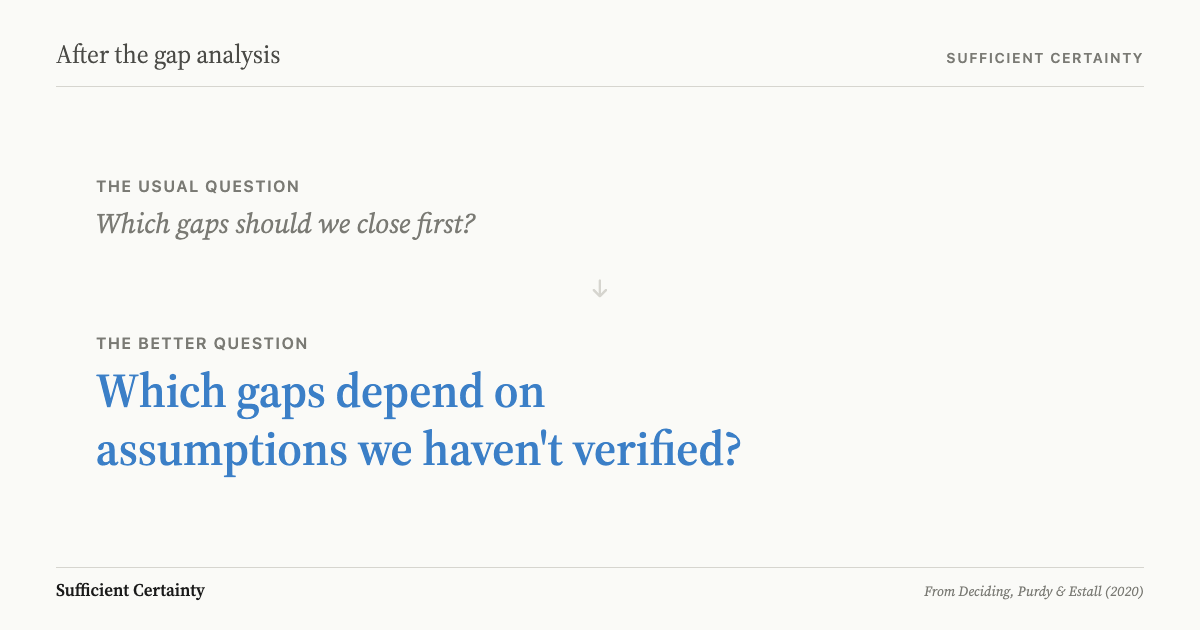
Before building a roadmap to close the gaps, test the assumptions each gap depends on.
This does not mean paralysing the planning process with months of additional research. It means inserting a structured checkpoint between "here are the gaps" and "here is the plan." The question at that checkpoint: which of these gaps depend on conditions that have not been verified?
A method built for this situation structures the work in five stages: Frame the decision. Identify tentative elements. Surface the assumptions the analysis rests on. Determine whether there is sufficient certainty to proceed. Then implement and monitor.
The critical stage is the third. Most strategic planning processes treat assumptions as background context rather than active risk. This method moves them to the foreground. Each assumption gets stated explicitly, then classified: is it verified or is it still an assumption? If the latter, how confident is the organisation in it, and can it be tested before resources get committed?
In JCPenney's case, applying this method would have flagged the assumption "customers prefer transparent pricing" as speculative rather than verified. A structured test, even a regional pilot or focused customer research, would have revealed the risk before the nationwide rollout destroyed a quarter of the company's revenue.
Applied to any strategic gap analysis, this means each identified gap gets examined for the assumptions it depends on, not only for size and priority. A market-share gap that assumes a stable addressable market needs different treatment than one built on the growth projections a growth strategy review signed off, or on a future market that strategic visioning took for granted. A capability gap that assumes available talent needs verifying before the hiring plan gets funded.
The roadmap still gets built. Gaps still get closed. The difference is that the organisation proceeds with tested assumptions rather than inherited ones, and knows which parts of its strategy rest on verified ground.
You could close this tab and carry that decision into another week.
Work through your decisionNo sign-up. Just pick your decision and start.
Grant Purdy is the co-author, with Roger Estall, of Deciding (2020), and the architect of the Universal Decision-Making Method.