
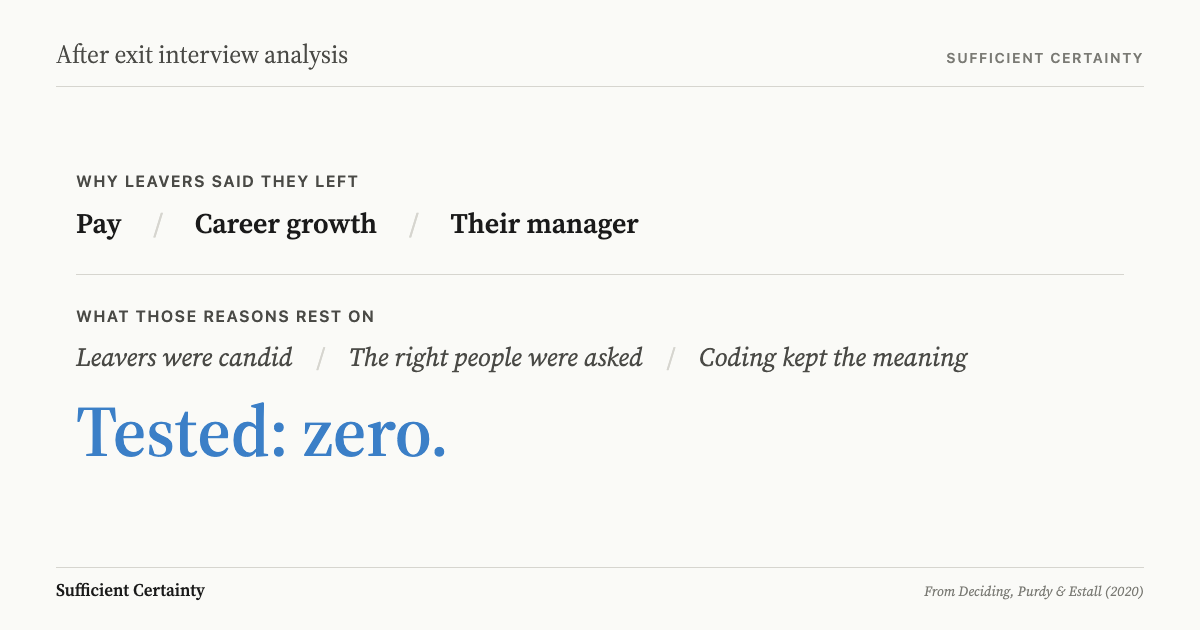
After exit interview analysis, test the assumptions behind each turnover theme before building a retention action on it. The analysis shows what leavers said. It cannot show whether what they said is why they left, and a retention budget aimed at the wrong reason changes nothing. Deloitte & Touche lived with the wrong explanation for its departures until 1992, when someone went back and checked.
Exit interview analysis aggregates what departing employees say about why they left, codes it into turnover themes, and uses those themes to guide retention decisions.
What exit interview analysis delivers
A single exit interview is an anecdote. Analysis turns hundreds of them into a data set. Reasons for leaving are coded into categories such as pay, progression, manager, workload and relocation, then cut by team, tenure, grade and manager. The output is a ranked list of turnover themes and a map of where they cluster.
Everett Spain and Boris Groysberg, writing in Harvard Business Review, argue that a well-run exit process does more than record goodbyes. It can reveal what does and does not work inside an organisation, surface hidden challenges and generate competitive intelligence. A cluster of departures under one manager, or a spike in leavers at the 18-month mark, is invisible in any single conversation and obvious in the aggregate.
That aggregate is what makes the analysis useful at the executive table. It converts people problems into numbers a leadership team can set beside other numbers: the cost of replacing a senior engineer, the time to fill a role, attrition against the industry. It is one of the few places where HR evidence meets the standard of data-driven decision-making on its own terms.
Run consistently, the analysis also creates a baseline. Themes tracked quarter by quarter show whether a policy change moved anything, which is the habit a data-driven culture depends on. Done well, exit interview analysis turns a stack of individual goodbyes into a pattern an organisation can act on.
The limit sits in the word "act". The analysis hands over a ranked list of reasons, coded and counted. What it cannot hand over is evidence that the reasons given are the reasons people left.
What it leaves unexamined
Every theme in the report rests on a chain of assumptions. The leaver told the truth. The interviewer recorded it accurately. The coder put it in the right category. The people who agreed to an interview resemble the people who declined. The stated reason caused the departure rather than justified it afterwards. None of these links is tested by the analysis itself. Each is an assumption embedded in the decision the analysis is meant to inform.
Candour is the weakest link. Lefkowitz and Katz (1969) compared the reasons employees gave in exit interviews with the reasons the same people gave in follow-up questionnaires later. The two converged only weakly. Leavers appeared to withhold information on the way out and shade their reasons toward the socially acceptable. Family commitments are a safe thing to tell a former employer. Naming a manager is not.
Aggregate evidence points the same way. Sull, Sull and Zweig (2022) analysed 1.4 million Glassdoor reviews against attrition data for large US employers. A toxic culture was 10.4 times more powerful than compensation in predicting a company's attrition rate relative to its industry. Compensation ranked 16th among the topics analysed. The gap between what is easy to say and what drives behaviour is the same gap a usability test exposes between what users report and what they do.
Coding compounds the problem. A category called "career progression" can hold a promotion blocked by one manager and a genuine ceiling in a small team. Counted under one label, two causes get one fix. Coders also bring priors: an organisation that already believes people leave for money will find money in ambiguous answers, a pattern familiar from the research on cognitive biases. An exit theme is a hypothesis about why people left, not a finding.
Write down the exit theme your retention plan depends on most and ask whether leavers said it because it was true or because it was safe to say. Start the Walk →
When the gap cost Deloitte its future partners
Deloitte & Touche had hired men and women at entry level in roughly equal numbers since the early 1980s. Its leaders assumed the women would rise into the partnership within ten or twelve years, a pipeline assumption of the same kind that sits under the readiness ratings in a succession plan. By 1991, as Douglas McCracken recounted in Harvard Business Review, only four of the firm's 50 candidates for partner were women, and women were leaving at a significantly higher rate than men.
The firm had an explanation ready. Its leaders believed women left primarily to raise families. Neither McCracken's account nor the later Catalyst study records what departing women told the firm on the way out. The family explanation was the partnership's own. It was plausible, matched what senior people already thought, and implied that nothing inside the firm needed to change. It had not been tested against where the women actually went.
In 1992 the chairman and CEO, J. Michael Cook, hired the research firm Catalyst to interview women who had left. Catalyst found that 70 per cent were working full-time for other companies and 20 per cent part-time. The 10 per cent at home generally intended to return to work. They were not leaving to stay home. They were leaving Deloitte.
The reasons they gave Catalyst were about the firm: a culture seen as male-dominated, too few opportunities to advance, exclusion from informal networks, mentoring and the best assignments, and hours and travel that, for some, made home life close to impossible. Proportionately, Deloitte was losing 80 per cent of its women before they reached partner. Turnover was costing the firm millions of dollars a year.
The test that broke the explanation was simple: a third party, talking to leavers after they had gone, about where they went as well as why. Destination is harder to argue with than a stated motive.
The response changed because the diagnosis changed. Over the following decade, the Women's Initiative, launched in 1993, introduced reduced-hour schedules that people actually used, mentoring that matched senior women with partners, and a travel pattern that kept consultants in their home office one day a week. By 2005, the Initiative's former national director reported that the gender turnover gap was almost completely gone. The costly error was never the departure data. It was the untested explanation laid over it.
One step before the retention plan
The insertion point sits between the theme report and the retention plan. Before a pay review, a manager programme or a flexible-working policy gets budget, the theme it answers is treated as a claim to test. The five-step Universal Decision-Making Method gives that test a structure.
Frame the decision the analysis feeds: which retention action, for which group, at what cost. List the Tentative Elements, the draft actions on the table. Surface the Assumptions each action depends on, starting with whether the stated reason is the operative one. Decide what Sufficient Certainty looks like: a company-wide pay adjustment warrants more evidence than a pilot with one team. Then Implement and Monitor against a named indicator, such as regretted attrition in the targeted group over the following two quarters.
Most of these tests are cheap. Re-contact a sample of leavers six months on, through a third party, and compare answers. Check destinations against stated reasons: a leaver who cites pay and moves for less has given a reason that did not operate. Compare interviewed and non-interviewed leavers on tenure, team and performance. Read raw transcripts against the codes. Evidence-based decision-making calls this appraising the evidence before using it.
The same discipline applies after a cultural assessment, where survey scores carry similar assumptions about who answered and how honestly, and after market research, where stated intent to buy stands in for a purchase. Testing the reasons costs little next to a retention budget aimed at the wrong one.
You could fund the retention plan your exit themes point to and still leave the reason people actually left untested.
Work through your decisionNo sign-up. Just pick your decision and start.
Grant Purdy is the co-author, with Roger Estall, of Deciding (2020), and the architect of the Universal Decision-Making Method.