
How to do a SWOT analysis is the wrong first question. The grid sorts beliefs into four boxes. It does not test whether those beliefs are true. A useful SWOT workshop leaves the room with owners for each untested claim, not a tidy quadrant and a false sense of rigour.
A manager asked me once how to do a SWOT analysis for a board paper due on Friday. She did not need another empty quadrant template. She had three directors, two hours, a nervous sponsor, and a recommendation that would send money one way or another. The real question was not how to fill the boxes. The real question was how to stop the boxes pretending to be the decision.
That is the part most SWOT instructions skip. They teach the room to collect strengths, weaknesses, opportunities, and threats. Useful enough, if the room is muddled. Then the meeting ends with a tidy matrix and everyone behaves as though the steps that turn the grid into a strategic commitment have somehow already happened. It has not. It has become a list with borders.
I would still use SWOT analysis in the right setting. I would just refuse to let it finish where most workshops finish.
A SWOT analysis is a way to sort strengths, weaknesses, opportunities, and threats around a decision, then test which of those claims actually matter.
How to do a SWOT analysis before the meeting starts
Start by writing the decision in one sentence, not the topic and not the organisation's annual strategy. Should we enter this market in Q3? Should we keep the product line open? Should we change supplier before the contract rolls over? If you cannot state the choice, you are not ready for SWOT. You are ready for a conversation that will feel useful and end nowhere in particular.
This is why I link SWOT back to the first step in the method: frame the decision before collecting material around it. A strength is only a strength in relation to a choice. A weakness is only a weakness if it could affect the result. An opportunity is not an opportunity because someone put it in the green box. It has to matter to the decision in front of you.
Set the boundary before the meeting. Decide the time horizon, the unit being examined, the option under consideration, and the people who must live with the outcome. Otherwise the workshop becomes a parade of unpriced opinions. Marketing talks brand, operations talks capacity, finance talks margin, and nobody asks which of those points would actually alter Friday's recommendation.
Send participants three prompts in advance. What do we know? What do we believe but have not tested? What would change the decision if it proved false? That last question is the one that keeps the exercise honest. It discourages people from arriving with a pet concern dressed as analysis.
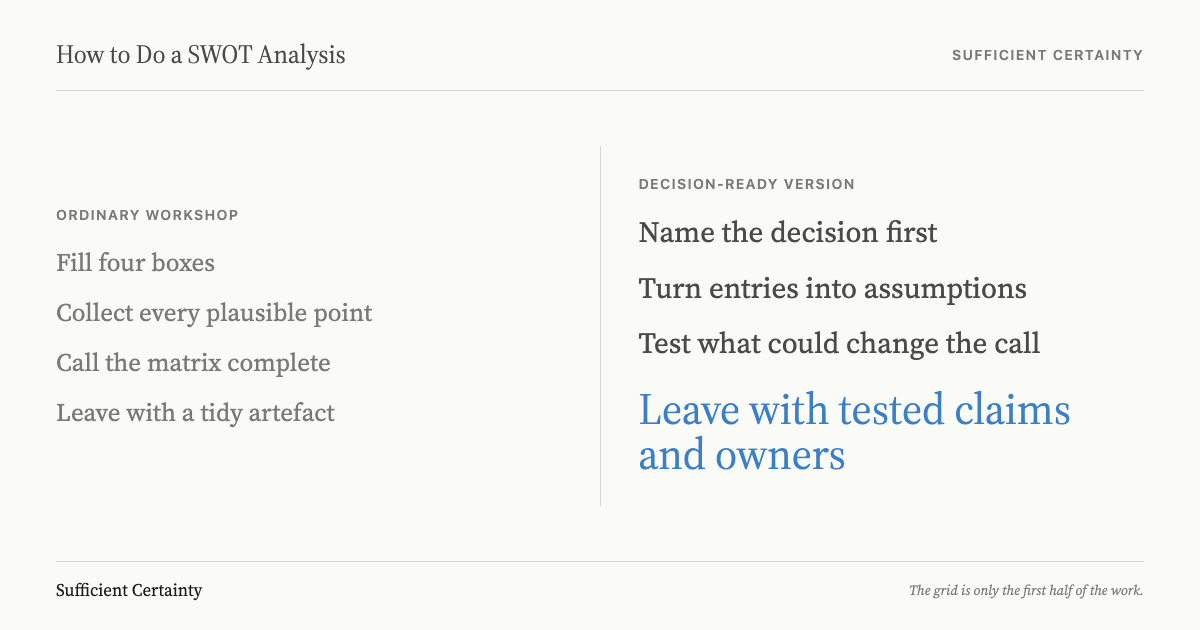
Fill the four boxes, then distrust the neatness
The familiar matrix still has a role. Strengths and weaknesses describe internal conditions. Opportunities and threats describe external conditions. A standard guide such as Smartsheet's SWOT walkthrough is right about the basic mechanics: assemble the team, draw the matrix, write observations, summarise the findings, and choose next steps. The mechanics are not the problem.
The problem is the visual trick. Once an item sits in a quadrant, it looks as settled as every other item. "Strong brand" sits beside "cash constraint" as though both have the same evidential weight. "New regulation" sits beside "emerging customer segment" as though both have the same timing and force. The grid is democratic in the worst possible way. It gives weak claims equal typography.
Terry Hill and Roy Westbrook saw this defect clearly. Their 1997 paper, "SWOT Analysis: It's Time for a Product Recall", examined how UK companies used SWOT in practice. Workshops generated long outputs, often more than 40 items. None of the companies used those outputs in later strategy formulation. That should make every cheerful template vendor pause. It usually does not.
When I run the exercise, I limit each quadrant to the entries that might affect the decision. If a point is interesting but would not change the recommendation, park it. If a point is true but too small to matter, record it and move on. SWOT should expose the few claims worth testing, not reward the person who can name the most factors before lunch.
Take the matrix from your workshop and set the go-no-go rule before another neat box breeds more analysis. Start the Walk →
How to do a SWOT analysis after the matrix is full
The second half is where the work starts. For every useful entry, write the assumption underneath it. "Strong brand" becomes: we assume customers still trust this brand enough to pay a premium in the new channel. "Low-cost supplier" becomes: we assume the supplier can hold price and quality at the higher volume. That is exactly the sort of dependency tested in bargaining power of suppliers. "Growing market" becomes: we assume demand is growing in the segment we can actually serve. The cost of skipping this rewrite is visible in organisations that committed strategy to entries nobody tested.
This shift changes the room. It is the same discipline I use for assumptions in decision making. A category invites agreement. An assumption invites testing. That is why people prefer categories. They are safer. Nobody has to admit that the attractive entry in the opportunity box rests on one survey, two anecdotes, and the sales director's optimism. The matrix smiles politely and lets the claim pass.
Pickton and Wright warned in their critique of SWOT in strategic analysis that simplistic use can produce unstructured data and weak conclusions. I think the repair is plain: separate evidence from belief. Beside each entry, ask what evidence supports it, how current that evidence is, what has to remain true, and what would show the claim has failed.
Then rank the assumptions by influence and confidence. Influence asks how much the decision changes if the assumption is wrong. Confidence asks how good the evidence is. High influence with low confidence is the danger zone. That is where testing belongs. Low influence with high confidence can sit quietly. Not every assumption deserves a research project. Some deserve a note and the courtesy of being ignored. The full sequence for turning a SWOT into a decision starts here: rate, test, then commit.
This is also the point where a SWOT exercise connects to SWOT analysis as a broader problem. The grid sorts what the room thinks it knows. It cannot tell the room which belief is carrying the decision. You have to add that discipline yourself.
Set the go-no-go rule before more analysis breeds
A good SWOT meeting should leave with a short test list, not a request for endless research. Ask which missing evidence would change the decision. If the answer is "none of it," stop asking for evidence and make the call. If one assumption could change the recommendation, test that assumption first. This is what sufficient certainty is for: not perfect knowledge, but enough tested judgement to act without pretending certainty has arrived.
Helms and Nixon's review, "Exploring SWOT analysis: where are we now?", found SWOT widely used across the strategy literature while still lacking strong proof of strategic effectiveness. That combination is not unusual in management. A tool becomes familiar, then familiarity gets mistaken for evidence. Very convenient, especially for people who sell workshops.
Write the go-no-go rule in the room. If customer-switching evidence reaches this level, we proceed. If supplier capacity fails this test, we delay or change scope. If the regulatory trigger appears before approval, the recommendation returns to the sponsor. A go-no-go rule turns the SWOT from a wall chart into a working instrument. It also gives the team permission to stop collecting decorative facts.
This is close to how to do a situation analysis properly. Gather the context, then decide which assumptions deserve attention. The danger in both exercises is the same: a larger worksheet can feel like better judgement. Often it is just a larger worksheet.
Leave with owners, signals, and a review date
The last step is monitoring. Take one ordinary entry: Strength, trusted brand in the existing channel. That is not yet useful. Turn it into an assumption: buyers in the new channel will still trust the brand enough to pay the same premium. Then name the evidence: repeat-purchase data from the old channel, a two-week conversion test in the new channel, and actual price realised after discounting. Now write the go-no-go rule: proceed only if conversion stays within 10 percent of the current channel and gross margin holds. Finally, give it an owner: the commercial lead watches conversion and price weekly until the launch review. One line has moved from optimism to management.
This is where a practical SWOT separates itself from theatre. Each critical assumption needs an owner, a signal, a cadence, and a pre-agreed response. Without those four, the matrix becomes an archive artefact. People will cite it later as evidence that they did the work. They did not. They completed the paperwork.
I would put the final output on one page. Not the decorated matrix. This table. It is close to a decision record, stripped down to the live claims the SWOT exposed.
| Line | What to write | Example |
|---|---|---|
| Decision | The choice this SWOT supports | Launch the offer in Q3 |
| SWOT entry | The useful item from the matrix | Strength: trusted brand |
| Assumption | What must be true for the entry to matter | New-channel buyers will still pay a premium |
| Evidence | The proof or test needed before approval | Two-week conversion and price test |
| Go-no-go rule | The threshold for proceed, change, or stop | Proceed if conversion stays within 10 percent and margin holds |
| Owner | Who watches the signal after approval | Commercial lead reviews weekly until launch |
That page is far more useful than a beautiful 20-item grid. It tells the room what it believes, what it knows, what it will test, and what it will watch after the decision moves.
If you want the full sequence, the Universal Decision-Making Method begins where ordinary SWOT ends. It forces the frame, draws out options, tests assumptions, states sufficient certainty, and keeps monitoring attached to the decision. SWOT can feed that process. It should not replace it. When the decision calls for a different tool altogether, the choice depends on the type of uncertainty the team faces.
So, how to do a SWOT analysis? Fill the boxes, by all means. Then make every useful entry earn its place. Ask what it assumes, how much it matters, how confident you are, what would change the decision, and who will know when the world has moved.
You could fill the matrix and still leave Friday's recommendation untested.
Work through your decisionNo sign-up. Just pick your decision and start.
Grant Purdy is the co-author, with Roger Estall, of Deciding (2020), and the architect of the Universal Decision-Making Method.