
After technical due diligence, mark the findings that could stop the proposed purchase or rollout. Canada launched its Phoenix pay system in 2016, and tens of thousands of federal employees were subsequently paid incorrectly or late. Its 2018 implementation audit examined what officials knew before launch. The case shows why a technical finding must be judged against the commitment it supports.
The practical question is whether the available evidence justifies putting this technology into the intended operation. A supplier's assurance can direct further enquiry. It cannot replace a result from the conditions that matter.
Technical due diligence examines technology and its supporting capabilities to inform a proposed purchase, investment or implementation.
Phoenix launched without proof of whole-system readiness
Public Services and Procurement Canada commissioned IBM to help build and implement Phoenix using customized PeopleSoft software. The first launch wave began on 24 February 2016. The Auditor General's 2018 report found that officials had neither tested the whole system nor completed final testing by pay advisors. A planned departmental pilot had been cancelled in June 2015 because of critical defects and stability problems.
Gartner delivered a readiness assessment on 11 February 2016. It warned that incomplete testing and unresolved defects threatened accurate, timely pay. It recommended gradual implementation and parallel operation with the old system. The audit found that Phoenix executives did not consider its findings before implementation.
This was a software acquisition and readiness decision. It is an analogy for technical due diligence, rather than an acquisition of a company. The sources do not establish that a formal technical due diligence report was completed. They do establish a decision to depend on technology while important readiness questions remained unresolved.
The distinction matters to a buyer considering technology today. A review might examine a working product in the supplier's environment. The proposed commitment may require that product to exchange data with the buyer's systems. Confidence in the first situation does not settle performance in the second. Evidence must cover the intended operation. The required test depends on what changes between those situations. Where launch depends on patent clearance, the follow-up to a freedom-to-operate analysis checks whether counsel reviewed the product version and activity being proposed.
The Public Accounts Committee's follow-up report also described interference with the external readiness review. Only project staff were interviewed, excluding departmental representatives. Its positive conclusion conflicted with concerns in its own findings. The existence of a review therefore needed to be distinguished from the strength of its evidence.
For a present-day decision-maker, this creates a specific task. Read the conclusion beside the observations that support it. Where a reviewer says a system is ready, check which users and interfaces were included. Ask what was demonstrated by operation and what was inferred from interviews. A broad conclusion needs support beyond the narrowest successful demonstration.
A properly run pilot could have produced more relevant evidence. It would still have had limits. Results from a simple department could not settle every question about more complicated pay arrangements. Similarly, a small customer trial can justify learning from that trial without justifying immediate expansion to every customer. Readiness depends on the proposed scale.
Before approving a comparable rollout, identify the missing result that would change the decision. That might be a complete transaction through connected systems. It might be a recovery exercise showing that operators can restore service without losing records. The question concerns observable technical performance, rather than whether another meeting has approved the plan.
This is a narrower application of the wider due diligence review. Technical findings determine whether the proposed operation is supportable. Financial findings answer different questions. A strong financial case cannot establish that a migration will preserve data or that a service will recover after failure.
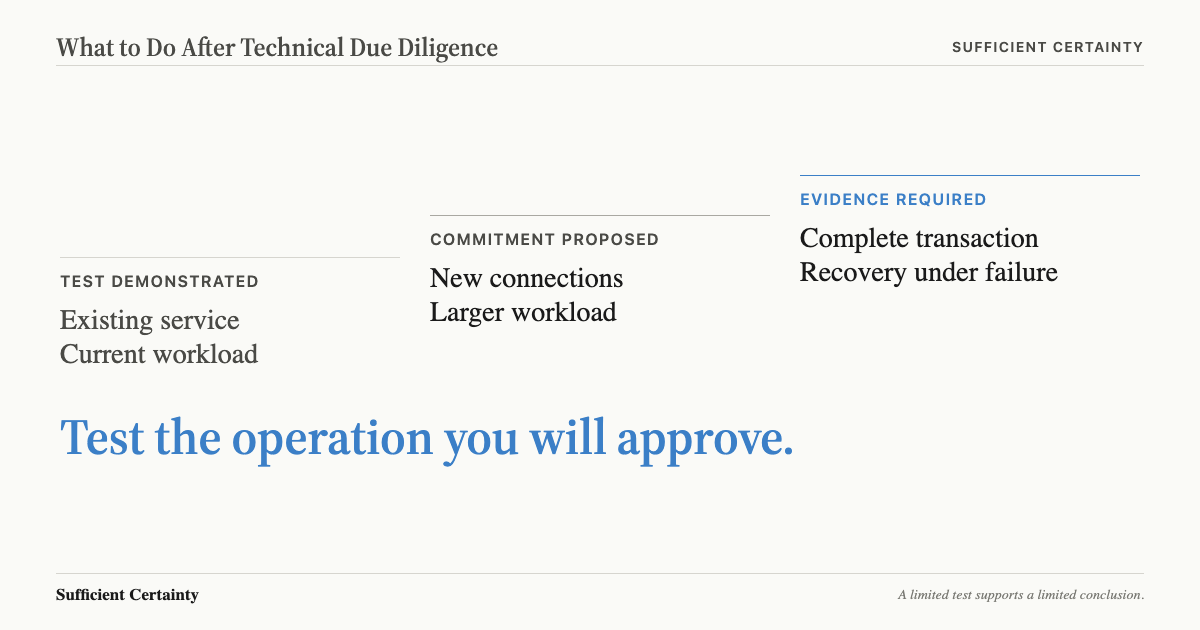
Phoenix does not prove that one additional checkpoint would have prevented every failure. The useful lesson is that missing whole-system evidence mattered before launch. A recommendation should make that gap visible while a smaller commitment or a delay remains possible.
Use The Walk to record what technical evidence justifies your proposed integration. Start the Walk →
What can a technical report justify?
A well-scoped technical review can change the decision. It can reveal unsupported software that needs replacement. It can identify a dependency whose owner will not permit the intended use. It can show that maintenance requires skills the buyer lacks. These findings help distinguish a technology that can serve the purpose from one that requires a different plan.
The report can also establish useful strengths. Reviewers may reproduce a working build or confirm that important records can be exported. They may inspect test results for a critical function. Each result has a scope. A successful test has boundaries. Record the software version and conditions before carrying its conclusion into a proposal. This is evidence-based decision-making applied to the technical claim being made.
NIST's Secure Software Development Framework gives purchasers a common vocabulary for discussions with software suppliers. That helps make security questions more specific. It does not establish that a particular product meets the buyer's needs. The buyer still needs evidence relevant to the product and use being contemplated.
Consider a hypothetical review that confirms successful transactions under the supplier's current workload. A proposed integration would introduce new connections and a different workload. The report is useful, but the expansion needs evidence about those changed conditions. Treating that distinction clearly is part of situation analysis.
Do not convert every technical weakness into a reason to stop. An isolated defect with a demonstrated workaround may be acceptable for a limited trial. An unresolved data-loss problem may undermine the entire service. Consequences determine the evidence needed. The decision-maker must judge the difference, with technical specialists explaining the likely failure and available controls.
This makes how much due diligence is enough a question about the commitment. Further investigation is useful when its result could change that commitment. Repeating a test whose result would change nothing adds work without resolving the important uncertainty.
Match the evidence to the commitment
Take the marked findings into the proposal before signing the purchase agreement or approving the rollout. Beside each finding, state the operation it affects. Replace “integration concern” with the particular connection and transaction that could fail. Replace “scalability concern” with the workload the service must handle and the result required.
For each consequential finding, specify an observable result that would justify proceeding. A migration question may require reconciliation of transferred records. An operability question may require the receiving team to restore the service from backup. Google describes launch preparation that covers reliability and practical technical actions. Select actions that answer the unresolved question in this proposal.
Set the acceptance condition before testing. Otherwise, a convenient result can become the definition of success. For a critical connection, specify the required transaction and acceptable handling of failure. Have the technical owner explain why those conditions are relevant. Have the decision-maker explain why meeting them would be sufficient for the commitment.
Approve the combined service using results from the standalone product. The new connection reaches customers before its failure handling has been demonstrated.
Require a complete transaction and recovery test through the new connection. Use the result to decide whether to approve a limited rollout.
The Universal Decision-Making Method asks whether sufficient certainty has been reached before implementation. Here, sufficient means enough evidence for this operation at this scale. Reduce the commitment when evidence is limited. A trial with recoverable data may be supportable while a permanent migration remains unjustified.
Make the record usable by the people receiving the technology. Include the acceptance result and its limits. Name who will check performance after handover. State what change in workload or software requires a fresh check. This carries the technical conclusion into operation without treating the review as permanently valid.
A supplier may be unable to provide the required access before purchase. State that constraint explicitly. Consider a conditional commitment or defer the integration while the service operates separately. Contract protection can allocate some costs, but it cannot demonstrate recovery. A warranty does not restore lost records.
The stopping point is explained in having enough information to decide. Stop collecting evidence when the important technical questions are sufficiently resolved for the proposed commitment. Close the consequential gap first. Leave minor improvements for implementation only when they do not undermine the operation being approved.
How much of the proposed integration depends on technical performance the review has not demonstrated?
Work through your decisionNo sign-up. Just pick your decision and start.
Grant Purdy is the co-author, with Roger Estall, of Deciding (2020), and the architect of the Universal Decision-Making Method.