
Accountability in the workplace only works when someone owned the call first. Most organisations skip that step. A launch date lands without a test, a staffing plan hardens because it came from someone senior, and the people who carry the consequences never had the authority to change the terms.
In 2016 the Wells Fargo board discovered that about 5,300 employees had been dismissed over five years for sales-practice breaches. By then the real decision had already been made, not by the teller at the counter, but by the people who kept blessing targets that should have been laughed out of the room. I see smaller versions of the same trick all the time, a launch date nobody tested or a staffing plan treated as fate because it came from somebody senior. That is how most organisations practise accountability in the workplace.
They start at the wrong end. By the time the blame arrives, the interesting work is over. Someone already turned a guess into a commitment, and everyone else is being judged inside the wreckage of that call.
Accountability in the workplace is the practice of making one person answerable for a work decision, including why it was made and how it will be checked.
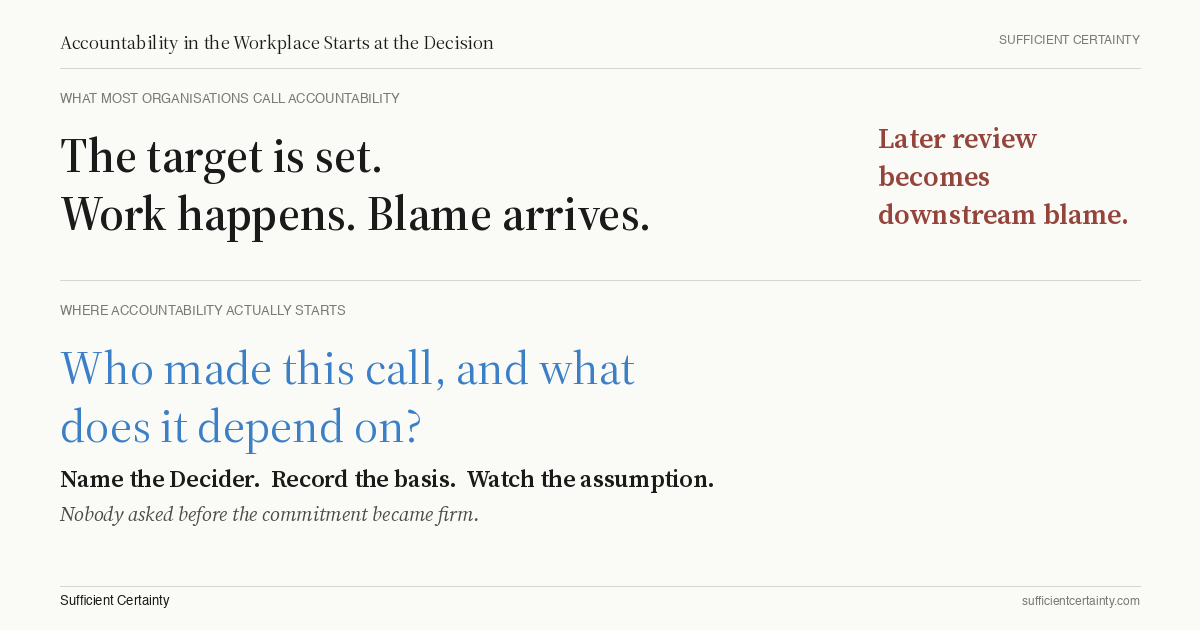
Why accountability in the workplace usually arrives too late
Late accountability is punitive because it arrives after the organisation has already decided what may no longer be worth defending. The 2017 Wells Fargo board report matters for that reason. It describes unrealistic sales goals and a management structure that kept deferring to the line while making slow little fixes around the edges. That arrangement suited the people who set the quota, because it let them keep the target while the branch level carried the stain.
This is why I have little patience for advice pieces that treat accountability as a character problem. A 2025 study in Public Management Review, based on 584 public employees, found that performance-based and transparency-based accountability systems aggravated job stress and health outcomes, while role clarity and job autonomy softened some of the harm. I would expect that. When people are answerable for outcomes they did not properly shape, accountability is just pressure moved downhill so the people who set the target can stay clean.
The usual fix is clearer goals and tighter follow-up, the cascade and check-in rhythm that follows OKR setting. Sometimes that helps. Sometimes the target itself is absurd, or the commitment is resting on an assumption nobody dared say aloud. That is why accountability in the workplace so often feels less like stewardship and more like a ritual for defending a bad call. In a bad accountability culture, the target survives long enough to land on a manager's review as if that were discipline.
Put the next workplace call on paper with one owner, the key assumption, and the signal that reopens it. Start the Walk →
Accountability in the workplace starts at the decision
The decisive moment is when someone says yes to the date or the quota. That is when I want accountability to become visible. One person needs the authority to make the call, and everyone in the room needs to know what question is actually being decided. Otherwise tasks get handed out while the judgment that created them floats off without an owner.
I start by naming who actually has the authority to make the call and what it is for. In the Universal Decision-Making Method those are the Deciders and the Purpose. Then I drag the main assumption into daylight before anyone starts promising delivery. If the room still wants one accountable owner, fine, but that person needs real authority, not ceremonial blame.
That is also the simplest way I know to explain the difference between accountability and responsibility. If the person carrying the deadline never owned the call, you have delegated labour and parked accountability nowhere.
I have sat in too many meetings where a commitment became firm because nobody senior wanted the awkward second question. A budget line turns into destiny. A dependency on another team disappears because reopening it would irritate the sponsor. Once that happens, the later performance review exists to protect the vanity of the person who announced the number first.
A decision nobody recorded cannot be owned later
If the work matters beyond the meeting, accountability in the workplace needs a record that outlives memory and rank. I do not mean a heroic stack of minutes. I mean something short that lets the next person see who made the call and what it depended on.
The NTSB's 2025 report on Alaska Airlines Flight 1282 is brutal on this. Investigators found no removal record for the step in which the 737-9 door plug was opened during rework. They also found that the relevant personnel could not say who opened it, and no quality-assurance inspection of the closure was performed because the disturbance was not formally recorded. Four bolts that should have prevented the plug's upward movement were missing before the accident sequence. I do not need to turn that into a grand theory of an undocumented decision trail. The simpler point is bad enough: later on, nobody could reliably reconstruct how the plug was disturbed or who later signed the work off.
That is why I keep coming back to the decision record. When a commitment survives handoffs or role changes, the record is what preserves the reasoning. Without it, the review becomes a contest between memory and hierarchy, and hierarchy usually wins.
Without monitoring, the commitment rots in silence
A workplace commitment stays accountable only if someone is watching the condition that could break it. I do not treat monitoring as admin at the tail end. It is the part that tells you whether the decision is beginning to rot while there is still time to do something about it.
The CrowdStrike root cause analysis reads like a process that looked mature right up to the moment it broke millions of machines. CrowdStrike said a content validator accepted 21 inputs while the interpreter expected 20, and the release process lacked a specific test for that case. Microsoft estimated the outage affected 8.5 million Windows devices. The release decision rested on an unstated assumption that the checks were strong enough, and they were not. Only after the outage did CrowdStrike tighten validation and slow exposure so customers had more control over when updates hit their systems.
Most organisations do something lazier. They wait for a dashboard to go red, or they trust an audit sample to tell them the commitment is still sound. It will not. Monitoring has to sit close to the assumption that could upset the result. If the plan depends on a supplier date, watch that date. If it depends on hiring, watch the hiring assumption. The same problem runs straight through accountability in leadership: the people who set the target stay clean while the people closest to the work carry the blame, and someone in HR tidies the paperwork and calls the arrangement accountability. Four cases, from a property algorithm to the Post Office Horizon scandal, trace the same pattern in accountability examples in the workplace. The same logic appears in decision science examples that show the work.
You could close this tab and carry that decision into another week.
Work through your decisionNo sign-up. Just pick your decision and start.
Grant Purdy is the co-author, with Roger Estall, of Deciding (2020), and the architect of the Universal Decision-Making Method.