
Collective decision making is a phrase organisations use when they want the comfort of shared ownership without the discipline of naming a decider. When nobody owns the call, nobody monitors what it rests on. The result is a room that agreed on Tuesday and cannot explain what went wrong by Thursday.
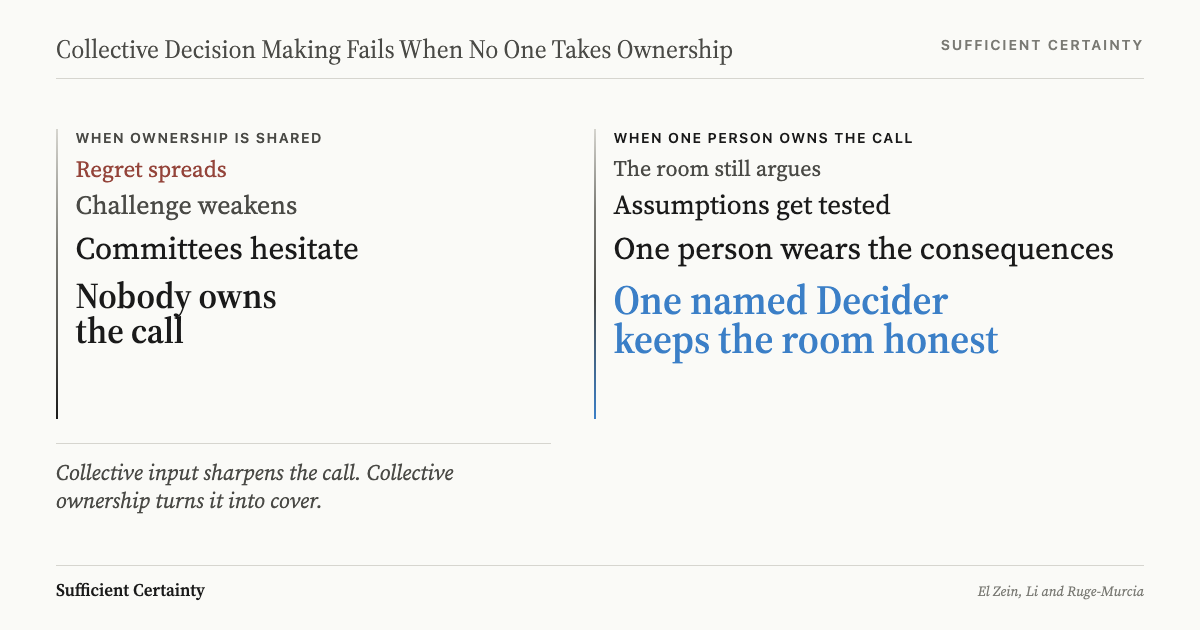
Collective decision making sounds democratic until you need to know who is accountable when the decision goes wrong. The phrase disguises the absence of a named decider. A group can contribute knowledge, test assumptions, and challenge framing, but the commitment belongs to one person who can state what was decided and what it assumed.
I once read a board paper on a shutdown decision that ended with the line "we decided". It ran to 38 pages, the outside adviser added 14 more, and the room left relieved because collective decision making had done its favourite trick: made everyone feel safer while leaving nobody exposed. When the numbers later missed, each person could point to the process and nobody could point to the owner.
In the Universal Decision-Making Method, a collective decision is a group conversation that tests assumptions while one Decider still has to wear the consequences.
After more than forty years around these rooms, I have become suspicious of the phrase "we decided". Roger Estall and I wrote Deciding because a group can sharpen a call brilliantly, or it can turn the whole thing into minutes and excuses. In my experience, once a paper starts praising "shared accountability", somebody is already looking for cover. I have sat in committees where the hidden objective was not to improve the decision but to spread the future blame as evenly as possible. Nobody says that aloud. They call it "good governance" and shuffle the paper.
Collective decision making is a group process that only works when one person is named as the owner who will act on the result and fix it if conditions change.
Collective decision making often spreads regret
People do not join groups only to improve judgment. They join them because being wrong alone stings.
Marwa El Zein and Bahador Bahrami ran two experiments, one with 125 people and another with 496, where participants could decide alone or step into a five-person majority vote before choosing between risky lotteries. After a bad outcome, people were more likely to move from solo choice to the group. Group choices were less driven by anticipated regret than solo choices. The experiment used lotteries, but the instinct behind it is pure boardroom.
I read that and thought, yes, of course. A collective can work like emotional insurance. The bruise is shared and the apology is diluted. The meeting then feels wiser than it is, which suits the committee pack nicely. In my experience, that is the moment the room stops testing the assumption and starts protecting itself. I have seen big investment decisions handled exactly this way. Once the mood in the room matters more than the truth of the assumption, the decision is already sliding off the rails.
Some collective decision making is just regret laundering with better stationery.
Put the committee decision in front of you through the five steps and name the person who owns the consequences. Start the Walk →
Collective decision making still needs one owner
One named owner makes the room work harder. Shared responsibility lets people hide behind the furniture.
Yue Li and Wendelin Schnedler modelled team decisions where credit and blame shape how much effort people put into improving the answer. Their result was clear enough: when responsibility is shared by everyone, effort weakens and free-riding gets easier. Name one responsible person and the problem improves.
That matches what I have seen for decades. Once the downside can be spread across six signatures, each person can challenge less and still feel protected. The meeting becomes a shelter from regret, and the weak assumption gets to stay in the room. Everyone can later point to the careful process, which is another way of saying nobody had to stand in the blast alone. The better arrangement is structured challenge: the group attacks the reasoning, then one person carries the call. A program director once complained to his board that I do not believe in collective ownership. He was half right. I am severe on it because shared cover is exactly what makes these decisions go soft. When the room knows one person cannot borrow the committee for shelter, the questions get harder and more useful. People stop speaking like future defendants and start speaking like challengers. This is why any serious collaborative decision making model keeps ownership visible from start to finish.
Committees make caution look wise
Francisco Ruge-Murcia and Alessandro Riboni studied what happened after the Bank of Israel moved interest-rate decisions in 2010 from one governor to a committee, while keeping the same governor in office. The committee changed rates less often and by smaller amounts. Add a committee, keep the governor, get more hesitation. That is the useful point.
I have watched the same trick in boards for years. Once nobody owns the stop-go call, postponement can pass for prudence. The pack gets fatter. The consultant gets another invoice, and the room congratulates itself for being careful. That is how groupthink in decision making survives in respectable clothes. The machinery loves this arrangement. It keeps moving even while nobody is actually deciding. It usually looks like lanyards and spreadsheets, all pretending caution is the same as judgment.
I see the same habit in weekly operating meetings. The spreadsheet gets another tab and nobody says stop. The team calls that care. That is why so few groups manage effective decision making in teams even while the agenda looks immaculate. A tidy agenda is not a decision. It is often just camouflage.
Blurred authority fails when the moment comes
The Transportation Safety Board of Canada said exactly that after the 2020 collision between the bulk carrier Florence Spirit and the tanker Alanis in the Welland Canal. A master and a piloting master were both involved in navigating the vessel. There were no injuries or pollution, but both ships suffered extensive damage. The board found that diffused responsibility meant each assumed the other was intervening, so communication and coordination failed when they were needed. Both men were competent. Competence did not rescue them from blurred authority.
If two qualified mariners can watch the same stretch of water and each assume the other is acting, imagine what a ten-person committee can do with a capital request and a forecast. A live decision needs structured challenge and one person who cannot hide when the moment comes. Without that, the committee becomes a waiting room for shared regret. The group calls it consensus, but it never tested the strongest objection.
When I hear that collective decision making has "full buy-in", I ask a ruder question: who is watching the assumptions now? If the answer is "the group", nobody is watching. That is what most collective ownership amounts to. If you want the wider case against this machinery, read the case against collaborative decision making.
You could leave with a collective decision and nobody left owning tomorrow's miss.
Work through your decisionNo sign-up. Just pick your decision and start.
Grant Purdy is the co-author, with Roger Estall, of Deciding (2020), and the architect of the Universal Decision-Making Method.