
Sound judgment is not a character trait or instinct. It is the ability to find the one claim a decision depends on and test whether that claim is true before you commit. Everyone agrees it matters. Almost nobody can describe what it contains.
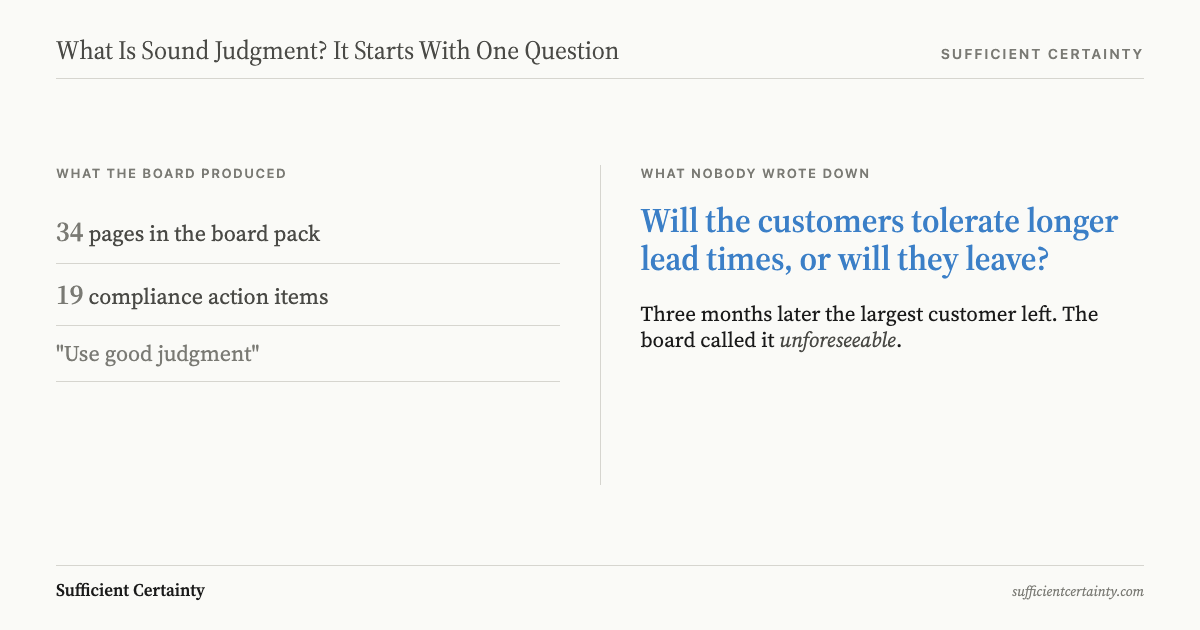
I sat through a board meeting where the recommendation was to close a plant. The pack ran to 34 pages, the compliance paper had 19 action items, and near the end the chair told the room to use good judgment. Nobody asked the only question that mattered: will the customers tolerate longer lead times, or will they leave?
Three months later the largest customer left. The board called it unforeseeable. It was not unforeseeable. It was unasked. The question had been sitting underneath the recommendation the whole time, and nobody had written it down.
People call judgment a trait because that flatters veterans and saves organisations from having to teach a method. I make the wider case in the piece on sound judgment. Here I want the narrower answer: what does the phrase mean when a real decision is on the table?
Sound judgment is the ability to see what a decision depends on and test whether that thing is true before you commit.
What sound judgment actually is
The dictionary usually goes in a circle. Judgment becomes the ability to make considered decisions, and considered decisions become the proof that someone has judgment. That is verbal fog. Aristotle's idea of phronesis is closer to the mark because it deals with practical judgment in a particular situation, not abstract cleverness. I have spent too long watching clever people explain themselves into a hole to confuse the two.
I know how slippery the word is because I helped develop ISO 31000. The standard tells people to use expert judgment in several places and never tells them how to produce it. That is not a drafting quirk. It is the whole racket in miniature. Standards writers get to sound precise while staying vague where it counts, which is a fine arrangement if your business is governance paperwork. Leave the word undefined and chairs get cover while consultants keep selling seriousness without showing the live bet.
So when I say judgment, I mean something rougher than reputation. I mean the moment a decision stops leaning on status and starts answering for the claim that has to be true. I have watched rooms go quiet when that claim is written in plain English, because the fog stops protecting the people who were hiding in it. The art-versus-science split is one shape of that fog: both camps pretend the other side owns the assumption.
Why experience does not guarantee good judgment
Experience helps only when it is tied to method. On its own it hardens into habit, and habit is often just memory wearing a tie. Pilots have a blunt label for one failure, got-to-get-there-itis. An experienced captain sees weather closing in, feels the timetable pressing on him, and keeps going. Thousands of flight hours do not save him once momentum has taken the controls.
I have seen the same thing in executive teams. Someone did a similar deal ten years ago, so the room borrows that certainty instead of examining the facts in front of it. I do not dismiss Kahneman and Tversky's work on bias, or Likierman's checklist of judgment elements. I am saying both are often used as tidy products for people who prefer respectable language to the harder job. Bias catalogues and leadership checklists are very saleable when nobody insists on writing down the unproven claim carrying the recommendation.
Name the question your current decision depends on and test whether experience is masking the thing that matters. Start the Walk →
What good judgment tests
Judgment works on assumptions. Every decision rests on a sentence about the future, usually one nobody has bothered to write down. A plant closure recommendation, for example, may rest on the claim that orders will not come back and customers will tolerate longer lead times. The work is to drag that sentence into the open and see whether it survives. That is the part of the Universal Decision-Making Method that most rooms avoid, because once the bet is visible it can be challenged.
I set out the formal distinction in judgment and decision making. The short version is simpler. Decision making is the whole job. Judgment is the quality of thought inside it, especially around the claim that has to be true for the preferred answer to work. In my experience, the better question in a room is not the old slogan about assumptions. It is this: which unproven claim is carrying this recommendation?
How sound judgment becomes visible
You can see it before the outcome arrives. A room using it can name the decision and the live assumption. It can also say what fact would force a rethink and who will watch that assumption after the decision. The clearest examples all share that trace. When it is missing, people are usually admiring confidence, or protecting seniority, or both. I wrote more about that in judgment failures in leadership, because boardrooms are where this confusion does the most expensive damage.
Governance language often makes the problem worse. The Australian business judgment rule, in section 180(2) of the Corporations Act, gives directors protection when they act in good faith and can rationally say the call served the company after informing themselves. Fine as legal shelter. It still does not tell a board how to expose the assumption underneath a proposal. So boards do what institutions usually do when a standard is vague: they buy paperwork. I have seen board packs run past 200 pages and still avoid the only sentence that mattered. The revenue claim turns into a chart and the customer assumption turns into a confidence range, so nobody says plainly what has to be true. That suits chairs who want procedural cover and the compliance industry that sells it, while the central claim goes untouched.
You can learn the practice, but not from flattering myths about seasoned instinct. I explain the working habit in practical ways to develop judgment. Learning it means comparing the claim you backed with what later happened, then adjusting how you decide next time. The trait story survives because it flatters veterans and protects committees from showing their reasoning. Real judgment is plainer than that. You show the bet, and you live with whether the assumption holds.
You could call for good judgment and still leave the real question unasked.
Work through your decisionNo sign-up. Just pick your decision and start.
Grant Purdy is the co-author, with Roger Estall, of Deciding (2020), and the architect of the Universal Decision-Making Method.