
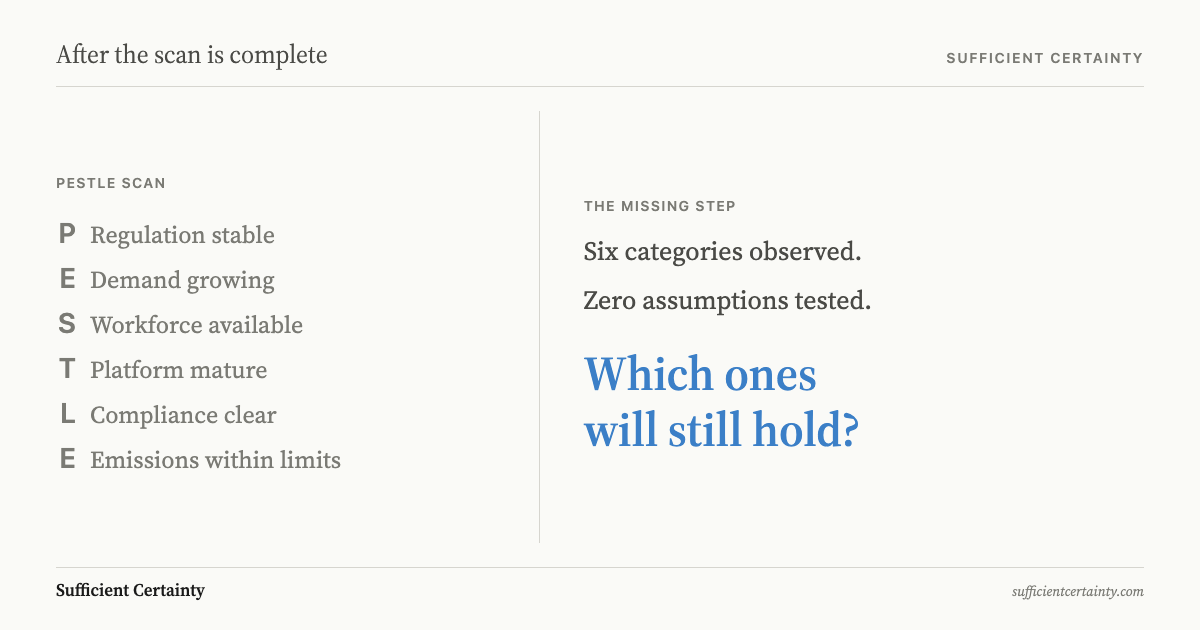
After a PESTLE analysis, most teams feed their categorised findings into strategy formulation or a risk register and move on. The step they skip is testing whether the external conditions they catalogued will actually hold long enough to act on.
PESTLE analysis scans the external environment across six categories to produce an inventory of conditions that might affect a decision.
The standard next step after a PESTLE analysis
The textbook answer is straightforward. Once the six-category scan is complete, the outputs feed into one of three downstream processes.
The most common is integration with SWOT. PESTLE findings populate the Opportunities and Threats quadrants, giving them external grounding. A team that flagged "rising interest rates" under Economic factors slots that into Threats; "regulatory simplification" under Political goes into Opportunities. The combined SWOT then shapes strategy. Teams that want more on this pairing can start with the PESTEL analysis framework, which covers how the two tools relate and where each one stops.
The second path is a risk register. Each PESTLE factor gets rated for likelihood and impact, producing a prioritised list of external risks. Project managers and compliance teams favour this route because it connects to existing governance structures. The logic traces back to Aguilar's (1967) original framework for environmental scanning, which treated the scan itself as the hard part. Once you had the data, the assumption went, processing it was mechanical.
The third is scenario planning. Teams cluster their PESTLE findings into two or three plausible futures and stress-test their strategy against each one. This approach appears more often in industries with long capital cycles: energy, infrastructure, pharmaceuticals. Each scenario reweights the same PESTLE factors under different conditions, asking what the strategy looks like if the regulatory environment shifts or if economic factors turn hostile.
All three paths share one feature: they treat PESTLE outputs as established facts that can be directly processed. The economic environment is "challenging." The regulatory outlook is "stable." The social trend is "toward sustainability." These statements enter the next framework as inputs, not hypotheses.
What that step adds
The standard next steps are not wrong. They add genuine structure to what would otherwise be a loose collection of observations.
SWOT integration forces prioritisation. A PESTLE scan can produce dozens of factors across six categories. Without a mechanism for sorting them by relevance, the scan becomes an inventory without direction. Mapping factors to opportunities and threats imposes a filter: which of these actually touch the decision at hand? Teams working through both tools together will find the post-SWOT process faces the same structural question.
Risk registers add accountability. Each factor gets an owner, a review date, and a response plan. For organisations operating under formal governance requirements, this step is often mandatory. It turns a strategic exercise into an auditable record.
Scenario planning adds resilience. Instead of betting on a single reading of the environment, teams explore what happens if their assumptions shift. If interest rates rise faster than expected, does the investment case collapse? If a competitor enters the market sooner than projected, does the social trend they identified still favour their position?
Each of these downstream steps converts raw environmental data into something actionable. That conversion is necessary. The problem is not what these steps do. It is what they leave untouched.
Write down the PESTLE factor your strategy depends on most and ask who tested whether it will hold through the life of the decision. Start the Walk →
Where the standard playbook breaks down
The gap is consistent across all three paths. None of them tests whether the PESTLE findings themselves are reliable enough to build on.
Consider a standard PESTLE output: "The regulatory environment in this market is stable." That finding might rest on several embedded assumptions: the current government will maintain its policy stance, enforcement agencies will continue interpreting regulations the same way, and no pending legislation will alter the landscape within the decision's timeline. If any of those assumptions fails, every downstream analysis built on that finding is compromised.
This is not a theoretical risk. Walmart's entry into Germany between 1997 and 2006 illustrates the failure pattern precisely.
Walmart acquired two German retail chains, Wertkauf and Interspar, and set about replicating its US operating model. A PESTLE-style environmental scan would have catalogued the relevant factors: Germany's competition law framework (Legal), consumer shopping habits (Social), labour market regulations (Legal/Political), and the competitive landscape dominated by hard discounters Aldi and Lidl (Economic). The scan would have been accurate. What went untested were the assumptions behind it.
Under Social factors, Walmart assumed German consumers would respond to American-style service: greeters at the door, employees packing bags, mandatory smiling. German shoppers found this off-putting. Under Legal and Political factors, Walmart assumed its below-cost pricing strategy, a core competitive weapon in the US, would be permissible. The Bundeskartellamt, Germany's competition authority, ruled it illegal under the Act Against Restraints of Competition. Under the same Legal category, Walmart underestimated co-determination law, which gave works councils authority over store-level operational decisions that US managers expected to make unilaterally.
As Knorr and Arndt (2003) documented in their post-mortem, the failure was not a failure of scanning. It was a failure of assumption-testing. Every relevant factor appeared in the environmental analysis. None of the assumptions behind those factors were verified before Walmart committed over $1 billion to the market. Christopherson (2007) reached the same conclusion from a different angle: institutional barriers that any structured testing process would have surfaced were treated as implementation details. The company exited Germany in 2006, selling its 85 stores to Metro AG at a substantial loss.
The timeline shows the pattern. The scan was accurate. The assumptions behind it were invisible. The verification never happened. PESTLE identified the context that mattered. Nothing in the standard playbook required anyone to verify whether that context would hold.
The step to take first
Before feeding PESTLE outputs into SWOT, a risk register, or scenarios, test the assumptions embedded in each finding.
This is not an additional bureaucratic layer. It is the step that determines whether the downstream analysis has a foundation or a guess.
The method is straightforward. For each significant PESTLE finding, ask: what must be true for this to hold? A finding that "the technological environment favours digital adoption" depends on assumptions about infrastructure readiness, consumer capability, and competitor response timelines. Some of those assumptions can be verified quickly. Others require investigation. A few may be unverifiable, in which case the decision must account for that uncertainty rather than paper over it.
The test for each PESTLE factor: What must be true for this finding to hold through the life of the decision?
If the answer is verifiable, verify it. If it rests on speculation, the decision must account for that uncertainty. If nobody can articulate the assumption, the factor is not ready to act on.
The five-step method structures this work. The first step frames the decision: what specifically is being decided, and who has authority. The second identifies tentative elements: what factors appear relevant, drawn from any scanning tool including PESTLE. The third, and the one most often skipped, surfaces and tests assumptions. The fourth asks whether sufficient certainty exists to act. The fifth covers implementation and monitoring.
The critical shift is between step two and step three. PESTLE handles step two competently. It identifies relevant external factors across six well-defined categories. But identification is not verification. A factor that appears in a PESTLE matrix carries no guarantee that the conditions behind it will persist through the life of the decision.
Organisations that add assumption-testing between their situation analysis and their strategic response do not abandon PESTLE. They make it load-bearing. The scan still does its job: it ensures nothing in the external environment is overlooked. The assumption test ensures nothing in the scan is taken on faith.
You could close this tab and carry that decision into another week.
Work through your decisionNo sign-up. Just pick your decision and start.
Grant Purdy is the co-author, with Roger Estall, of Deciding (2020), and the architect of the Universal Decision-Making Method.