
In a 1983 study, Wind, Mahajan and Swire placed 15 business units of one Fortune 500 company on several standard portfolio grids. Where a unit landed depended on the model chosen and on how its dimensions were defined and measured.
What to do after a GE-McKinsey matrix is to size how much certainty each cell's recommendation needs before capital moves on it, starting with the factor weights behind the score.
The bubble can look settled long before it is.
The GE-McKinsey matrix is a nine-cell portfolio grid that scores business units on industry attractiveness and business-unit strength, each a weighted composite of several factors.
From factor sheet to capital paper
The matrix was developed with McKinsey for General Electric in the early 1970s, and the working method has barely changed. A team lists the factors that make an industry attractive: market size, growth, margins, competitive intensity, cyclicality, regulation. It lists the factors that make a business strong: share, cost position, brand, technology, distribution, management depth. Each factor gets a weight, each unit gets a rating from 1 to 5, and the weighted sums fix its position on each axis.
The output is a grid of bubbles, sized by revenue or market, sitting in one of three bands. The upper-left cells say invest and grow. The diagonal says hold selectively and manage for earnings. The lower-right cells say harvest or divest. The arithmetic is the same as any weighted decision matrix, scaled up to a whole portfolio.
What follows is capital allocation. Units in the invest cells get business cases, expansion budgets and acquisition mandates. Units in the harvest cells get cost targets and, often, a sale process. The strategy team writes a paper per unit, the board approves the allocation, and the cell becomes the justification for every number in the plan.
The nine-box forces a portfolio argument onto one page
Before the grid, a portfolio review is a series of pitches, each unit head arguing for a budget. The nine-box makes every unit answer the same questions on the same scale. That alone disciplines the conversation. A business that has grown on momentum has to show why its industry deserves a 4 on margins, and a team can no longer claim strength without naming the factor that supplies it.
It also improves on the two-axis grid it replaced. The BCG growth-share matrix reduces attractiveness to market growth and strength to relative share. The GE-McKinsey version admits that an industry can be attractive for reasons other than growth, and that a business can be strong without the biggest share. For strategic thinking about a diversified company, that breadth is a genuine gain.
Before any invest cell on your nine-box reaches the capital paper, find the factor that would sink the move on its own and ask how sure anyone is of its score. Start the Walk →
A weighted sum cannot see a locked gate
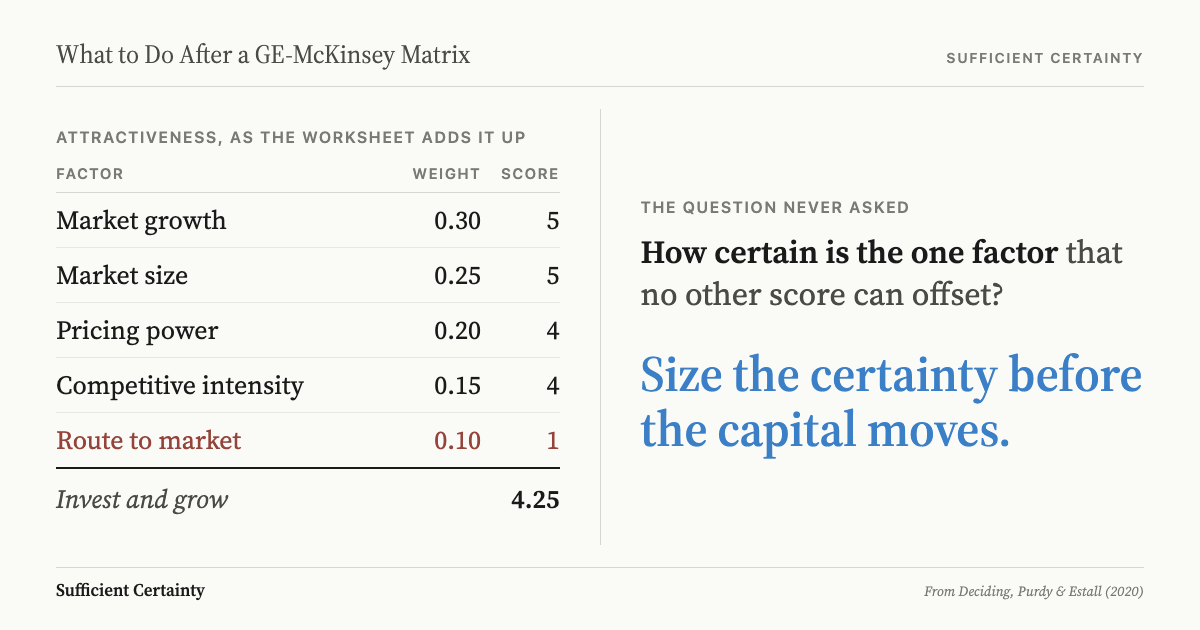
The breadth has a cost. Each axis is a compensatory score: a weak rating on one factor is offset by strong ratings on the others. That suits factors that genuinely trade off, such as thinner margins in a faster-growing market. It fails for factors that are preconditions. If the product cannot reach a customer, no amount of resource quality makes the business strong. A precondition is a gate, not a weight, and a weighted sum has no way to represent a gate.
The ratings compound the problem. Take an illustrative worksheet of twelve factors, six per axis. Four can draw on published figures: market size, market growth, industry margins and relative share, and even those carry the assumptions any market sizing exercise carries. The other eight are ratings agreed in a workshop, and every weight is chosen by the same people.
The number that comes out, a 3.7 on attractiveness, say, looks precise to one decimal place. Its precision is arithmetic. Its confidence was never measured, and nothing in the method asks whether that confidence matches the decision it will justify. The same tension sits under any multi-criteria decision analysis: the aggregation is rigorous, the inputs are opinions.
The missing question is proportion. A hold call on a small unit can rest on a rough score, because it is cheap to revisit. An invest call that commits billions to an asset that is hard to sell back needs certainty sized to the capital at stake, above all on any factor that acts as a gate.
Rio Tinto's Riversdale deal rested on a barge route that was never approved
In 2011 Rio Tinto bought Riversdale Mining, whose Benga and Zambeze coal projects sat in Mozambique's Tete province, completing the acquisition in August for about US$3.7 billion. The logic was the kind an invest cell rewards. Hard coking coal is scarce, sells at a premium to thermal coal and feeds steelmaking. Rio Tinto described the assets as one of the world's most prospective tier one coking coal developments.
The value depended on getting the coal to the coast. According to the SEC's 2017 complaint, the acquisition case assumed up to 30 million tonnes a year could be barged down the Zambezi River, with about 12 to 15 million tonnes more carried by existing rail. In August 2010 the company's own technical group had called the barging plan "only a concept" with potentially "showstopping" unknowns.
By October 2011, the complaint states, the company's logistics lead had put barging capacity at about 10 million tonnes a year. In December 2011 the Mozambique government formally rejected the barging proposal, citing 36 grounds. The complaint also alleges there was less coal, and of lower quality, than expected. In January 2013 Rio Tinto cut the assets' value by more than US$3 billion, over 80 per cent, and after a further write-down sold them for US$50 million in 2014.
The timing of that write-down drew regulators. The UK Financial Conduct Authority fined Rio Tinto £27.4 million in 2017 for breaching disclosure rules; Rio Tinto's announcement noted that the FCA made no finding of fraud. Rio Tinto settled the SEC case in 2023 for a US$28 million penalty, without admitting or denying the allegations.
There is no public record that Rio Tinto drew a nine-box. The deal is still the kind of multi-factor call the matrix formalises: an attractive market, and what would have scored strongly on resource size and position. Read that way, transport was a gate, not one factor among twelve. In a weighted sum, strong market and resource ratings dilute a doubtful transport rating. Treated as a gate, its certainty had to be sized against a multi-billion-dollar commitment that was hard to reverse.
Sizing the certainty behind each invest cell
Before the capital allocation paper for any invest cell goes to the board, pull the factor-weighting sheet behind that bubble. For each factor, mark whether its rating rests on published data or on workshop judgement. Then ask which factors are gates: conditions that, if false, make the business worth little regardless of every other score. Transport, permits, licences, recoverable reserves and a single dominant customer are common candidates.
Take the gates out of the weighted sum and state each one as an assumption. Then set the certainty each gate needs, in proportion to the capital at stake and how hard the move is to reverse. A reversible pilot can proceed on a plausible gate. A multi-billion-dollar acquisition cannot.
How sure must the team be of each gate factor before this score releases capital?
Then test the rest of the score. A sensitivity analysis on the weights shows whether the bubble changes cell when two or three weights move. If it does, the cell is an opinion, not a finding, and the paper should say so.
Where certainty on a gate is not yet sufficient, the choice is to gather evidence on it first or to restructure the commitment so it can be stopped. The Universal Decision-Making Method treats that threshold as a step of its own, and it applies across decision-making frameworks, not only portfolio grids.
Rio Tinto had an attractive coal market and a large coking-coal resource. What it didn't have was certainty that the coal could reach the sea.
Work through your decisionNo sign-up. Just pick your decision and start.
Grant Purdy is the co-author, with Roger Estall, of Deciding (2020), and the architect of the Universal Decision-Making Method.