
After an Ansoff matrix, test the assumptions behind the chosen quadrant, above all that existing capabilities will transfer and that the new market will behave like the home market, before any capital is committed. The quadrant label is one of those assumptions, and it rarely gets checked. Tesco took a grocery business it knew into a country it had studied for two years, and the exit cost £1.2bn.
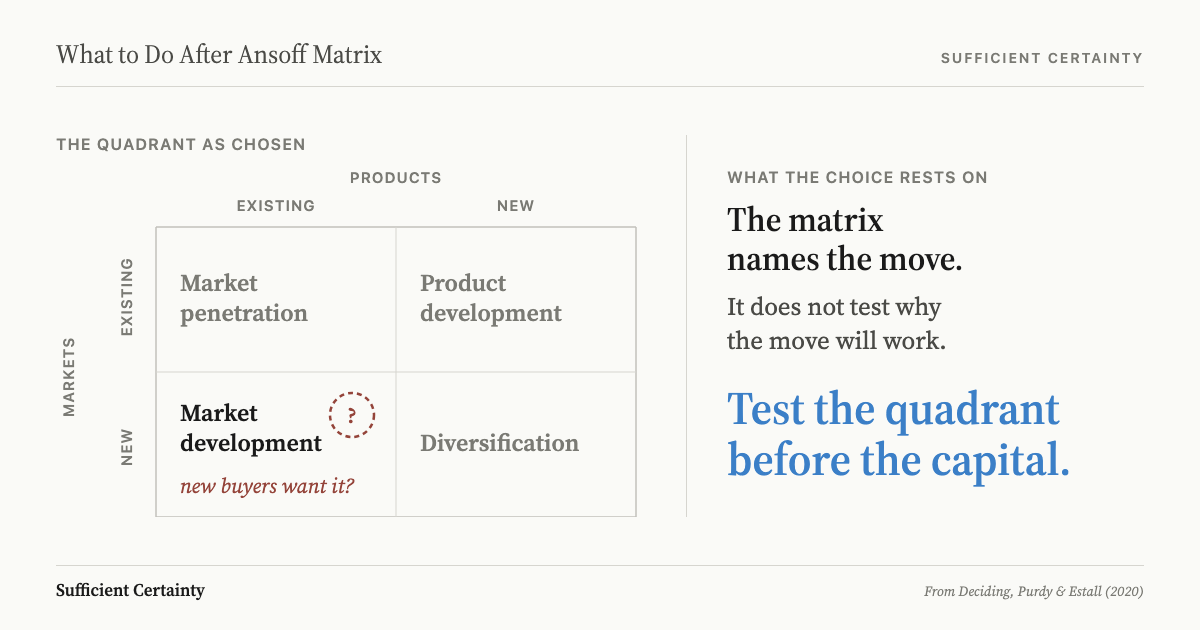
The Ansoff matrix is a two-by-two growth grid, from Igor Ansoff's 1957 work, that pairs existing or new products with existing or new markets to give four strategies.
The standard next step after an Ansoff matrix
Ansoff set out the grid in his 1957 Harvard Business Review article, "Strategies for Diversification". Market penetration sells more of the current product line to current customers. Market development adapts the present product line to new missions. Product development builds new products for the existing mission. Diversification departs from both at once, and Ansoff warned that it "generally requires new skills, new techniques, and new facilities."
Practitioners take the output in a familiar sequence. First, choose the quadrant, often by scoring each candidate move on attractiveness and fit. Second, build the business case: market size, share, margin, payback. Third, resource it: capital, people, supply chain and the capabilities the quadrant implies. Fourth, for any move into new markets, write the entry plan covering sites, format, pricing and the order in which regions open.
The inputs usually come from earlier work. A SWOT supplies the strengths the team intends to carry into the move. A PESTEL scan supplies conditions in the target market, including the economic factors that could sink an entry. The matrix sits on top as the organising frame.
By the end, the choice has a label, a number and a plan. Market development gets a regional rollout schedule. Product development gets an R&D budget. Diversification usually gets an acquisition screen. The label then decides how much scrutiny each plan receives. Penetration and market development are treated as the safer half of the grid, so their plans tend to move faster.
What that step adds
The sequence does real work. Growth routes compete for the same capital in the same budget round, and the matrix forces a choice among them instead of a little funding for each. Naming a quadrant makes a team say, in one line, what is new about the move: the product, the market, both or neither. Many strategy documents never manage that much clarity.
The ranking by familiarity is sound as far as it goes. Ansoff's point was that each step away from the current business asks the organisation to learn something it does not yet know. A board that sees "diversification" on a paper knows to ask harder questions than it would of a penetration plan. The business case then turns the choice into numbers a board can approve or reject, and the entry plan turns the numbers into dated actions someone owns.
The sequence also ties the growth choice to evidence gathered elsewhere, such as the incumbent strengths mapped in a competitor analysis. The matrix is good at naming how far a move sits from home; it cannot say whether the ground at the destination is what the plan assumes.
That missing evidence rarely gets requested, because the quadrant arrives looking like a classification rather than a forecast. A BCG matrix quadrant arrives the same way.
Write down what the new market has to do for your chosen quadrant to pay back, and ask who has tested it before the capital is committed. Start the Walk →
Where the standard playbook breaks down
The label is where the trouble starts. Market development assumes the product is known and only the market is new. Two assumptions ride inside that: that the capabilities which make the product work at home will transfer, and that customers in the new market will respond as customers at home do. The matrix records both as given.
Tesco's American venture shows what happens when they go untested at the scale of the commitment. Before launching Fresh & Easy, Tesco staff lived with families in California for two weeks and ran focus groups in a full-scale mock store hidden in a warehouse, according to a 2007 account from Arizona State's W. P. Carey School. The same account put the commitment at $2bn over five years, with a first distribution centre able to service 350 stores.
The research was thorough. What it put into the market was not a known product. Fresh & Easy was a new format, Tesco's sixth, built for American shoppers. On the grid it read as market development; in practice both the product and the market were new, which put it nearer the quadrant Ansoff said needs new skills, new techniques and new facilities.
| Existing products | New products | |
|---|---|---|
| Existing markets | Market penetrationLowest risk | Product developmentNew product, known customers |
| New markets | Market developmentFresh & Easy, as labelled → moves right once the format counts as new | DiversificationHighest risk: new skills, techniques, facilities |
Pace was the second assumption. At home, Tesco had grown Express, its closest format, cautiously: after the first store in 1994 it opened just two more the following year. The American launch in late 2007 came with plans for as many as 1,000 stores on the west coast and a projected break-even within about two years.
By the end of February 2009, 119 stores had opened and the chain had lost $208m in the year. Shoppers complained about self-service-only checkouts, small portions and short expiry dates. Fresh & Easy's chief executive blamed the economy. The format kept trading for four more years. When Tesco announced its exit in April 2013, the chain had 199 stores, around 5,000 staff and had never turned a profit.
The exit cost Tesco £1.2bn after tax, a figure reported from its 2012/13 results that combined £169m in trading losses with about £1bn in asset impairments and lease provisions. The research answered how Americans shop; the commitment assumed they would shop at Fresh & Easy, at the pace a 350-store distribution centre needed. Walmart's exit from Germany, traced in the assumptions behind a PESTLE analysis, followed a similar pattern.
The step to take first
The missing step sits between choosing the quadrant and approving the business case. It does not reopen the matrix. It asks what the chosen quadrant takes for granted. The five-step Universal Decision-Making Method gives it a sequence: Frame, Tentative Elements, Assumptions, Sufficient Certainty, then Implement and Monitor.
Frame states what the growth is for and what the organisation would accept losing to get it. The Tentative Elements are the quadrant, the target market and the entry format, held as proposals. Treat the quadrant as tentative too: classify the move again by asking, for product and market separately, what the organisation has actually done before.
The Assumptions come next, and most are never written down. For market development they include whether customers will use the product as customers at home do, whether the capability being carried depends on volumes the new market has not shown, and whether the rollout pace matches what is known rather than what is hoped.
Sufficient Certainty is a judgement made assumption by assumption, weighted by the cost of being wrong. The assumptions that carry the whole case need testing at a scale that can fail cheaply: a handful of sites, run long enough to show repeat custom, before infrastructure sized for hundreds. The size of the test should match the size of the assumption, not the size of the ambition.
Implement and Monitor closes the loop. Each critical assumption gets a named signal, such as repeat visits or sales per site against the case, and a threshold agreed before the next tranche of capital is released. That is strategic thinking applied to a growth grid. A quadrant is a hypothesis about familiarity, and the first sites are where it gets tested.
You could build the business case for your chosen quadrant and still leave the familiarity it assumes untested.
Work through your decisionNo sign-up. Just pick your decision and start.
Grant Purdy is the co-author, with Roger Estall, of Deciding (2020), and the architect of the Universal Decision-Making Method.