
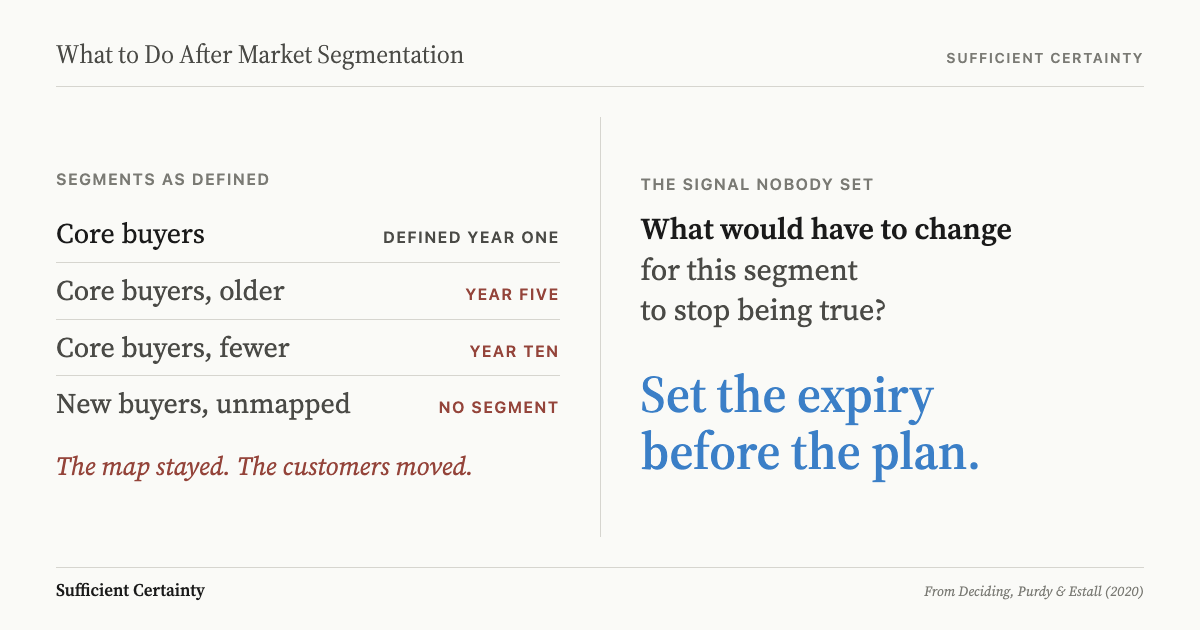
A market segmentation is at its most dangerous in the years it keeps working. The job after market segmentation is to write down, for each segment, the observable that would show its definition has expired, and the planning date on which someone checks it. Segments carry no end date of their own, so without that step they outlive the customers they were drawn to describe.
Market segmentation divides a market into groups of buyers with similar needs or behaviour, so each group can be served with its own product, price and message.
Turning named segments into targets, personas and territories
Once the segments are named, the work moves from analysis to allocation. Targeting comes first. Each segment is scored on size, growth, margin and fit, and the organisation picks the few it will serve. The scoring leans on estimates already built for the market as a whole, which is why the questions in what to do after market sizing tend to surface again here.
Personas follow. Each chosen segment becomes a character with an age band, a job, a set of frustrations and a buying trigger. Positioning statements are written per segment, and the media plan is split so that spend follows where each segment pays attention.
Sales and product then take their cut. Territories and account lists are redrawn so representatives call on segment members rather than postcodes. Product roadmaps are keyed to segment needs, with features justified by the share of a target segment that asked for them. By the end, the segment names are written into budgets and release plans, and often into job titles.
Measurement is set up last. Dashboards report revenue, share and campaign response by segment, and the segment becomes the unit in which progress is described to the board. From that point, questioning a segment means questioning the reporting built on it.
Each of these steps treats the segment as settled. The data behind it, the subject of what to do after market research, was collected in one period, and everything downstream inherits that period as if it were permanent.
A shared map keeps every function aiming at the same buyer
The value is real. Before segmentation, marketing, sales and product often work from different pictures of the customer, and budgets drift toward whoever argues loudest. A named segment gives all three one reference point. Resources concentrate instead of spreading thin across buyers who want incompatible things.
Done well, segmentation also exposes demand that averages hide. Yankelovich and Meer (2006) argued in Harvard Business Review that the technique earns its keep when it finds customers whose behaviour can be changed or whose needs are not being met, and that it loses its value when it drifts into profiling for advertising. A segmentation built on buying behaviour tells an organisation where effort will move revenue.
Segmentation also makes trade-offs visible. Choosing three segments means declining the rest, and a written segmentation lets a leadership team see what it has decided not to pursue. That is a stronger position than a plan aimed at an average buyer who rarely exists.
It also sharpens the argument about rivals. Once segments are defined, a competitive analysis can ask who wins each segment rather than who is biggest overall, and share within a segment becomes a number a board can track. Segment share is a legitimate measure of progress, provided the segment itself still holds.
Pick the segment your plan leans on hardest, write down the number that would show it has stopped describing your buyers, and put a date on the check. Start the Walk →
The Harley-Davidson rider who never left the map
Harley-Davidson segmented its home market in plain terms. Its Form 10-K for 2014 defined US core customers as Caucasian men over the age of 35, and US outreach customers as women, young adults aged 18 to 34, African-American adults and Latino adults. The filing reported that Harley led US new motorcycle registrations among core customers and in each outreach group.
The core definition had a floor and no ceiling. A man who bought at 40 in 1990 still counted as core at 65, whether or not he was still buying new motorcycles. Industry figures reported by the Associated Press in 2017 put the median age of US motorcycle owners at 47, up from 32 in 1990, and a retired Harley executive described ageing baby boomers leaving the sport because they could no longer handle the machines.
Registrations moved in one direction. The 2014 filing recorded 167,100 new Harley-Davidson registrations in the US over-600cc class, a 53.3 percent share. The Form 10-K for 2018 recorded 131,100 and a 49.7 percent share. Across the same years, total industry registrations in the class fell from 313,600 to 263,800.
The 2018 filing described the US motorcycle market as stagnant or declining and restated a 2027 objective to build two million new Harley-Davidson riders in the US, with the More Roads to Harley-Davidson plan to accelerate it. The Hardwire, announced in February 2021, concentrated on touring, large cruiser and trike models, which the company called its strongest and most profitable lines. Both plans answered a customer base that had changed while its definition stayed the same.
None of this depends on guessing what Harley knew internally. The point is narrower. A definition with no ceiling cannot report its own expiry, and leading an outreach group says nothing about whether that group is large enough to replace the buyers ageing out of the core.
What signal says a segment definition has expired?
Segment drift is not an edge case. Blocker and Flint (2007) treated customer segments as moving targets, unstable because the value customers seek changes over time. The practical response is to give every segment an expiry condition before the plan built on it is approved.
For each segment, write down one observable that would say the definition no longer describes real buyers. Useful candidates include the segment's share of new buyers rather than of the installed base, the median age or tenure of buyers entering the segment, and the share of revenue from customers who fit no defined segment. Each gets a threshold, agreed in advance, beyond which the segment is reopened rather than re-marketed.
Applied to a core segment like Harley's, an expiry line might read: the core definition reopens if the median age of new core buyers rises by five years across two plans, or if the core's share of new registrations falls three years running. The figures are illustrative. What matters is that they are written before the plan, by someone who will be asked about them later.
The trigger point matters as much as the observable. Check the expiry conditions at each annual plan, and again before the next product cycle is funded, because those are the moments when segment names turn into commitments. A group of buyers that fits no segment belongs on the same page, since it is often the first visible sign that the map has aged.
The same discipline applies when segments justify a move into a new country, the ground covered in what to do after a market entry analysis, or a new product-market combination chosen through an Ansoff matrix. Deciding in advance what would change the decision is the monitoring step of the Universal Decision-Making Method, and it sits at the centre of strategic thinking more broadly. A segmentation with a written expiry stays a working tool rather than a founding story.
A segmentation tells you which buyers to chase. It doesn't tell you when those buyers stopped looking like the segment you drew.
Work through your decisionNo sign-up. Just pick your decision and start.
Grant Purdy is the co-author, with Roger Estall, of Deciding (2020), and the architect of the Universal Decision-Making Method.