
After a pricing analysis, compare the proposed price with what one target buyer would pay for their closest alternative. Applying the recommendation to fewer buyers may make it more suitable. Before approving a price change, define who pays it, what they receive, and which existing terms still apply.
Pricing analysis examines how a proposed price fits customer demand, competing offers and costs, to support a decision about what to charge.
Use the completed analysis to define the offer
A completed analysis should give the commercial manager a reason for the recommended price. It may compare competitors, estimate willingness to pay or calculate the return needed to cover costs. Those findings help when the approval names the exact offer they support. If willingness to pay comes from a conjoint study, the conjoint analysis follow-up checks whether the tested configuration matches the offer being approved.
Start by copying the proposed price into an approval note. Put the buyer group and the unit being sold beside it. Specify whether that unit means a product, a visit or a period of service. Include what the buyer must pay separately. A price comparison becomes misleading when one offer includes delivery and another excludes it.
Check the date of the evidence used in the analysis. A competitor’s expired promotion cannot support a comparison with an ongoing charge. Ask the analyst to distinguish observed transaction prices from advertised prices. If the evidence covers a different buyer group, describe that limitation beside the recommendation.
Approve a price for a defined offer and buyer group. A recommendation for occasional buyers does not automatically support the same charge for customers who buy repeatedly. Existing contracts may also keep some customers on earlier terms. Separate those groups before estimating what the change would collect.
OpenStax explains pricing objectives that include customer value, competition and target return. The objective changes the approval question. A price intended to improve contribution needs a different check from one intended to widen access. State the objective before judging the recommendation.
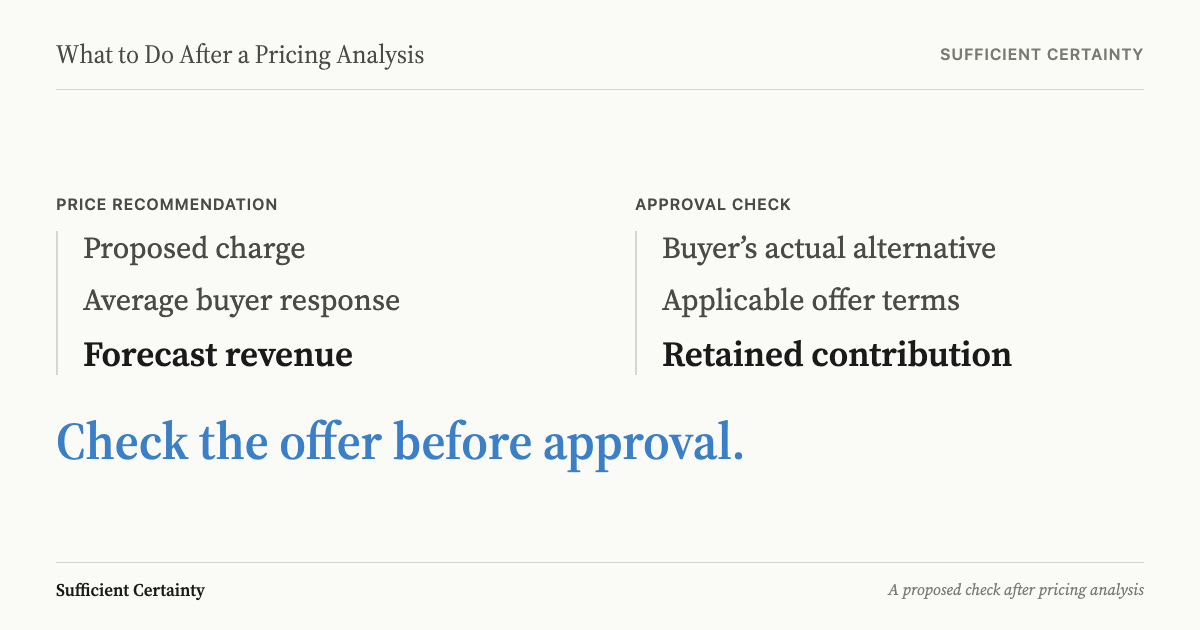
The following comparison is a proposed approval check. It describes how a manager could use completed work, rather than reporting a measured business result.
Price recommendation alone
- Suggested charge for the product
- Average response across the sample
- Revenue before channel deductions
Proposed approval check
- Charge for a named buyer and offer
- Alternative that buyer can choose
- Contribution after variable selling costs
Use the findings from a competitive analysis to identify the relevant rival offer. Avoid copying its headline price without checking the terms. The useful recommendation states what must remain true for this price to meet its objective. That connects the analysis to the wider strategic thinking behind the offer.
Which buyer alternative could make the proposed price unacceptable? Start the Walk →
Does the suggested price fit the buyer’s alternatives?
A buyer can reject the offer without buying from the competitor shown in the report. They may keep their current product or delay the purchase. Ask a target buyer what they would actually do at the proposed price. Record the alternative they name, then check what choosing it would cost.
The US Small Business Administration’s market research guidance asks what potential customers pay for alternatives. It also includes indirect competitors in competitive analysis. That is a useful test of a pricing comparison: the nearest substitute may come from outside the product category used in the spreadsheet.
Test the alternative the buyer can choose, including keeping what they already have. If switching requires training, include that burden in the comparison. If the alternative is available immediately while the proposed offer has a long wait, record that difference too. Explain why the buyer would accept the proposed terms.
Evidence from market research can inform this check. Keep stated interest separate from an accepted offer. A buyer who likes a product has not necessarily accepted its price. Ask sales to show comparable accepted quotes and rejected quotes, where available. Check whether the reasons for rejection relate to price or to another term.
Where there is no comparable transaction, mark the response as untested. Decide whether a limited offer could provide useful evidence before a wider change. Keep its terms close enough to the intended offer that the response can inform the actual approval.
Consider the following illustrative conflict within a proposed pricing report. These are example statements, not findings from a real company.
Resolve that conflict before approval. Ask which price the forecast uses and how the distributor’s deductions affect the amount retained. A buyer’s acceptance and the seller’s retained revenue are separate conditions. Use sensitivity analysis to examine a supported range for either condition, without treating the selected range as evidence that it will occur.
The Met changed admission terms by visitor group
The Metropolitan Museum of Art’s January 2018 admissions announcement shows a pricing decision with more than a revenue objective. The museum wanted financial stability while preserving access. It announced mandatory admission for visitors from outside New York State, with exemptions for eligible students.
Pay-as-you-wish access would continue for New York State residents and students from New York, New Jersey and Connecticut. Full-price tickets would cover three consecutive days across its locations. The proposed change therefore combined payment obligations with eligibility and ticket terms.
The museum reported that 63% of visitors paid the full suggested admission in 2004, compared with 17% of adults at announcement. Those populations differ. They should not be presented as an identical-population comparison. It also reported an average per-person contribution of $9.
The Met projected that mandatory admission would affect about 31% of visitors. Its internal research indicated that most affected visitors were tourists. It forecast additional admissions revenue and described plans for communicating eligibility and preparing staff.
The decision changed who had to pay, as well as the terms of admission. Reading only the suggested price would miss the eligibility rules. For a commercial manager, the proposed application is to check whether the analysis has grouped together buyers who face different terms or alternatives.
The announcement does not establish realized revenue, attendance or access outcomes after the change. It also does not establish that the museum used a formal pricing-analysis framework. A forecast supports a decision only to the extent that its underlying conditions have adequate evidence. The case illustrates the scope of the decision, rather than proving that the announced policy succeeded.
A museum’s access objective cannot simply become a retailer’s profit objective. Decide which outcomes matter in the actual setting. As with cost-benefit analysis, a favorable financial calculation still needs an explicit statement of whose benefits and costs count.
Check contribution before committing to the price
Take the offer for the named buyer group and calculate what the business would retain from a sale. Deduct the discount the buyer can actually receive. Then include channel charges and other variable selling costs. Ask finance to show each deduction once, using the same basis throughout.
OpenStax defines unit contribution margin as selling price less variable cost per unit. The remainder contributes to fixed costs before becoming profit. A higher list price supports the decision only if the achievable contribution meets the stated objective. Do not count a channel commission as money available to cover the seller’s fixed costs.
This differs from checking the sales volume behind a break-even analysis. Here the immediate question is whether the proposed offer earns the assumed contribution when the buyer and channel terms are applied. If it does not, change those terms or revise the recommendation before relying on the volume forecast.
Record the condition that would require reconsideration. For example, a proposed launch could be reviewed if accepted orders require discounts beyond the approved terms. Choose a condition relevant to the decision and assign someone who can act on it. Do not describe an intended review as evidence that the price already works.
Make the review usable by the person receiving sales information. State which records they should inspect and who can authorize a change. If the terms cannot be withdrawn from existing contracts, assess that commitment before approval. A review after release cannot recover an option that the contract has already removed.
The Universal Decision-Making Method connects that check to the purpose of the decision. State the outcome sought and test the assumption that matters to it. Then decide whether the available evidence is sufficient for this commitment. Approve the offer with a clear response to contrary evidence, rather than treating the recommended price as permanent.
How confident are you that the recommended price will produce the contribution the decision requires?
Work through your decisionNo sign-up. Just pick your decision and start.
Grant Purdy is the co-author, with Roger Estall, of Deciding (2020), and the architect of the Universal Decision-Making Method.