
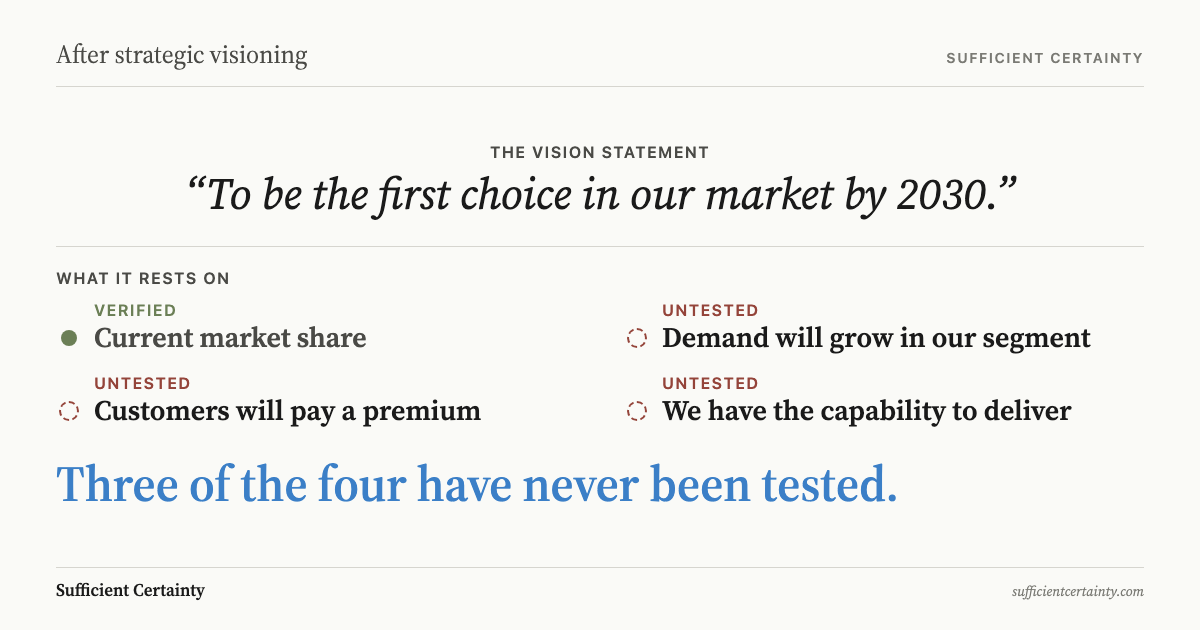
After strategic visioning, test the assumptions the vision depends on before cascading it into goals, plans and budgets.
Every vision statement describes a future market and an organisation able to serve it, and both are forecasts written in the language of ambition. Once the cascade starts, every objective beneath the vision inherits those forecasts without anyone signing for them. Motorola spent eleven years and more than $5 billion learning what that costs.
Strategic visioning defines the long-term future an organisation intends to reach, usually as a vision statement that its mission, goals, plans and budgets are then built to serve.
Iridium and the assumption nobody checked
In the mid-1980s, Motorola engineer Bary Bertiger's wife complained that she could not reach clients on her mobile phone from the Bahamas.
Bertiger and two colleagues in Motorola's satellite communications group in Arizona turned the complaint into a vision: a constellation of low-orbit satellites that would let a subscriber make a call from anywhere on Earth.
His superiors rejected it. Chairman Robert Galvin approved it anyway, and the Galvins came to treat Iridium as a symbol of what Motorola could do.
The vision was then cascaded the way the textbooks recommend. Motorola set up Iridium LLC as a separate company in 1991 and put in $400 million for a 25 percent stake. Partners including Sprint, Raytheon and Lockheed Martin added $3.7 billion.
Iridium signed $6.6 billion of contracts with Motorola for satellite design, launch and operations. Market research screened more than 200,000 people and surveyed over 3,000 corporations, and settled on a target segment: international business travellers visiting places without cellular coverage.
That segment carried the whole plan, and it rested on an assumption about the future: that terrestrial cellular coverage would stay patchy long enough for a satellite phone to fill the gaps. Cellular build-out was a critical uncertainty, and the vision treated it as settled.
The concept took eleven years to reach service. Over those years, according to Finkelstein and Sanford (2000), cellular networks spread across the overwhelming majority of Europe and into China and Brazil. The customers the vision was written for were being served by someone else before the service ever launched.
Nobody was ignorant of this. The 1998 prospectus ran to 25 pages of risks, including the build-out of cellular networks, handset size and pricing, and severe degradation inside cars and buildings.
Finkelstein and Sanford found little evidence that Motorola or Iridium made appreciable progress on any of them. A risk that is written down and then left alone is only a record that someone saw it coming.
Service launched on 1 November 1998 with a $180 million advertising campaign, a $3,000 handset and calls at $3 to $8 a minute. CEO Edward Staiano had predicted 500,000 subscribers by the end of 1999.
By April there were 10,000, and Staiano had resigned. By August there were 20,000, against the 52,000 the loan covenants required. Iridium filed for Chapter 11 on 13 August 1999, one of the 20 largest bankruptcies in US history.
In November 2000 a bankruptcy judge approved the sale of the constellation for $25 million, heading off a plan to steer the satellites into the atmosphere to burn up.
The interim CEO, John Richardson, had already given the verdict: "First we created a marvelous technological achievement. Then we asked how to make money on it." The vision was right about the technology. It was wrong about the future market, and that was the part nobody went back to check.
Write down the one thing about the future your vision needs to be true and ask what evidence exists for it before anyone turns it into targets. Start the Walk →
What strategic visioning gets right and where it stops
Visioning does real work. In Building Your Company's Vision (1996), Collins and Porras split a vision into a core ideology that should not change and an envisioned future: a big, hairy, audacious goal set ten to thirty years out, plus a vivid description of what reaching it would look like.
A good vision gives a large organisation one direction to pull in and a test for which projects belong.
Kotter counted lacking a vision among the errors that sink transformation efforts, next to under-communicating it by a factor of ten.
The standard sequence after the vision is well established. Leadership drafts a mission, sets strategic goals and runs a gap analysis between today and the envisioned future.
Then it builds a plan and cascades objectives down through divisions, teams and budgets, often through a balanced scorecard. Each layer translates the vision into something a manager can be measured against.
Here is where it stops. The cascade is a translation mechanism, not a testing one. Each layer takes the layer above as given. A regional sales target inherits the market the vision described. A capital budget inherits the capability the vision assumed.
Nothing in the sequence goes back up to ask whether the described future is actually arriving. The further down the cascade a number sits, the more precise it looks and the less anyone remembers what it assumed.
Mintzberg made a related point in The Fall and Rise of Strategic Planning (1994): planning is analysis, strategy-making is synthesis, and formal planning is better at programming strategies that already exist than at questioning them.
The space between strategic thinking and strategic planning is where a vision's assumptions slip through. A vision is a bet on the future written as a statement of intent.
The checkpoint between analysis and action
The missing step sits between the approved vision and the first cascaded goal. Before any objective is written, list what must be true for the vision to be reachable: about the market, about the customer, about the organisation's own capability and about timing.
Then mark each item as evidenced or untested. For Iridium, one line would have carried most of the weight: business travellers will still lack cellular coverage when the service launches.
The five-step Universal Decision-Making Method puts that checkpoint in order. Frame the decision and its Purpose. Set out the Tentative Elements, the provisional choices the vision implies. Surface the Assumptions each element rests on. Decide what level of Sufficient Certainty is enough to proceed.
Then Implement and Monitor, with the assumptions that most threaten the vision named as the things to watch. A vision that passes the checkpoint loses none of its ambition and gains a list of what would prove it wrong.
Vision cascaded as written
- Goals and targets derived straight from the envisioned future
- Market and capability premises accepted because the board approved the vision
- Risks listed in the plan and left there
- Reviews measure progress against targets, not against the premises
Vision cascaded after the checkpoint
- Each premise under the vision named and given an owner
- Evidence for each premise recorded, gaps marked untested
- Sufficient certainty agreed before capital is committed
- Review dates set to recheck premises against current evidence
Timing matters as much as the list. Finkelstein and Sanford argue Iridium should have been run as a real option, with a reassessment fixed in the business plan before the heavy spending began. By 1996, when the decision to build and launch the satellites was taken, the market evidence had already turned.
A cascaded vision needs the same discipline, the one that applies after scenario planning: named dates at which each premise is checked against current evidence rather than against the original workshop.
Owning those premises is part of strategic leadership, not a task for the planning office. It is strategic thinking applied to the output of a visioning exercise. A vision is worth cascading only once someone has checked that the future it describes is still on its way.
You could cascade the vision into goals and budgets and still leave the future it depends on untested.
Work through your decisionNo sign-up. Just pick your decision and start.
Grant Purdy is the co-author, with Roger Estall, of Deciding (2020), and the architect of the Universal Decision-Making Method.