
A steering committee not making decisions has only two honest explanations. Either a material fact is genuinely missing, or the facts arrived weeks ago and nobody wants their name against the conclusion. Only one earns another meeting, and most committees have long passed that point.
A steering committee not making decisions has only two honest explanations. Either a material fact is genuinely missing, or the facts arrived weeks ago and nobody wants their name against the conclusion. From inside the diary those two look identical. Only one of them earns another meeting, and most committees have long passed that point.
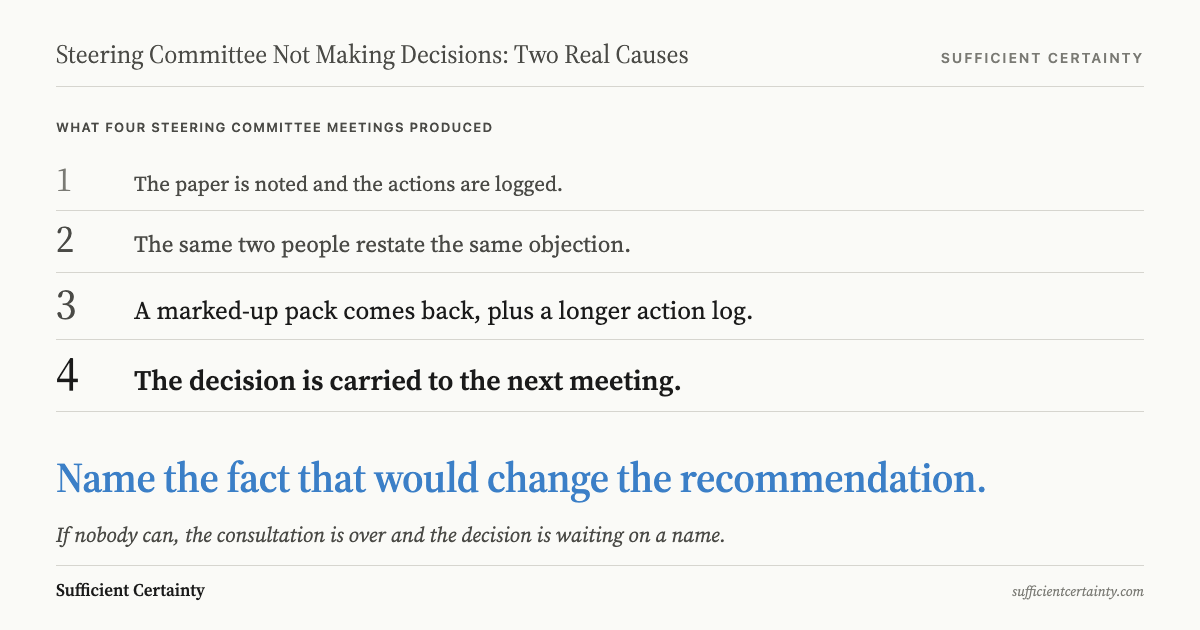
When a program lead tells me the steering committee is not making decisions, the complaint has usually stopped being about the committee. The paper has been noted rather than approved, the same two people raised the same objection in round four, and somebody has proposed a fifth session because saying “make the call” sounds too exposed.
There are two honest reasons for a committee to defer again. A material fact is genuinely missing, or the facts arrived a while ago and nobody wants their name against the conclusion. From inside the diary those two look identical, which is exactly why the second one survives so long. Only the first one earns another round.
A steering committee not making decisions is one that defers a call it already has the authority to make, session after session.
Sometimes a steering committee not making decisions is waiting for a fact
Another round is justified only if someone at the table can name the unresolved assumption and the evidence that would change the call. That does happen, and when it does the committee is doing the job it exists for, holding a matter open because settling it now would mean settling it on something nobody has checked.
There are committees that can meet that test on the spot. Finance names a revised cost range, and Operations confirms implementation capacity. Those are genuine gaps and they are worth an hour. A committee that can produce two answers like that has a reason to meet again, and a date by which the answers are due.
A genuine gap has a shape you can describe. What is missing sits outside the room, in a supplier's quotation or a regulator's position, so no amount of discussion among the people present will produce it. It has an owner, and a fact that would leave the recommendation exactly where it is was never the thing holding the decision open.
One follow-up question separates the genuine gap from the other case. If that item arrived tomorrow and went against expectation, who at this table would then vote differently? Where nobody will name themselves, the committee is not waiting on the fact, whatever the action log says.
Two steps of the Universal Decision-Making Method do the diagnostic work here, the first and the third. Frame the decision, then Recognise assumptions, and within an hour you will know whether the room is short of evidence or short of nerve. The tell for the second is the answer that arrives as a proposal to socialise it a bit more.
More often a steering committee not making decisions has the facts and no owner
What is left on the table then is ownership, and nobody is reaching for it. The meeting becomes a holding pattern that suits the sponsor who should have signed three months ago, while the lead carrying the delivery date is accountable for the outcome without owning the call.
The National Audit Office's account of the cancelled InterCity West Coast franchise competition shows what that costs once it runs long enough. Legal preparation ran to £2.7 million and the reviews to another £4.3 million, with the full taxpayer bill still unknown. The NAO found no single senior responsible owner and a second consultation on risk mechanisms added late, without enough time to resolve the concerns it raised before tender. That late round was presented as diligence. What it shows is that nobody had settled who decided, or on what evidence, before the competition went out.
Atlassian's State of Teams 2024 puts a figure on the ordinary version of the same thing. Where meeting culture is poor, people spend 50 per cent more time in unnecessary meetings than on the work that actually matters. Nobody in that picture is lazy. The crowded calendar is doing a job for somebody, because it lets a manager show motion without showing a decision, and it is very hard to criticise a person who is in meetings all day.
Watch what that does to the demand for stakeholder buy-in. In a room where nobody can name a missing fact, the request stops being a test of the reasoning and becomes a search for co-signatories. By that point the chair has given up weighing the recommendation and started counting how many names he can get alongside his own before he signs. Roger Estall and I spent a good part of our working lives watching that substitution, and it is the exact point where involving people turns into spreading the blame thinly enough that none of it sticks.
Each extra round tells the people sitting in it one of two things: their earlier input was not used, or nobody can say how it was used. By the fourth round they stop bringing their best objection, because the best objection costs an afternoon and moves nothing. The question is whether the room needs more stakeholder meetings or a clearer decision.
The NSW Coalition of Aboriginal Peak Organisations ran phase two of its accountability-mechanism work the other way round. Nineteen face-to-face workshops, and the round was bounded before any of them sat: consultation fatigue and limited time were the stated reasons the engagement had to be targeted and purposeful, confined to matters different stakeholders could still influence and split across two phases so input arrived ahead of the key decision points rather than after them. The report is equally plain about who would close the matter. NSW CAPO Leads remained the final Aboriginal decision makers on the recommended model. The design said how far the asking went, and whose name sat at the end of it.
Most organisations will not work that way, because an open question is a comfortable one to hold. No difficult director has to be disappointed. The chair keeps a clean record of having listened to everybody, and the consultant running the engagement keeps a workstream. What all of them get to avoid is the moment one person says this is what we are doing. The bill for that comfort goes to the people who have to run the thing afterwards on their own private reading of what was agreed. That is the working difference between alignment and consensus: consensus is what got minuted, and alignment would have meant every person leaving the room owing the same thing.
Ask what fact would change the recommendation on the decision your committee keeps deferring, and see whether another round has anything left to bring. Start the Walk →
Write down who decides and what would reopen it
The remedy is two lines that are almost never in the minutes, the name of the person who decides and the condition that would reopen the question. Where neither has been written down, you will usually find that nobody has settled which body decides and which body may challenge the decision either.
The Victorian Auditor-General found the Department of Education and Training in exactly that condition. Decisions taken by leadership and committees were not clearly and consistently communicated through the organisation, in a department that had been writing strategic plans since at least 2011, and the auditor's remedy started with streamlining a committee structure it judged overly complex. A plan can be circulated as it stands. A decision with no name against it and no stated condition for reopening has nothing in it to circulate, which is what makes the two lines worth writing down.
A name on its own is only half the fix. To be aligned enough to start execution, the team also needs a stated reopening condition; otherwise the question gets reopened anyway, through the diary, at a moment chosen by whoever is least happy with the answer.
That is most of what I mean by stakeholder alignment, and it is a smaller thing than the phrase suggests. Once the facts are in, the outstanding item is who carries the call, and no further round in my experience has ever resolved that.
What to say when round five is proposed
Before I approve another meeting, tell me the fact that would change the recommendation. If nobody can name one, the consultation is over and I want a name against the decision by Friday. Those are the words, and they have to come from somebody with enough standing to survive them.
Saying them costs something. Cancelling a round of consultation looks like shutting people out, and in a governance culture that carries real career risk, while sitting through a fifth meeting carries none and nobody has ever been performance-managed for consulting too much. That asymmetry is why the second cause outlasts the first. A missing fact either arrives or is eventually declared unobtainable, whereas an unowned decision has nothing at all working against it.
Once a name is against the decision, state what would reopen the question and move to the last step of the Universal Decision-Making Method, Design monitoring. Keeping a settled question socially open protects nobody. The work that remains is making sure the right people see the right variance early enough to do something about it. We gave monitoring a step of its own in Deciding because it is the one everybody skips, and because it is what lets you close a question without pretending it can never be revisited.
What I object to is the use of a steering committee as respectable shelter. A steering committee not making decisions is rarely short of information, and every session booked after the information is in gets charged to the delivery date so that nobody senior has to put a name to a call. The date slips anyway. The only thing the extra rounds change is who ends up explaining the slippage, and it is never the person who should have signed.
You could sit through round five and hear the same two objections restated again.
Work through your decisionNo sign-up. Just pick your decision and start.
Grant Purdy is the co-author, with Roger Estall, of Deciding (2020), and the architect of the Universal Decision-Making Method.