
After a SWOT-to-strategy session, most teams move straight to implementation: owners, budgets, timelines. The step they skip is testing whether the assumptions baked into each initiative are actually true.
SWOT-to-strategy is the process of translating a SWOT matrix into prioritised strategic initiatives an organisation intends to execute.
The standard next step after a SWOT-to-strategy
The textbook path is clear. Once SWOT outputs have been mapped to strategic initiatives, teams build an operational plan. Strengths become leverage points. Weaknesses become remediation projects. Opportunities become growth bets. Threats become contingency plans. Each quadrant generates a workstream, and each workstream gets an owner, a budget, and a deadline.
Most frameworks prescribe some form of prioritisation at this stage. A SWOT-to-strategic-planning bridge might use impact-effort matrices, weighted scoring, or portfolio balancing to decide which initiatives proceed first. The more analytical the organisation, the more layers of evaluation sit between the SWOT and the action plan.
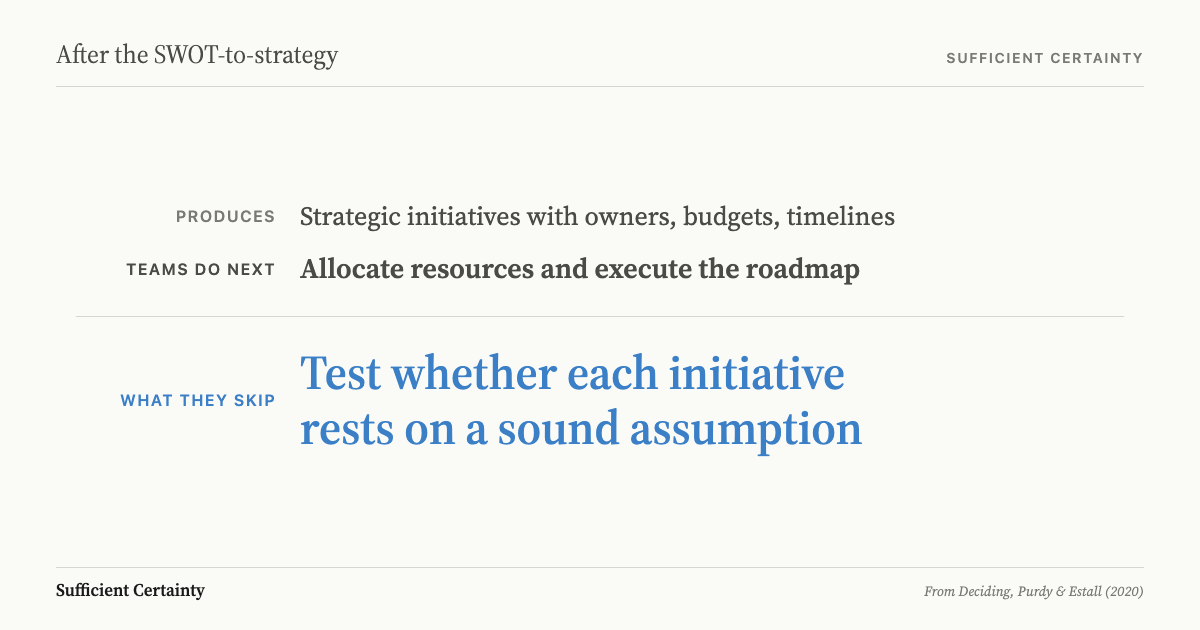
The output is a roadmap, not a hypothesis. It tells the organisation what to do, in what order, with what resources. A decade-long review of SWOT research found that the translation from matrix to action plan was the most commonly prescribed next step, yet the least scrutinised for validity (Helms & Nixon, 2010).
Every initiative on the list carries inherited assumptions from the SWOT itself, but the planning process treats them as settled inputs. Stakeholder alignment sessions, resource negotiations, and milestone tracking all proceed as though the diagnosis is sound. By the time budgets are approved and teams assembled, challenging the premise of any single initiative means challenging the entire plan.
What that step adds
Operational planning is not wasted work. It converts vague intent into trackable commitments. Without it, strategies stay on whiteboards. Structure creates accountability, and accountability creates movement.
The planning step also forces alignment. When three vice-presidents disagree on which SWOT opportunities are worth pursuing, operational planning makes the disagreement visible. Budgets have to be allocated. Headcount has to be assigned. Timelines have to be committed to. These constraints surface conflicts that the SWOT itself, with its tidy quadrants, can paper over.
Good operational planning also establishes measurement. Teams define what success looks like before they start, which makes post-implementation review possible. Research on strategy execution finds that organisations with formal implementation processes deliver closer to projected value than those without (Mankins & Steele, 2005). The analysis itself surfaces patterns. The strategy translation gives those patterns direction. The operational plan gives direction a schedule.
The gap is not in the planning. The gap is that the planning accepts the SWOT's outputs as fact. Every initiative rests on interpretations made during the SWOT session: that the strength is real, that the weakness is fixable, that the opportunity will materialise, that the threat will arrive in the form anticipated. These interpretations become load-bearing walls in the operational plan. None of them were stress-tested before the organisation committed.
Name the assumption your top-priority initiative depends on and ask who tested it before the budget was approved. Start the Walk →
Where the standard playbook breaks down
SWOT-to-strategy pipelines fail when untested assumptions survive the entire journey from matrix to execution. The SWOT analysis names what the organisation sees. The strategy translation assigns meaning and priority. The operational plan commits resources. At no point does anyone ask: is this assumption actually true?
J.C. Penney's 2012 transformation is the textbook case. Ron Johnson, the former Apple retail executive brought in as CEO, conducted a thorough analysis of the company's position. The diagnosis was defensible: J.C. Penney's weakness was its addiction to promotional pricing. Coupons had trained customers to wait for discounts, eroding margins and degrading the brand. The opportunity was clear: reposition as an everyday-low-price retailer with boutique-style departments. The strategy translated directly from the SWOT.
Seventy-two per cent of J.C. Penney's revenue came from items purchased on promotion. The "Fair and Square" pricing strategy was rolled out nationally without a single store pilot (Reingold, Fortune, 2014). Revenue dropped 25% in 2012, a decline of more than four billion dollars. Johnson was fired after seventeen months. His successor immediately restored the promotions.
The SWOT-to-strategy pipeline worked flawlessly. The problem was not the strategy. It was the assumption the strategy depended on. Johnson assumed the weakness (coupon dependency) was a disease to cure. In reality, it was the business model. The SWOT identified a real pattern. The strategy translation assigned the wrong meaning. The planning process locked in that meaning before anyone tested it against the customers who actually shopped there.
This pattern is not rare. Research on strategy implementation finds that organisations deliver, on average, only 50 to 60 per cent of a strategy's projected value, with untested assumptions cited as a primary driver of the shortfall (Cândido & Santos, 2015). The more confident the SWOT-to-strategy translation, the less likely anyone is to question it. Assumptions in decision-making are most dangerous when they feel like conclusions.
The step to take first
Before committing resources to the initiatives that emerge from a SWOT-to-strategy session, list the assumptions each initiative depends on. Not all assumptions. The ones that, if wrong, would make the initiative pointless or harmful.
The question is not which initiatives to pursue. It is which assumptions each initiative depends on. For Johnson's J.C. Penney strategy, the load-bearing assumption was that removing coupons would retain existing customers while attracting new ones. That assumption was testable in a handful of stores. It was never tested at all.
The five-step method provides structure for this. Frame the decision (which initiative to pursue and why). Identify tentative elements (the factors that could affect the outcome). Surface assumptions (what has to be true for this initiative to work). Determine sufficient certainty (how much evidence is enough to proceed). Then implement with monitoring built in from the start, not added after launch.
This is not an argument against SWOT-to-strategy. It is an argument for one additional step before committing. The SWOT provides the raw material. The strategy translation provides direction. But direction without assumption testing is confidence without evidence. Turning a SWOT into a decision requires naming what has to be true and determining whether it is.
Strategic thinking is not the same as strategic planning. Planning organises action. Thinking questions whether the action rests on solid ground. The best time to question it is after the strategy is drafted and before the resources are committed. That window is short. Most organisations walk past it without noticing it was there.
Before those strategic initiatives commit resources, there is a step the SWOT-to-strategy process does not include.
Work through your decisionNo sign-up. Just pick your decision and start.
Grant Purdy is the co-author, with Roger Estall, of Deciding (2020), and the architect of the Universal Decision-Making Method.