
After an employee satisfaction survey, and before the action plan is signed, pick the scores the plan is meant to move and agree what reading would send it back for rethinking.
The usual cycle runs the other way. Each division head signs a three-priority action plan in the week the results are presented, and the next time anyone opens the numbers is when next year's survey closes.
Between the two surveys, the organisation has no agreed signal that conditions have moved far enough to revisit the plan. A red cell under "My workload is reasonable" in October can become a run of resignations by March, and nothing in the plan is set to notice. If the concern requires a psychosocial assessment, its follow-up work check asks whether the proposed response changes the condition creating the exposure.
An employee satisfaction survey is a periodic, usually anonymous questionnaire that measures how employees rate their job, manager, pay, leadership and organisation, reported as item scores and indices.
An annual survey gives leaders a baseline, a benchmark and a mandate
Run properly, an employee satisfaction survey does something no other instrument in the organisation does. It asks every employee the same questions, anonymously, in the same window, and returns the answers as item scores and indices that can be cut by division, grade, tenure and manager. A complaint in one team becomes a pattern across twelve, or a pattern turns out to be one team.
The second thing it delivers is a benchmark. The US Federal Employee Viewpoint Survey, run annually by the Office of Personnel Management, reported a governmentwide Engagement Index of 64 per cent in 2015, and every agency could set its own figure against it. A score only means something next to another score, and the survey supplies both the internal trend and the external comparison.
The third is a mandate. The same OPM report tells agencies to pick a few focus areas, set actions with a manageable scope and timeframe, include measures for tracking progress, and keep employees informed. Church and colleagues (2012) tracked survey action planning and its effect on employee attitudes across 11 years at a multinational consumer products company, and used employee comments to explore why action does not follow some surveys. The survey earns its cost in the action plan, not the report.
Done well, the survey also exposes distance between levels. When senior leaders rate direction and communication higher than the front line does, the gap shows up in the cut by grade. That gap is the raw material of organisational alignment work, and of the stakeholder alignment any change program needs before it can hold.
The result is a baseline, a benchmark and a public commitment to act, all dated to the weeks the survey was open.
Take the one score your survey action plan depends on most and write down the level that would send the plan back to the executive table before next year's survey. Start the Walk →
What does this year's engagement score assume about next spring?
Every action plan built on the survey inherits the date stamp of the fieldwork. The priorities were chosen because of how people felt during a few weeks of fieldwork. The plan then runs for twelve months on the assumption that those conditions hold, or change only in the direction the plan is pushing them. An annual survey is a photograph used as a map.
Three further assumptions sit inside the scores. The first is that the people who answered are the people whose views matter for next year, when the most disaffected may already be interviewing elsewhere. Their reasons arrive later, if at all, through exit interview analysis.
The second is that a fall in a score will be visible in time to act on it. The third is that the index moves with the conditions the organisation actually depends on: capacity, overtime and the loss of experienced staff. Respondent bias is the familiar problem, the same one that undermines a Net Promoter Score read as the voice of every customer. Timing is the less discussed one.
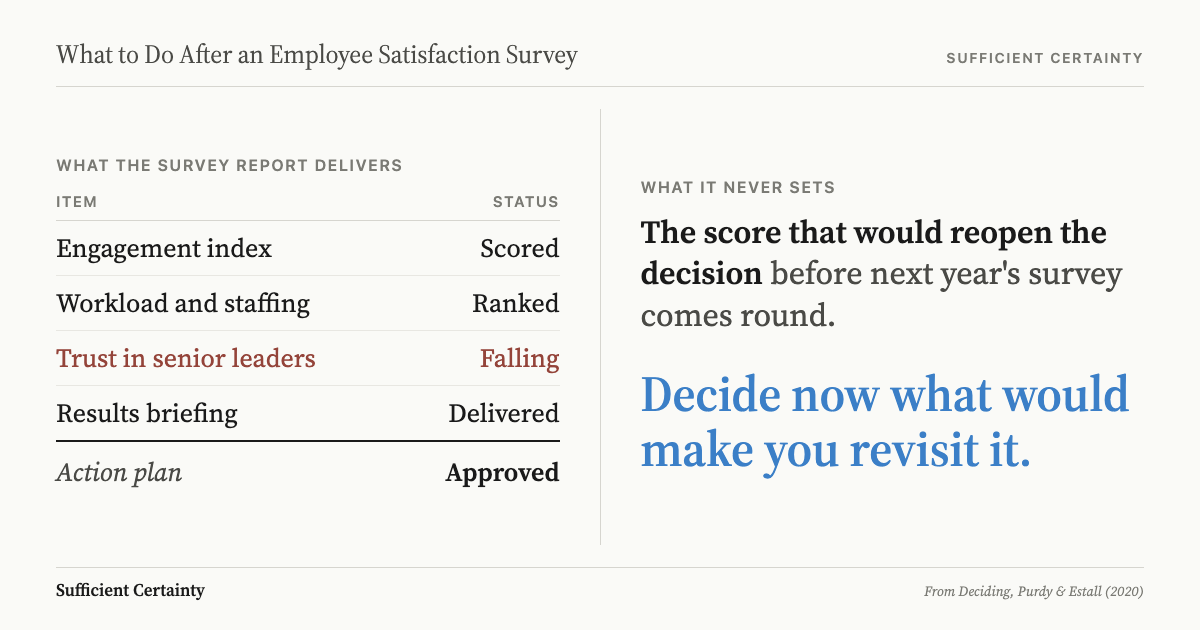
Each reading is reasonable on its own. None contains a rule for when the plan stops being the right plan. The survey supplies the numbers that data-driven decision-making relies on, but the action plan names owners and dates, not the conditions that would prove it wrong.
The Secret Service read a falling gauge every year
The US Secret Service took the Federal Employee Viewpoint Survey every year, and from 2011 each result was worse than the last. The share of its employees satisfied with their job was 69.3 per cent in 2011, 60.1 per cent in 2013, 55.8 per cent in 2014 and 42.9 per cent in 2015, against 65.2 per cent governmentwide. The share who believed their work unit could recruit people with the right skills fell from 52.0 per cent to 25.3 per cent over the same period.
The workforce was shrinking at the same time. The Uniformed Division, which guards the White House, had 1,420 officers in fiscal year 2011 and 1,329 at the end of fiscal year 2015. From May 2014 the agency flew special agents in from around the country for one- and two-week White House details to cover the shortfall.
On 19 September 2014, Omar Gonzalez climbed the White House fence carrying a knife, outran officers, entered the building and reached the East Room. The committee later noted speculation that the rotating details, filled by agents less familiar with the grounds, may have played a part. Director Julia Pierson resigned on 1 October, after it emerged the President had not been told about a separate breach in Atlanta for two weeks.
The House Committee on Oversight and Government Reform's December 2015 report, United States Secret Service: An Agency in Crisis, set the survey data beside the staffing data. The 2015 engagement score was 49, down seven points in a year, against 64 governmentwide. Special agent attrition in fiscal year 2015 was the highest in at least ten years. The committee found morale "critically low" and likely to be contributing to attrition.
None of the signal was new. The committee cited internal documents on Uniformed Division retention going back to the late 1990s, and wrote that the December 2014 Protective Mission Panel report "mirrors reports from over ten years earlier." The survey measured the drift accurately, year after year. What was missing was a score tied in advance to a decision about staffing, overtime or leadership. In the committee's account, those decisions were reopened by breaches, a resignation and hearings, not by the survey.
Setting the reopen line before the action plan is signed
The step sits between the results deck and the signed action plan. Before the plan is approved, name the one or two scores it depends on. For a plan built around workload, that might be the workload item and the intent-to-stay item. Then write down the level at which each would reopen the plan rather than prompt another action: a further five-point fall, say, or a drop below the sector benchmark.
The survey cannot fire that trigger on its own, because it runs once a year. Pair each score with a leading indicator that moves monthly: regretted attrition in the affected teams, overtime hours per head, internal transfer requests, unplanned leave. Set a threshold for each and a date to check it, such as the first executive meeting after the monthly workforce report. It is the same test that decides when a dashboard should change the decision rather than decorate it.
Both lines can sit in the same plan without anyone noticing. A pre-set threshold resolves the conflict before it matters. It also spares one manager the job of delivering bad news up the line alone, because the level was agreed by the people who would otherwise resist hearing it.
Monitoring is the last step of the Universal Decision-Making Method, and the monitoring plan is written before the decision is implemented, not after. The survey tells leaders where the organisation stood. A trigger tells them when to decide again.
The Secret Service had five years of falling survey scores. What it didn't have was a score agreed in advance that would reopen its staffing decisions.
Work through your decisionNo sign-up. Just pick your decision and start.
Grant Purdy is the co-author, with Roger Estall, of Deciding (2020), and the architect of the Universal Decision-Making Method.