
In January 2008 Ratan Tata drove the Nano onto the stage at the Delhi Auto Expo, a four-door car meant to sell for about Rs 1 lakh to families who rode scooters. What to do after blue ocean strategy is to test the frame behind the new value curve against the buyer's own frame before the plant is committed, because in its best year the Nano sold fewer than a third of the cars its factory was built to make.
The Nano is now a teaching case in strategic thinking about new markets, including one written by blue ocean strategy's own authors. It is an even better case for a question the framework does not ask: whose view of the problem drew the canvas in the first place.
Blue ocean strategy, from W. Chan Kim and Renée Mauborgne (2005), creates uncontested market space by pursuing differentiation and low cost at the same time.
The Tata Nano wore its price tag like a badge
The idea, as Ratan Tata told it, came from watching families of four ride scooters through Indian traffic, the child wedged between the parents, often on wet roads. He asked his engineers for a safe, all-weather car those families could afford. The price came first. Cyrus Mistry later summarised the concept as a car "below Rs 1 lakh," and every design choice was measured against that number.
The finished car reads like a four-actions grid filled in with discipline. Eliminated: the passenger-side wing mirror, the second windscreen wiper, power steering and, on the base model, air conditioning. Reduced: three wheel nuts per wheel instead of four, and less steel in the body. Raised: room for a family of four, and fuel economy that a company filing called the best of any petrol car in India. Created: a roofed, four-wheeled option for households that had never owned a car.
No public record shows that Tata Motors drew a strategy canvas. Kim and Mauborgne, with two INSEAD colleagues, later wrote a 2017 teaching case arguing that the Nano reconstructed market boundaries and found a commercially viable blue ocean. The design matched the method almost line for line.
The production bet was as bold as the design. Tata Motors began building a plant at Singur in West Bengal, on land the state government had acquired from farmers. Protests over that acquisition halted the work.
In October 2008 the company moved the project to Sanand in Gujarat, leaving behind about Rs 310 crore in buildings at Singur. The Sanand plant opened on 2 June 2010 with an initial capacity of 250,000 cars a year, expandable to 350,000, according to Tata Motors' 2010 annual report to the SEC.
Commercial launch came in March 2009 and deliveries began that July. The company reported an "overwhelming response" to paid bookings. Then demand stalled. The Nano's best year was fiscal 2012, at 77,394 cars. The following year's filing reported 48,122, and the year after that 23,400. The plant had been sized for a buyer who never arrived in those numbers, a gap that no market entry analysis drawn from the same frame would have caught.
In November 2013 Ratan Tata told CNBC the car should have been marketed to the two-wheeler owner as "an all-weather, safe form of transportation, not (the) cheapest." It "became termed as the cheapest car by the public," he said, and also by the company when it was being marketed. Speaking in Chennai in 2015, he put it more plainly: people did not want to be associated with a cheap car.
In October 2016, a day after he was removed as Tata Sons chairman, Cyrus Mistry wrote to the board that the Nano had "consistently lost money" and that "emotional reasons alone" had kept the company from shutting it down. In June 2018 the Sanand plant produced one Nano, according to figures reported by the Press Trust of India. The cost engineering held up; the frame it served did not.
Take the factor list on your strategy canvas, write down whose view of the problem chose it, and check the value curve against how a non-customer would describe the purchase before capacity is committed. Start the Walk →
Who decides which factors go on the strategy canvas?
Blue ocean strategy earns its place. Kim and Mauborgne's 2004 Harvard Business Review article told companies to stop benchmarking rivals and to create demand where none existed. The strategy canvas plots the factors an industry competes on and how much each player offers on each. The four actions framework asks which factors to eliminate, reduce, raise and create. Together they show an industry as a set of choices rather than a fixed menu, which a competitive analysis rarely does.
The non-customer idea is the sharper tool. Kim and Mauborgne sort non-customers into three tiers: people on the edge of an industry, ready to leave; people who considered its offer and refused it; and people who never saw it as an option at all. Families riding scooters were non-customers of exactly this kind. Finding them was the part of the method that worked.
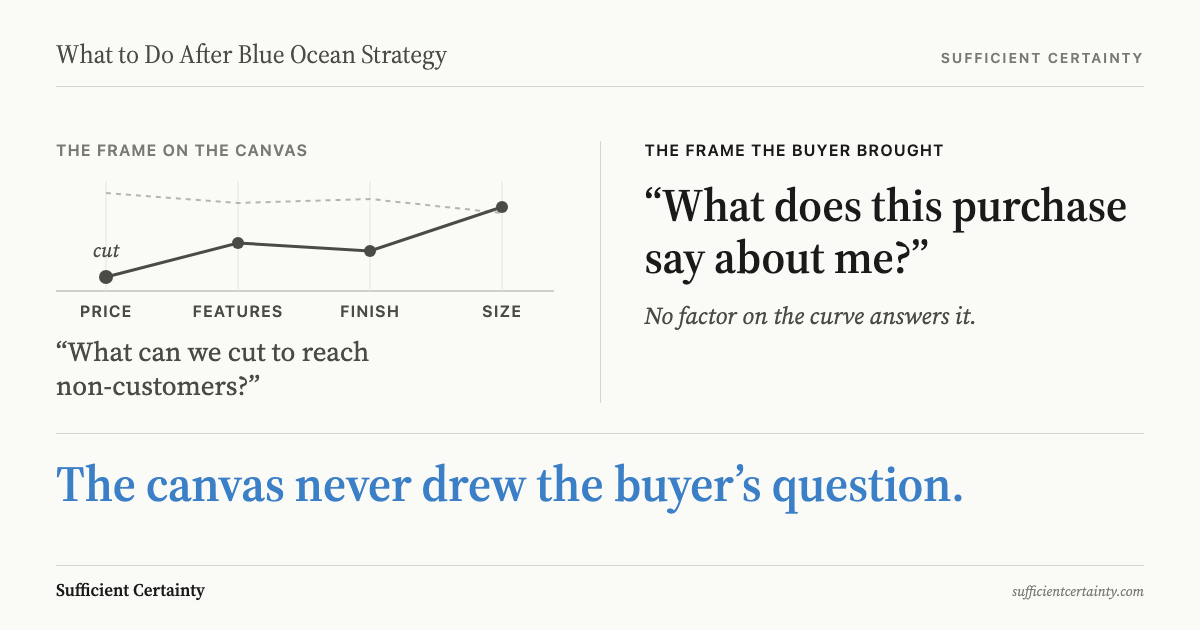
The weak point is the factor list. The canvas starts from the factors an industry already competes on, plus whatever the analyst chooses to add. Those choices come from inside a frame: a view of what the product is and what problem it solves. Tata's frame was engineering and price. How cheaply can a safe, roofed vehicle carry a family of four? Every factor on that canvas answers that question, and answers it well.
The buyer's frame asked something else. For a household buying its first car, the purchase is also a statement to everyone who sees it parked outside. Ratan Tata's own words confirm buyers read the Nano that way. A factor such as "what owning this says about the family" does not appear on a canvas drawn from the maker's side, and the four actions cannot raise or reduce a factor nobody listed. The frame decided which options existed before the grid was filled in.
The framing effect is usually taught as a bias in how a choice is presented to someone else. In the Nano's case it worked one level earlier, on the people designing the choice. Kim and Mauborgne's teaching case places the failure in execution, in what they call the people proposition. That reading leaves the canvas itself unexamined, and the canvas is where the buyer's question went missing.
Restating the frame before the value curve gets a factory
The checkpoint sits between the finished four-actions grid and the capital it justifies: the plant, the tooling contracts, the launch budget. Before any of those is signed off, restate the decision frame in writing. Whose problem is this? What purpose does the purchase serve for them? What do they think they are buying? Answer in the buyer's words, not the product team's, and treat the answers as assumptions until someone outside the project confirms them.
Then take the strategy canvas factor list and check it against that restatement. For each non-customer tier the move targets, ask what that group would put on the horizontal axis if they drew the canvas themselves. People who refused the industry's offer are the best source. Market sizing says how many of them there are. It does not say what they want the purchase to mean.
Any factor the buyer names that the canvas lacks is a gap in the frame, not a detail for the marketing team to fix after launch. The Nano's missing factor was social. The price that put the car within reach also put a label on its owner. A factor left off the canvas still gets scored, by the buyer.
The canvas lists price, fuel economy, seating for four and shelter from the rain. The grid strips out a mirror, a wiper and power steering, the car is sold as the cheapest in the world, and a 250,000-a-year plant is built on that curve.
Before the plant is signed off, scooter-owning households are asked what a first car should say about them. "Not the cheapest" joins the factor list, the price is presented as a safer way to carry the family, and capacity is phased against real orders.
This is the first move in the decision-making method: set out the frame and the purpose before generating options, because the frame limits which options appear. When the restated frame and the canvas disagree, reframing the problem is cheaper than retooling a factory. A blue ocean is only uncontested if buyers see it the way the canvas does.
Tata Motors had a value curve built around a Rs 1 lakh price. What it never tested was whether buyers framed the purchase around price at all.
Work through your decisionNo sign-up. Just pick your decision and start.
Grant Purdy is the co-author, with Roger Estall, of Deciding (2020), and the architect of the Universal Decision-Making Method.